

Essential Insights
- Langlands program links number theory, geometry, and symmetry through deep correspondences.
- Galois symmetries influence modular forms, revealing the pattern behind equations’ solutions.
- Wiles proved Fermat’s Last Theorem via Langlands’ ideas, uniting different mathematical worlds.
- Physicists see Langlands duality as fundamental, hinting at a deeper, unified mathematical reality.
Unraveling the Mystery of the Langlands Program
The Langlands program is a huge idea in mathematics. It tries to connect different fields that seem very different. At its core, it links number theory, the study of numbers, with harmonic analysis, the study of waves and patterns. But the connection is deep and hidden. It’s like a secret code that explains how numbers, shapes, and symmetries relate.
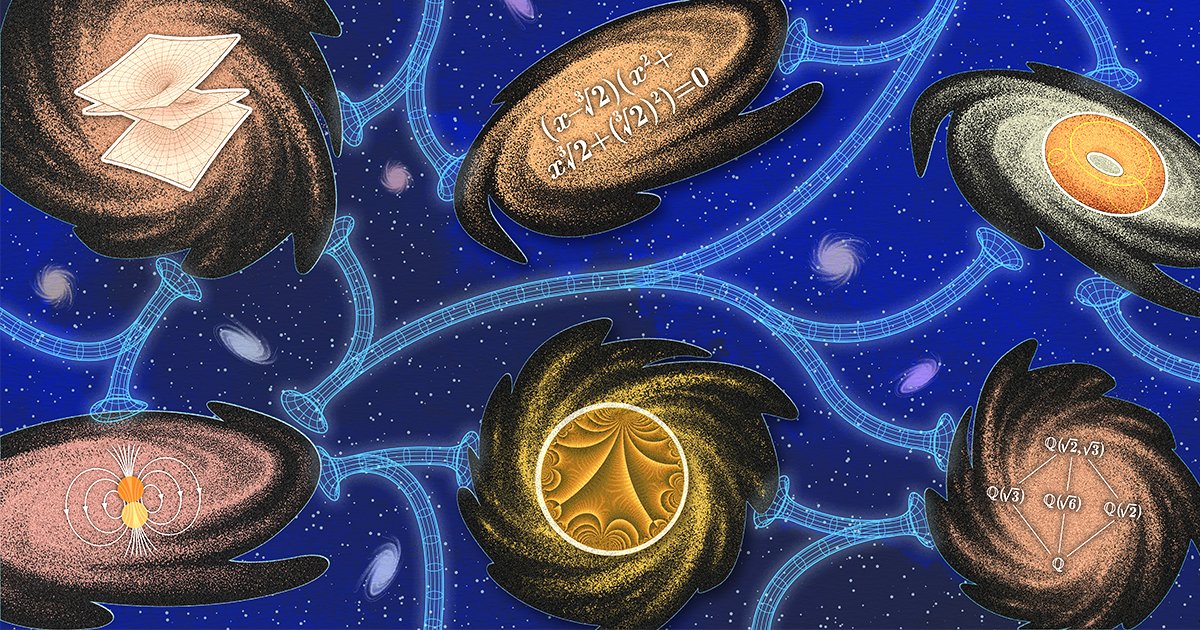
One way to see this is through number equations called polynomials. For example, solving the equation ( x^3 – 2 = 0 ) modulo some prime number shows patterns that match what a modular form—a special type of math function—predicts. These solutions have symmetries that are linked to algebraic structures called Galois groups. How solutions change when you multiply or transform them reveals a hidden pattern. This pattern is what mathematicians call a “correspondence” between different mathematical objects. It’s as if the solutions are actions in a distant galaxy, and the form’s coefficients are snapshots of those actions. These mysterious relations aren’t random; they are connected through what’s called Galois symmetries. They paint a complex, swirling picture of the universe of math.
The Langlands program suggests that, beneath the surface, many seemingly unrelated objects are actually part of a bigger system. It’s like discovering that different language dialects are variations of a single core language. Historically, this idea helped prove famous theorems. For example, in 1994, mathematician Andrew Wiles used a Langlands-like correspondence to prove Fermat’s Last Theorem, a problem that puzzled mathematicians for 357 years. Wiles showed that certain elliptic curves could not exist, thanks to the connections the Langlands program predicts. These connections are also seen in physics, where dualities—like electric and magnetic fields—show how two different descriptions can really be the same thing. Physicists believe that the Langlands program could be pointing toward a hidden, unified structure in both math and the universe. Many experts think the program might reveal the true roots of how math connects across different areas, though the full picture remains a mystery.
Continue Your Tech Journey
Explore the future of technology with our detailed insights on Artificial Intelligence.
Access comprehensive resources on technology by visiting Wikipedia.
QuantumV1
