

Fast Facts
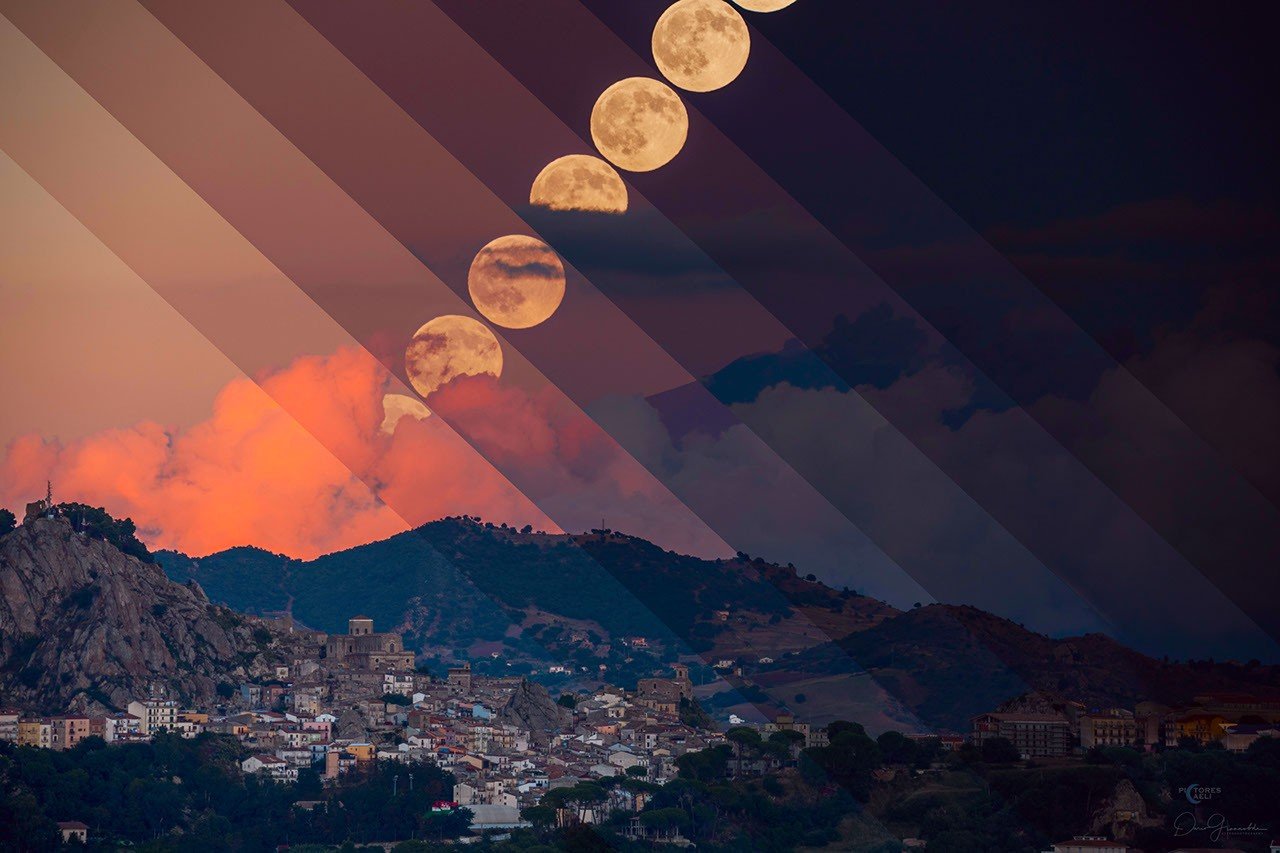
- The article describes a colorful full moon rising over Sicily, Italy.
- It features a composite photo showing moonrise, clouds, Mount Etna, and twilight colors.
- The “Belt of Venus” appears as a pink band in the lower sky.
- Full moon and Sun are opposite, with the moon rising at sunset’s end.
APOD: 2026 October 1 – Harvest Moon with Erupting Mount Etna
On October 1, 2026, NASA’s Astronomy Picture of the Day showcased a stunning photo of the Harvest Moon rising over Sicily while Mount Etna erupts in the background. This captivating image combines natural beauty with volcanic activity, offering viewers a unique perspective on both lunar and terrestrial phenomena.
The Beauty of the Harvest Moon
The photograph was taken last weekend near Nicosia, a town on the Italian island of Sicily. It captures the full moon as it rises above the horizon, just as the sky begins to darken. During this time, lower clouds reflect the colors of antitwilight, creating a vibrant glow. The moon appears bright and full, a key feature of a full moon cycle that lasts about 29.5 days. Interestingly, the moon completes its orbit around Earth in approximately 27 days. In many Northern Hemisphere cultures, the full moon in September is called the Harvest Moon. This nickname relates to the traditional time for gathering crops. The full moon appears in opposition to the sun—meaning the moon rises as the sun sets—highlighting the natural rhythm of lunar phases.
Mount Etna’s Eruption and Atmospheric Effects
In the background, Mount Etna erupts with ash and gases billowing into the sky. Volcanoes like Etna often produce spectacular displays of volcanic activity, and this eruption adds a dramatic element to the scene. Higher in the atmosphere, ash and gas clouds contrast with the lower clouds reflecting twilight colors. A distinctive pink band known as the Belt of Venus is visible near the horizon. This colorful arc forms during twilight when the sun’s light is scattered by the atmosphere, creating a beautiful band of pink and orange hues. The combination of the full moon, the volcanic eruption, and atmospheric effects makes this image a remarkable capture of natural phenomena.
APOD reminds viewers that tomorrow’s picture will be from the Sharpless catalog, continuing its tradition of showcasing the universe’s wonders. Students and enthusiasts can submit their space images through APOD’s updated submission email, now hosted on NASA’s science website. For more space photography and astronomical insights, visit NASA’s main site at science.nasa.gov/apod.
Expand Your Tech Knowledge
Explore the future of technology with our detailed insights on Artificial Intelligence.
Discover archived knowledge and digital history on the Internet Archive.
Space
