

Top Highlights
- Earth’s early molten surface was bombarded by space rocks, creating a chaotic environment.
- The planet’s core releases hydrogen, helium, and tungsten, indicating ongoing deep-earth exchanges.
- Researchers used advanced simulations to study hydrogen isotope ratios, revealing Earth’s primordial history.
- Evidence shows continuous core-mantle chemical exchange, not just remnants of Earth’s formation.
Earth’s Core: A Leak of Ancient Materials
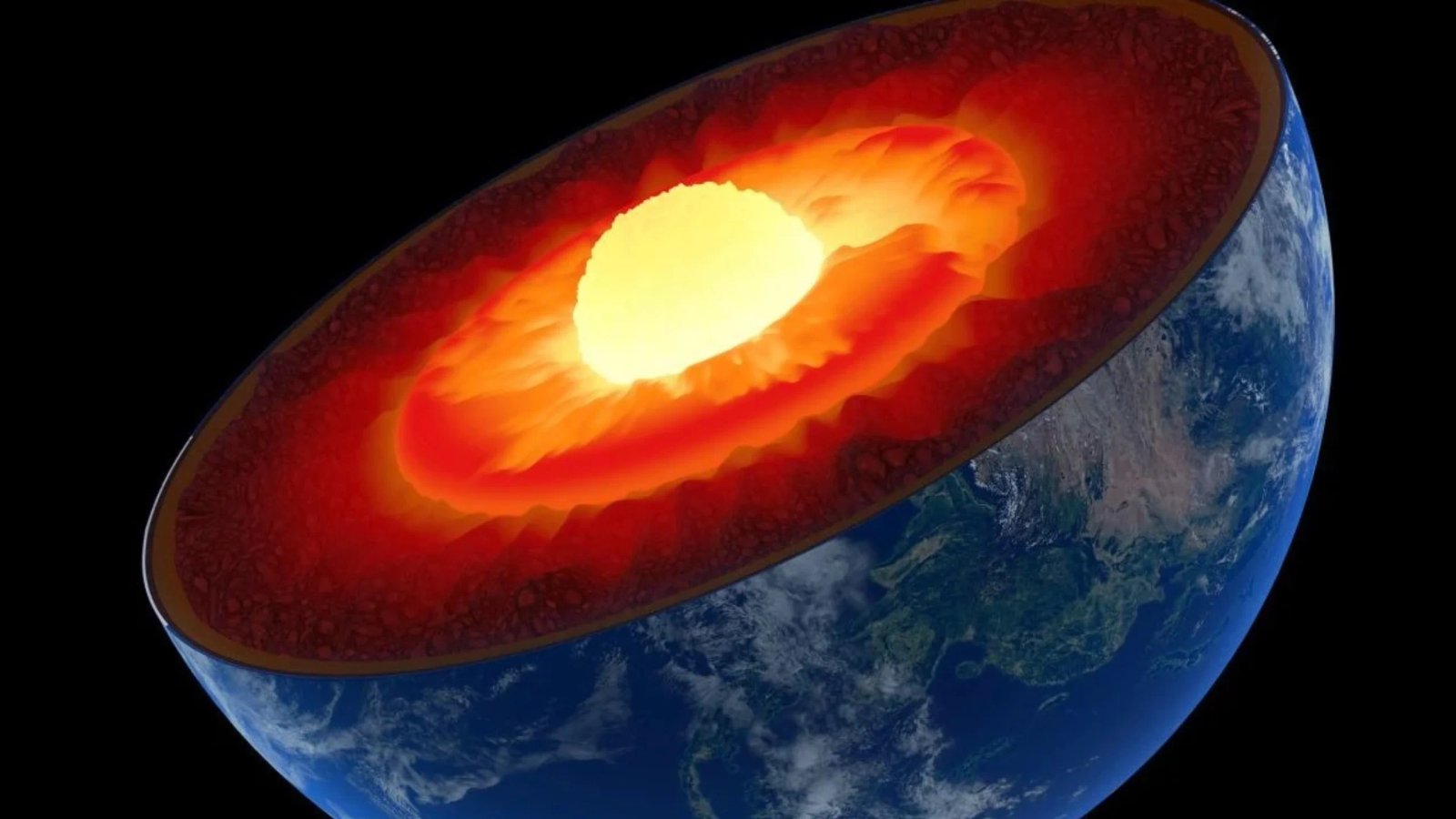
Scientists have discovered that Earth’s interior is not static. Instead, it constantly releases materials from its deep core. These materials have been trapped since Earth’s formation over 4.5 billion years ago. The core, a molten metal ball, is extremely hot—hotter than the sun’s surface. Despite its intense heat, it sends chemical signals upward through the mantle and crust. These signals include hydrogen, helium, and tungsten, which help scientists understand how our planet has evolved over time.
New research shows that the core’s materials are not just legacy remnants. They actively exchange with the surrounding mantle. By studying these exchanges, scientists can better understand Earth’s early history and ongoing dynamism. This ongoing leak reveals that Earth’s deep interior remains a place of active chemical communication, shaping the surface we see today.
How Scientists Uncover Earth’s Hidden Changes
Researchers used advanced simulations and machine learning to analyze molecules deep inside Earth. They focused on the ratio of deuterium (a heavier form of hydrogen) to hydrogen. If the core was trapped early, this ratio would be uneven. Instead, the findings show a mostly uniform hydrogen isotope distribution. This suggests that during Earth’s formation, intense chaos mixed these elements thoroughly, preventing stratification.
Further evidence comes from ocean island basalts (OIBs)—lava eruptions from near Earth’s core-mantle boundary. These lavas carry signatures of primordial hydrogen and helium, which escape from the core and enter the mantle. Helium isotopes support this idea by showing a higher amount of primordial helium-3, also coming from the core. Tungsten isotopes provide additional proof, tracing core materials moving upward through Earth’s layers.
Together, these chemical clues demonstrate a dynamic process. Earth’s core continuously leaks ancient materials, modifying the composition of the mantle over billions of years. This ongoing exchange shapes our planet’s deep interior and influences surface geology in ways scientists are only beginning to understand.
Expand Your Tech Knowledge
Dive deeper into the world of Cryptocurrency and its impact on global finance.
Discover archived knowledge and digital history on the Internet Archive.
QuantumV1
