

Top Highlights
NASA is developing SPEARS solid-state batteries for the Moon’s extreme temperatures.
Solid electrolytes avoid freezing, evaporation, and damage from severe temperature swings.
Prototypes operated down to minus 80°C and survived minus 170°C exposure.
Heaters can restore operation, powering lunar tools, rovers, habitats, and instruments.
NASA Develops Batteries to Power Humanity’s Return to the Moon
A battery that works in a car on a cold morning may still fail on the Moon. At the lunar South Pole, nighttime temperatures can fall to minus 328 degrees Fahrenheit (minus 200 degrees Celsius). Future missions will need batteries that can survive those extremes, warm up when needed and safely power equipment ranging from emergency kits to exploration rovers.
NASA is developing one possible solution through a project called Solid Power for Extreme Environment Adaptability and Resilience in Space, or SPEARS. The effort aims to create batteries for the Artemis campaign and other lunar operations. The technology is still under development, but early tests suggest it could address some of the limitations of conventional batteries.
Replacing liquid electrolytes with solid materials
Most familiar rechargeable batteries, including those in phones and laptops, use a liquid electrolyte to move charged particles inside the cell. Extreme temperatures create problems for that liquid. In deep cold, it can freeze and damage the battery. In high heat, the battery may stop working until it cools. In a vacuum, liquid can evaporate.
SPEARS batteries replace the liquid electrolyte with a solid material made from ceramic or polymer. A solid electrolyte does not freeze or evaporate in the same way. That could help the batteries withstand the Moon’s sharp temperature swings while avoiding some risks associated with liquid-based designs.
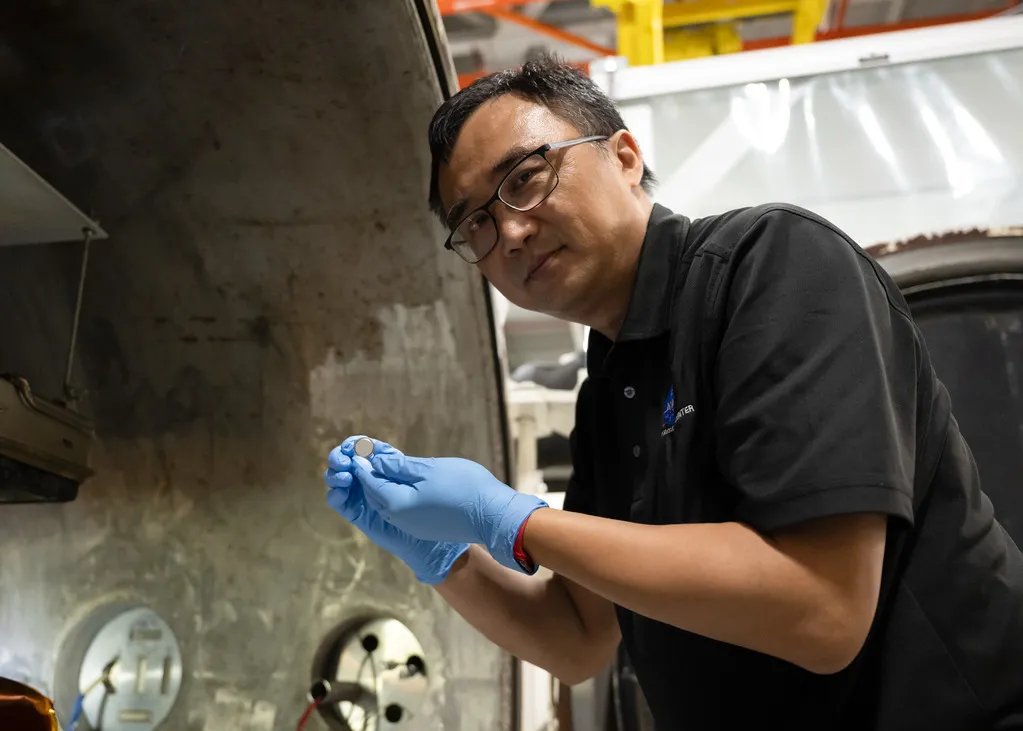
NASA researchers have tested small prototype cells in a thermal vacuum chamber. The cells operated at temperatures as high as 176 F (80 C) and as low as minus 76 F (minus 60 C). Their performance declined somewhat at minus 112 F (minus 80 C), but they continued to function. Researchers say this is the first demonstration of these cells operating at that low a temperature.
The tests also examined whether the batteries could survive temperature extremes, not just operate through them. After exposure to temperatures ranging from 212 F (100 C) to minus 274 F (minus 170 C), the cells showed no lasting damage. They could not operate at the coldest temperature, however. A small heater would need to warm a cell back to its working range.
That distinction matters. A battery that survives lunar night does not necessarily work throughout it. Still, NASA’s approach could reduce the need to keep batteries warm around the clock. Less continuous heating may mean lighter thermal-control systems, lower costs and more room for other equipment. Those benefits remain goals to test, not guaranteed mission outcomes.
From prototypes to lunar applications
The possible uses range from drills and emergency power packs to rovers that enter permanently shadowed craters. Solid-state batteries also could supply long-duration scientific instruments. Researchers can adjust the battery chemistry for different needs: more stored energy for one device, greater power for another, or longer service life for equipment expected to operate over many years.
That flexibility does not eliminate the engineering challenges. Lunar hardware must tolerate radiation, vibration, vacuum and repeated temperature changes, as well as the difficulty of repair far from Earth. SPEARS prototype results are an important early step, but they do not yet show that a complete battery system is ready for flight or can meet the demands of every lunar task.
The project began in 2026 with funding from NASA’s Research and Technology Mission Directorate. NASA’s Glenn Research Center leads the work, while NASA’s Langley Research Center has conducted thermal vacuum testing. NASA’s Ames Research Center is developing flight hardware, including test boards and electronics, to prepare the batteries for future space testing.
Although SPEARS is designed for space, the underlying technology may also have uses on Earth. Solid-state batteries could be relevant to vehicles, phones, communications equipment and drones. Each application has different requirements, and performance in a lunar test does not automatically translate into a commercial product. Any wider use would depend on factors such as cost, manufacturing capacity, durability and safety.
For Artemis, the immediate question is practical: Can a battery endure lunar conditions, then provide dependable power when a crew or machine needs it? SPEARS has not answered that question fully. Its early results show a promising route toward batteries that can survive extreme cold and heat—and could help make longer, more capable lunar missions possible.
Stay Ahead with the Latest Tech Trends
Stay informed on the revolutionary breakthroughs in Quantum Computing research.
Access comprehensive resources on technology by visiting Wikipedia.
Space
