

Fast Facts
- Oysters filter Chesapeake waters, support seagrass, and create habitat for marine life.
- Overharvesting destroyed more than 99% of reefs, though restoration is gradually helping.
- Robots and AI map oyster beds, helping farmers plant and harvest precisely.
- Local volunteers, led by Consoli, are expanding oyster restoration throughout their community.
Oyster Stocks Have Plunged in the Chesapeake. One Resident Wants to Bring Them Back
Oysters may look like stones, but in the Chesapeake Bay they do the work of living infrastructure. They filter water, create habitat and support a web of marine life. Their numbers have fallen dramatically. Now, a Kent Island resident is recruiting neighbors to help restore them, while researchers develop robots to give oyster growers a clearer picture of what lies beneath the bay’s murky surface.
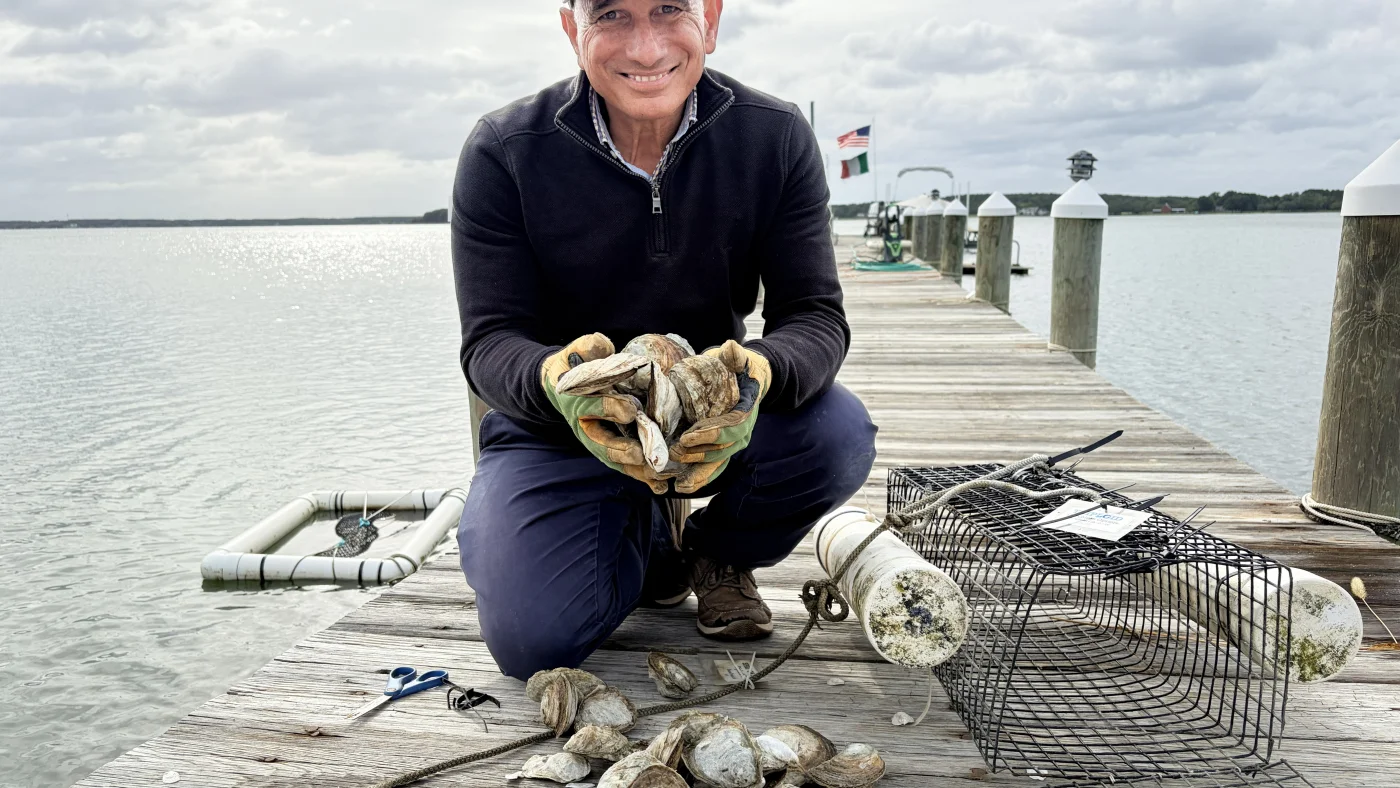
John Consoli’s project starts close to home. From his pier, he lifts a mesh bag filled with young oysters. After three months in the water, the oysters have grown enough to make the bag heavy. Consoli does not raise them for the table. He wants to help the bay.
A small animal with a large role
Oysters once formed extensive reefs throughout the Chesapeake. Overharvesting cut their numbers by more than 99% by 2011, according to one estimate. That loss had consequences beyond the oyster industry: Fewer oysters meant less habitat and a diminished capacity to filter the water.
An adult oyster can filter up to 50 gallons of water a day. Clearer water can help underwater grasses grow, supporting crabs and other organisms. Oyster shells also provide nooks and hiding places where small fish and crabs can live and feed. The benefits are real, though they depend on oysters surviving in sufficient numbers and suitable conditions.
There are signs of recovery. Oyster farming has expanded, and better management and restoration investments have helped wild populations make a partial comeback. But those gains do not put the bay back where it was. Researchers say today’s oyster populations are still likely only a fraction of their historic levels. Disease and environmental pressures remain challenges, too.
Consoli has taken a hands-on approach. He keeps oysters below the surface, where he says nutrients help them grow. He also encourages neighbors with waterfront access to try raising oysters. His efforts have drawn in dozens of people, including residents in their 80s, a local restaurant and even his dental hygienist.
A restaurant project showed the scale — and difficulty — that community efforts can reach. In August, Consoli and volunteers placed 1 million baby oysters around the pilings at Libbey’s Coastal Kitchen. The installation required eight people in wetsuits and life jackets, with jellyfish in the water. The restaurant joined because it saw the project as a way to contribute to the community.
Those local projects can add oysters and build public interest. They are not a substitute for baywide restoration or careful management. But they give residents a direct role in an effort that can otherwise feel distant and technical.
Robots seek a clearer picture underwater
Restoring oysters is not simply a matter of putting them in the water. Young oysters need a hard surface to attach to. If they land in mud, they can suffocate and die. Growers also need to know where adult oysters are and when they are ready to harvest. In the Chesapeake’s cloudy water, those decisions can be hard to make by sight.
Mechanical engineer Miao Yu and her team at the University of Maryland are developing tools to help. Their raft-like Oysterbot uses sonar to scan a broad area of the seabed. A smaller underwater robot, the BlueROV, can then examine locations more closely with live video.
Researchers use artificial intelligence to combine and analyze the images. The system is designed to identify whether oysters are present, estimate how many are alive or dead, and measure their size. The algorithms are still being refined. The long-term goal is to turn sonar images into maps that give growers practical information about where to plant and when to harvest.
Better information could reduce guesswork. It may also help avoid inefficient or damaging dredging, which can disturb the seabed or remove oysters that are not ready. Still, the technology has limits. A map is useful only if its readings are reliable and its recommendations work in real conditions. Researchers must continue testing the tools, and growers need information they can use in their day-to-day decisions.
Yu’s team has also done fieldwork beyond Maryland, including along the Washington coast and the Gulf Coast. The researchers hope the technology can be adapted for coastlines across the country within a decade. That is an ambition, not a guarantee: Different locations may require changes to the robots, the analysis or how growers use the results.
The work in the Chesapeake combines two approaches. Researchers are trying to make oyster restoration more precise. Consoli is trying to make it more personal. He has built what he calls the Peer to Pier Network by inviting people to grow oysters and showing them what can appear around a pier when oysters are present.
For him, the appeal is not just cleaner water. He has seen crabs, eels and other marine life near the oysters, and once spotted a seahorse. His enthusiasm is infectious, but the broader case does not rest on enthusiasm alone. Oysters provide measurable ecological functions, while restoration projects face real limits in water quality, disease, habitat and scale.
The next steps will require both practical tools and sustained care. Robots may help growers see the seabed more clearly; local projects may bring more people into the work. Neither approach can restore the bay on its own. Together, however, they offer a way to make oyster recovery more informed, more visible and more widely shared.
Expand Your Tech Knowledge
Explore the future of technology with our detailed insights on Artificial Intelligence.
Stay inspired by the vast knowledge available on Wikipedia.
Space
