

Essential Insights
Artemis III will test spacecraft systems in Earth orbit before lunar landings.
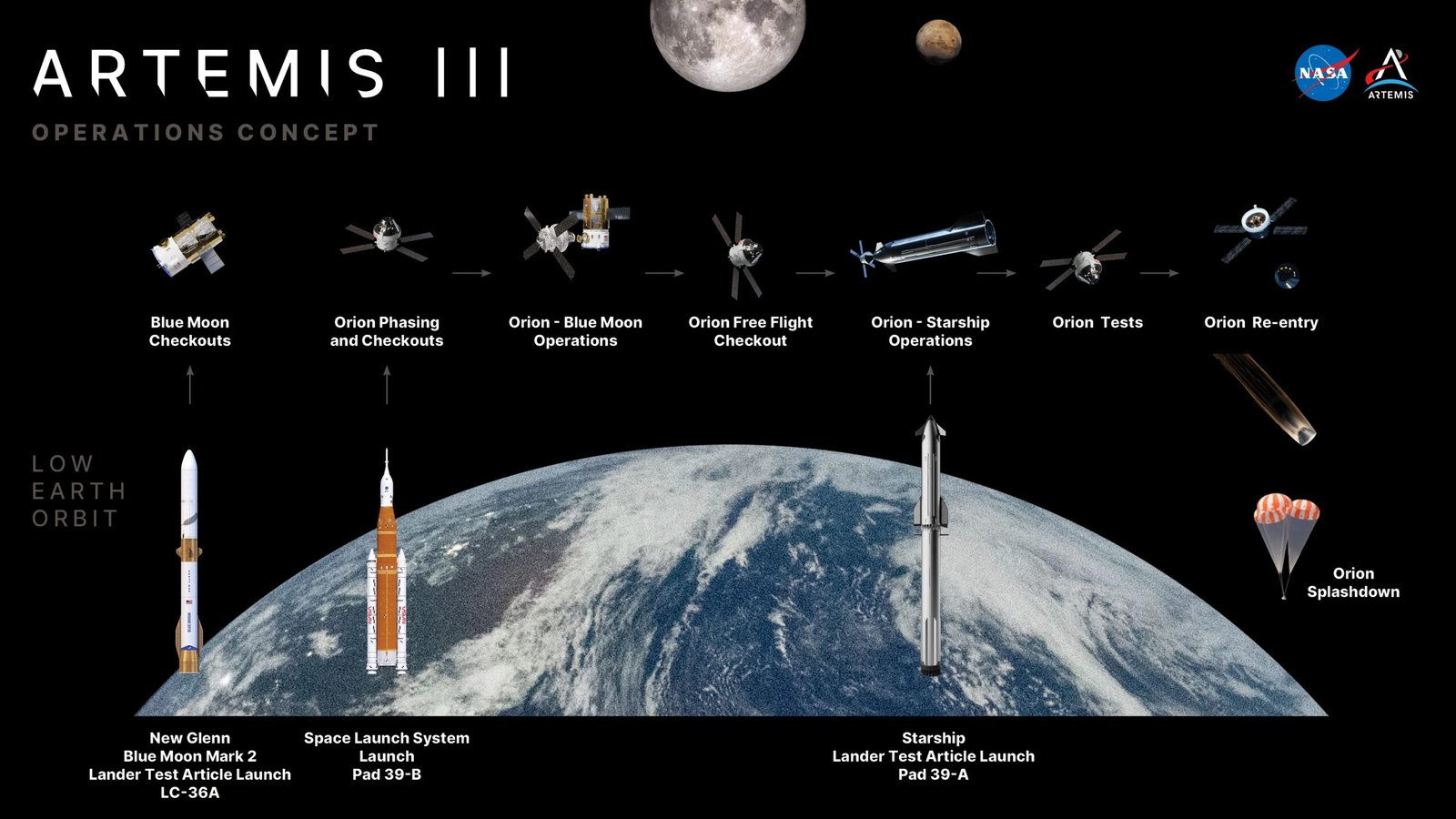
Orion will rendezvous with Blue Origin’s Blue Moon and SpaceX’s Starship landers.
Astronauts will evaluate docking, life support, communications, crew operations, and spacecraft interoperability.
It aims to reduce risks and prepare crews for 2028 lunar landings.
NASA’s Artemis III Mission to Test Future Moon Lander Operations
Before astronauts attempt another landing on the Moon, NASA plans to test key spacecraft and procedures closer to home. Artemis III is designed as a 14-day mission in low Earth orbit, not a lunar landing. Its central task: bring NASA’s Orion spacecraft together with test versions of landers built by Blue Origin and SpaceX.
NASA’s plan calls for the mission to launch in 2027 with astronauts Randy Bresnik, Frank Rubio, Andre Douglas and European Space Agency astronaut Luca Parmitano aboard Orion. The crew will practice rendezvous, docking and spacecraft operations that future lunar missions will depend on. The tests are intended to reveal problems while the spacecraft remain relatively close to Earth.
“Every piece of this mission in Earth orbit is designed to reduce risk before we put astronauts back on the Moon,” said Jeremy Parsons, NASA’s Artemis program manager. He said the mission will involve three spacecraft launched on three different rockets, a combination NASA has not attempted before.
That complexity is also the point. Artemis III will test how spacecraft, crews, flight controllers and commercial partners work together. But an Earth-orbit demonstration cannot prove that every system will perform the same way near the Moon. The mission can provide essential evidence and experience; it cannot remove all risk from future landings.
Two landers, two docking tests
The first commercial vehicle planned to reach orbit is Blue Origin’s Blue Moon Mark 2 test article. It will launch into a circular orbit about 273 miles above Earth and could remain there for up to 30 days. That long on-orbit lifespan gives mission planners some scheduling flexibility.
NASA plans to launch Orion on the Space Launch System rocket from Kennedy Space Center in Florida a few days later, after confirming that Blue Moon is ready for joint operations. Orion is expected to enter an elliptical orbit before using its service module to move into a more circular orbit about 345 miles above Earth. The spacecraft will then adjust its path to approach Blue Moon.
The orbital choreography matters. Orion and Blue Moon will operate in different orbits, each selected to meet the needs of its spacecraft. Reaching the right position and speed will require a sequence of precise maneuvers. During the first two days, the crew will check Orion’s systems and prepare for close-proximity operations.
The first rendezvous and docking will give NASA a chance to evaluate Orion’s interaction with a commercial lunar lander in space. Engineers will assess guidance and communications systems, software and operational procedures. Flight controllers will also practice coordinating work across NASA and industry teams.
After docking, the astronauts plan to spend about two days inside Blue Moon’s test article. They will enter through the hatch and assess the cabin, controls and life-support systems. Teams will check whether the cabin can maintain suitable pressure and atmosphere.
The test article includes avionics, software, flight controls, crew-cabin technologies and life-support functions intended for future lunar missions. Testing them together in orbit can show how the systems work as an integrated vehicle. It also gives the crew a chance to identify practical issues that ground tests may not expose, such as how people move through the cabin or interact with controls in weightlessness.
Once Orion undocks, the mission will turn to a second test. SpaceX plans to launch a Starship Version 3 test article from Florida. The vehicle is designed for a shorter on-orbit lifespan than Blue Moon, so NASA plans to launch it later in the mission. Starship is expected to enter an orbit about 206 nautical miles above Earth, selected in part to support communications coverage.
Orion will then rendezvous and dock with Starship in a demonstration expected to last up to two hours. The crew will not enter the vehicle. Instead, NASA and SpaceX will assess how the spacecraft operate while connected, including their controllability, communications and software. They will also study the forces and handling involved in docking and undocking.
The two demonstrations use different docking arrangements. Orion will connect to a port beside Blue Moon’s crew cabin, then align its forward docking system with the port at Starship’s nose. Testing both configurations on one mission should give engineers useful comparisons. It will also let the crew and flight controllers practice distinct procedures.
The approach offers a broad test of how Orion may work with different lander designs. It also creates operational demands: three launches, multiple orbital paths and two separate docking campaigns must fit into one tightly managed schedule. The plan includes flexibility, but launch delays or spacecraft issues could affect the sequence. NASA will need to confirm that each vehicle is healthy before moving ahead.
Building experience for missions beyond Earth orbit
The work will not end after the docking demonstrations. NASA plans to use up to five additional days in orbit for tests and research that could support later Artemis flights.
The crew will conduct additional assessments of Orion’s Crew Survival System suits, docking sensors, acoustics and thermal conditions. They will also complete human-factors evaluations and other science and technology demonstrations. Some investigations will build on work from Artemis II, adding information relevant to future deep-space missions.
One study will examine how astronauts might assess their health when they cannot communicate directly with mission control. That capability could matter during lunar surface expeditions, where distance and communications limits may complicate real-time support. NASA also plans to fly a cellular biology experiment.
Other work will focus on preparing for future lunar sample returns. Teams will test concepts for transporting samples to Earth, receiving them after landing and moving them into curation facilities. They will also assess Orion’s environment for potential contamination concerns. These steps could help protect both the samples and the scientific value they may hold.
The crew will make Earth and solar observations from Orion’s orbital vantage point. Such work can strengthen observation skills that astronauts may use on future missions. Plant seeds will also fly aboard the spacecraft for later scientific study and educational engagement.
NASA plans additional schedule flexibility so the crew can complete objectives as conditions allow. That flexibility is useful on a complex test flight, where one delay can change the time available for later tasks. It also means some objectives may have to compete for limited crew time and spacecraft resources.
When the mission is ready to end, Orion will begin its return preparations. The crew will configure the cabin for reentry, then splash down in the Pacific Ocean off California. NASA personnel and the U.S. Navy will recover the spacecraft and astronauts.
Artemis III will not demonstrate a lunar landing. Its value will come from testing the systems and procedures needed to make future landings more practical and reliable. NASA will gather data on spacecraft compatibility, crew operations, communications, mission-control coordination and commercial hardware performance.
That experience can help teams revise designs and procedures before astronauts travel to the Moon’s South Pole, where NASA plans future landing missions. Earth orbit offers a more accessible place to test complex operations, but it is not a perfect stand-in for deep space. Later missions will still need to address the different demands of lunar travel and surface operations.
Artemis III is therefore both a technology test and a rehearsal for a new way of working. NASA, commercial companies and international partners will have to coordinate across vehicles, organizations and mission phases. The lessons from that effort are intended to support a sustained human presence on the Moon and, over time, prepare for crewed missions to Mars.
For more information, visit NASA’s Artemis program.
Continue Your Tech Journey
Explore the future of technology with our detailed insights on Artificial Intelligence.
Explore past and present digital transformations on the Internet Archive.
Space
