

Quick Takeaways
NASA Glenn researchers use specialized instruments to measure airflow and sound.
Rotating microphone rakes reveal tone modes that stationary microphones cannot measure.
Phased microphone arrays pinpoint noise sources in models and full-scale engines.
Hot-wire and laser measurements map airflow disturbances and validate engine-noise predictions.
Instrumentation at NASA: Measuring the Sources of Aircraft Noise
Reducing aircraft noise starts with finding out where it comes from and how it moves through an engine. At NASA’s Glenn Research Center, researchers combine acoustic instruments with detailed airflow measurements to investigate that problem. Their experiments help explain how noise forms, test ways to reduce it and provide data that engineers can use to check prediction tools.
No single instrument captures every part of the picture. Particle image velocimetry (PIV), hot-wire anemometry and laser Doppler velocimetry measure airflow in different ways. Raman spectroscopy can provide complementary information about the gas. Microphone arrays and rotating microphone rakes, meanwhile, reveal how sound behaves and where it originates.
Listening for tones and locating noise
A steady, irritating tone from a turbofan can point to a repeating interaction inside the engine. For example, a fan blade may leave a wake that strikes a downstream stator vane, producing a periodic disturbance and a tonal sound. Engineers may address such noise with an advanced acoustic liner or a specially tuned active noise control system. Choosing an effective solution requires knowing more than the tone’s loudness. Researchers also need to identify its acoustic mode: the pattern of pressure variations as sound travels through the engine duct.
A stationary microphone cannot capture that full pattern. In the 1990s, NASA Glenn engineers pioneered procedures for measuring it with rotating microphones. These microphones move around the duct, allowing researchers to distinguish sound modes that a fixed sensor could miss. NASA Glenn’s Rotating Microphone Rakes have supported tests ranging from early, low-speed work in the Advanced Noise Control Fan Rig and the 9- by 15-Foot Low Speed Wind Tunnel to full-scale turbofan ground tests.
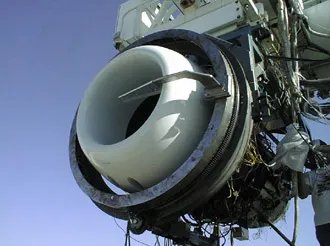
Microphone arrays address a different question: Where is the sound coming from? In a phased array, microphones are arranged in one, two or three dimensions. Researchers process the recordings together to map noise sources. NASA Glenn’s Array48 system has been used to study scale-model jet flows, a counter-rotating open-rotor fan model and a full-scale F404 military engine.
Researchers have also developed a method, supported by NASA funding, that uses microphones embedded in an engine’s fan duct to locate sound sources on rotating blades. Such approaches can add insight that external microphones alone may not provide. Their usefulness depends on careful sensor placement, reliable measurements and analysis suited to the experiment.
Measuring airflow to explain the sound
Noise measurements reveal what listeners hear. Airflow measurements help explain why it happens. Periodic disturbances can create tones, while turbulent air entering an engine can generate broadband noise—a less distinct sound spread across a range of frequencies. To investigate both, researchers measure air velocity upstream of a propulsor, downstream of it and between its rotor and stator.
Each measurement method offers a different balance of detail and practicality. Hot-wire probes detect changes in airflow through the cooling of a fine heated wire. They can capture rapid velocity fluctuations at a point, but the probe must be positioned carefully in the flow. Laser Doppler velocimetry (LDV) uses light to measure air velocity without placing a probe in the measurement location. Particle image velocimetry tracks the movement of small particles in images to map flow across a region. Raman spectroscopy can complement these methods by providing information about the gas itself.
Together, these tools help researchers visualize disturbances created by a rotor and connect those disturbances to measured sound. Hot-wire and LDV data are routinely used to check calculations that estimate turbofan noise. PIV and other techniques can add further detail, though each method has practical limits, including setup needs, measurement coverage and the conditions of the test.
This combination of airflow and acoustic data supports work well beyond a single experiment. The global aviation noise reduction community uses data from NASA Glenn tests to validate theories and noise-prediction software. Better validation can make those tools more useful to engineers weighing design changes, from acoustic liners to active control systems. The measurements do not replace engineering judgment; they give it firmer evidence.
To learn more about NASA Glenn research, software or data, get in touch through the contact link below.
Expand Your Tech Knowledge
Dive deeper into the world of Cryptocurrency and its impact on global finance.
Discover archived knowledge and digital history on the Internet Archive.
Space
