
Close Menu
    Facebook X (Twitter) Instagram
    Monday, November 9
    Top Stories:
    • China AI Milestone: Models Generate More Tokens Than They Trained On
    • Why Some People Hear Pitch Better: The Role of Internal Noise
    • China’s Robotaxis: What It’s Really Like to Ride
    Facebook X (Twitter) Instagram Pinterest Vimeo
    IO Tribune
    • Home
    • AI
    • Tech
      • Gadgets
      • Fashion Tech
    • Crypto
    • Smart Cities
      • IOT
    • Science
      • Space
      • Quantum
    • OPED
    IO Tribune
    Home » One AI Model Simulates Sand, Proteins, and MoreOne AI Model Simulates Sand, Proteins, and More
    Quantum

    One AI Model Simulates Sand, Proteins, and MoreOne AI Model Simulates Sand, Proteins, and More

    Staff ReporterBy Staff ReporterNovember 9, 2026No Comments3 Mins Read
    Share Facebook Twitter Pinterest LinkedIn Tumblr Reddit Telegram Email
    Share
    Facebook Twitter LinkedIn Pinterest Email

    Fast Facts

    WorldParticle simulates diverse materials using particles, learning their underlying physical dynamics.

    It predicts particle motion stepwise, adapting to unfamiliar materials, forces, and environments.

    The framework surpassed simulators across six phenomena, including proteins and granular materials.

    Researchers envision a general-purpose simulation foundation model accelerating scientific discovery.

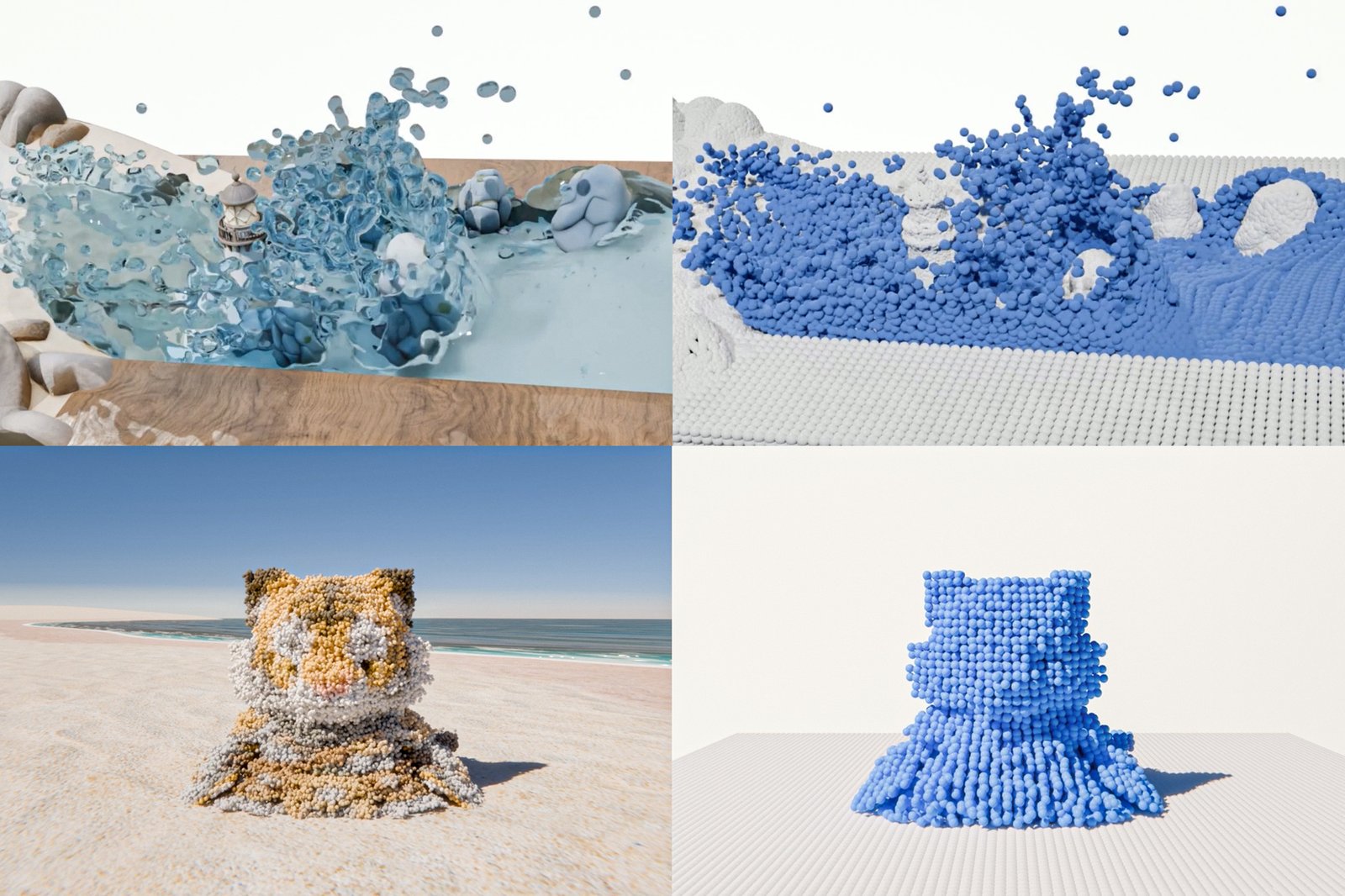
    A single AI system could help researchers simulate materials that behave in very different ways. Called WorldParticle, the model represents everything from sand to proteins as collections of tiny particles. It predicts how those particles move from one step to the next.

    The approach could reduce the need to build a separate simulator for each physical process. But it remains an early research system, not a ready-made replacement for established scientific tools.

    One model, many kinds of motion

    Traditional simulations often rely on equations tailored to a particular material or process. WorldParticle instead uses a neural network trained to predict particle motion from positions and physical properties. It also accounts for outside forces, such as a wave striking a seawall.

    The researchers tested the system on six physical phenomena, including deformable objects, granular materials and proteins. They report that it outperformed numerical simulation methods in their tests. For protein structures, it ran about 100 times faster than numerical simulators. In another test, it modeled sand settling into a pile without leaving particles suspended in the air.

    The model’s particle-based design offers a common way to represent very different systems. That could make it easier to study how physical processes interact. The researchers also developed a method to merge and compress particles, helping the system manage complex objects with large numbers of particles.

    Promise, with practical limits

    WorldParticle’s ability to handle unfamiliar materials, forces and environments points toward more flexible simulation tools. Potential uses include soft-robotics research, studies of RNA and modeling astrophysical events.

    Still, broad claims of generality need careful testing. A model that performs well across selected examples may not be reliable for every material or scientific question. Large simulations also pose a computing challenge, and researchers had to make substantial design changes to improve the system’s speed and scalability.

    The work, which is set for presentation at the ACM SIGGRAPH conference in Asia, marks a step toward general-purpose scientific simulation. Its value will depend on whether future versions can deliver dependable results across more fields—and fit into researchers’ existing workflows.

    Continue Your Tech Journey

    Learn how the Internet of Things (IoT) is transforming everyday life.

    Access comprehensive resources on technology by visiting Wikipedia.

    QuantumV1

    deep learning HPC Minghao Guo Peter Yichen Chen Quantum Research VT1 Wojciech Matusik world models WorldParticle
    Share. Facebook Twitter Pinterest LinkedIn Tumblr Email
    Previous ArticleSmart City Expo Barcelona 2024: Are You Going?
    Next Article Canon Cameras Compatible with Free 3D Photo Software
    Avatar photo
    Staff Reporter
    • Website

    John Marcelli is a staff writer for IO Tribune, with a passion for exploring and writing about the ever-evolving world of technology. From emerging trends to in-depth reviews of the latest gadgets, John stays at the forefront of innovation, delivering engaging content that informs and inspires readers. When he's not writing, he enjoys experimenting with new tech tools and diving into the digital landscape.

    Related Posts

    Gadgets

    Canon Cameras Compatible with Free 3D Photo Software

    November 9, 2026
    IOT

    Smart City Expo Barcelona 2024: Are You Going?

    November 9, 2026
    AI

    MIT AI Platform Helps Robots Reason Beyond Commands

    November 9, 2026
    Add A Comment

    Comments are closed.

    Must Read

    Canon Cameras Compatible with Free 3D Photo Software

    November 9, 2026

    One AI Model Simulates Sand, Proteins, and MoreOne AI Model Simulates Sand, Proteins, and More

    November 9, 2026

    Smart City Expo Barcelona 2024: Are You Going?

    November 9, 2026

    MIT AI Platform Helps Robots Reason Beyond Commands

    November 9, 2026

    California Crew Unearths 40-Million-Year-Old Giant Mammal Fossils

    November 9, 2026
    Categories
    • AI
    • Crypto
    • Fashion Tech
    • Gadgets
    • IOT
    • OPED
    • Quantum
    • Science
    • Smart Cities
    • Space
    • Tech
    Most Popular

    Galaxy S26 Leak: Major Battery Health Downgrade Exposed!

    February 24, 2026

    4 Must-Have Google TV Projectors Over a New TV

    January 3, 2026

    Get Silly: Why Phone Cameras Need Fun Telephoto Lenses!

    April 15, 2026
    Our Picks

    Sealing the Data Gap in AI Drug Discovery

    July 27, 2026

    Revolutionizing Our Understanding of Dopamine: A Breakthrough in Parkinson’s Research

    December 23, 2025

    FTX Recovery Trust Unveils $1.6B Third Creditor Payout

    September 21, 2025
    Categories
    • AI
    • Crypto
    • Fashion Tech
    • Gadgets
    • IOT
    • OPED
    • Quantum
    • Science
    • Smart Cities
    • Space
    • Tech
    • Privacy Policy
    • Disclaimer
    • Terms and Conditions
    • About Us
    • Contact us
    Copyright © 2025 Iotribune.comAll Rights Reserved.

    Type above and press Enter to search. Press Esc to cancel.