

Fast Facts
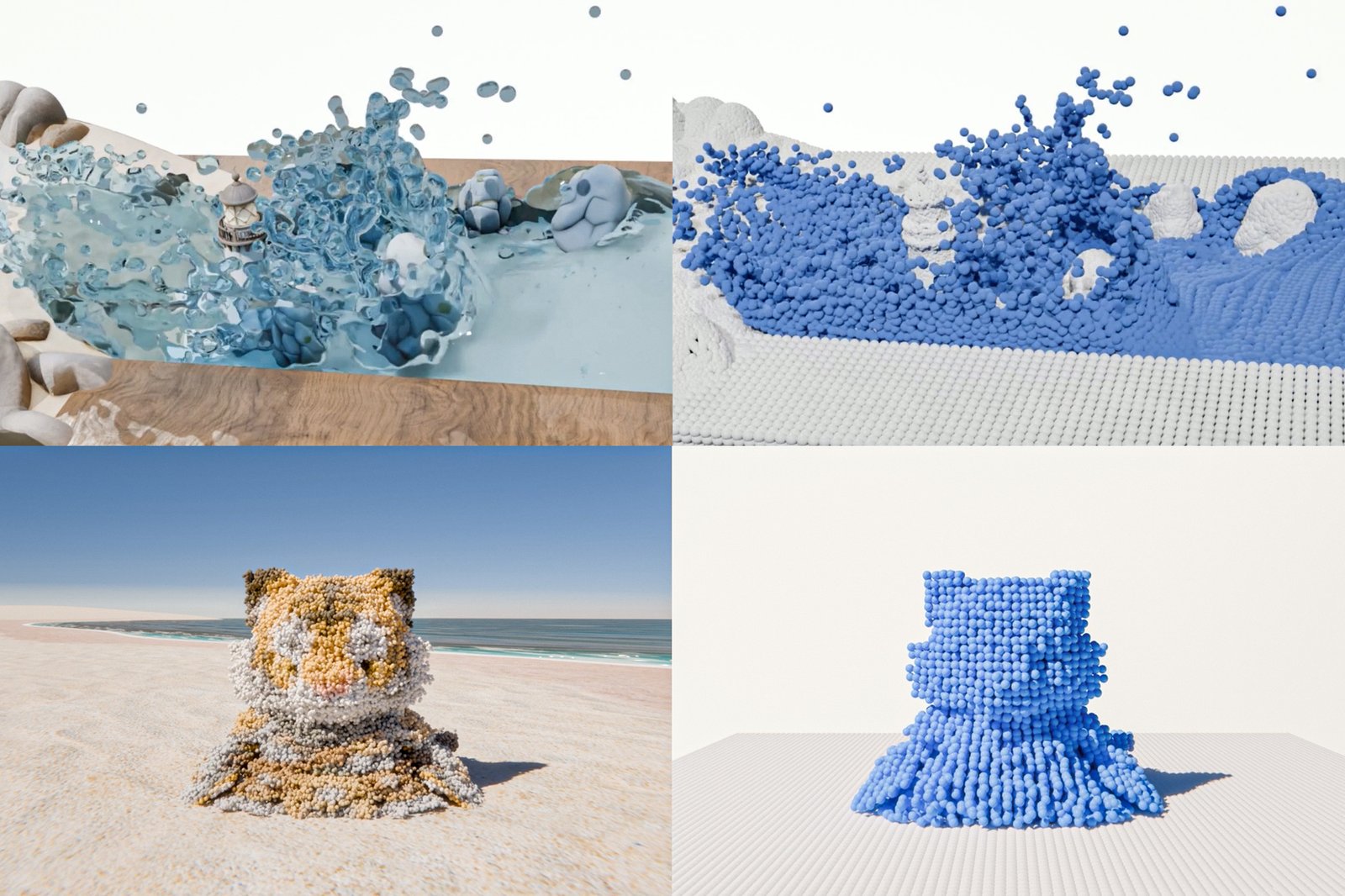
WorldParticle simulates diverse materials using particles, learning their underlying physical dynamics.
It predicts particle motion stepwise, adapting to unfamiliar materials, forces, and environments.
The framework surpassed simulators across six phenomena, including proteins and granular materials.
Researchers envision a general-purpose simulation foundation model accelerating scientific discovery.
A single AI system could help researchers simulate materials that behave in very different ways. Called WorldParticle, the model represents everything from sand to proteins as collections of tiny particles. It predicts how those particles move from one step to the next.
The approach could reduce the need to build a separate simulator for each physical process. But it remains an early research system, not a ready-made replacement for established scientific tools.
One model, many kinds of motion
Traditional simulations often rely on equations tailored to a particular material or process. WorldParticle instead uses a neural network trained to predict particle motion from positions and physical properties. It also accounts for outside forces, such as a wave striking a seawall.
The researchers tested the system on six physical phenomena, including deformable objects, granular materials and proteins. They report that it outperformed numerical simulation methods in their tests. For protein structures, it ran about 100 times faster than numerical simulators. In another test, it modeled sand settling into a pile without leaving particles suspended in the air.
The model’s particle-based design offers a common way to represent very different systems. That could make it easier to study how physical processes interact. The researchers also developed a method to merge and compress particles, helping the system manage complex objects with large numbers of particles.
Promise, with practical limits
WorldParticle’s ability to handle unfamiliar materials, forces and environments points toward more flexible simulation tools. Potential uses include soft-robotics research, studies of RNA and modeling astrophysical events.
Still, broad claims of generality need careful testing. A model that performs well across selected examples may not be reliable for every material or scientific question. Large simulations also pose a computing challenge, and researchers had to make substantial design changes to improve the system’s speed and scalability.
The work, which is set for presentation at the ACM SIGGRAPH conference in Asia, marks a step toward general-purpose scientific simulation. Its value will depend on whether future versions can deliver dependable results across more fields—and fit into researchers’ existing workflows.
Continue Your Tech Journey
Learn how the Internet of Things (IoT) is transforming everyday life.
Access comprehensive resources on technology by visiting Wikipedia.
QuantumV1
