

Fast Facts
- NASA demonstrated SPLICE autonomous navigation for safer lunar and planetary landings.
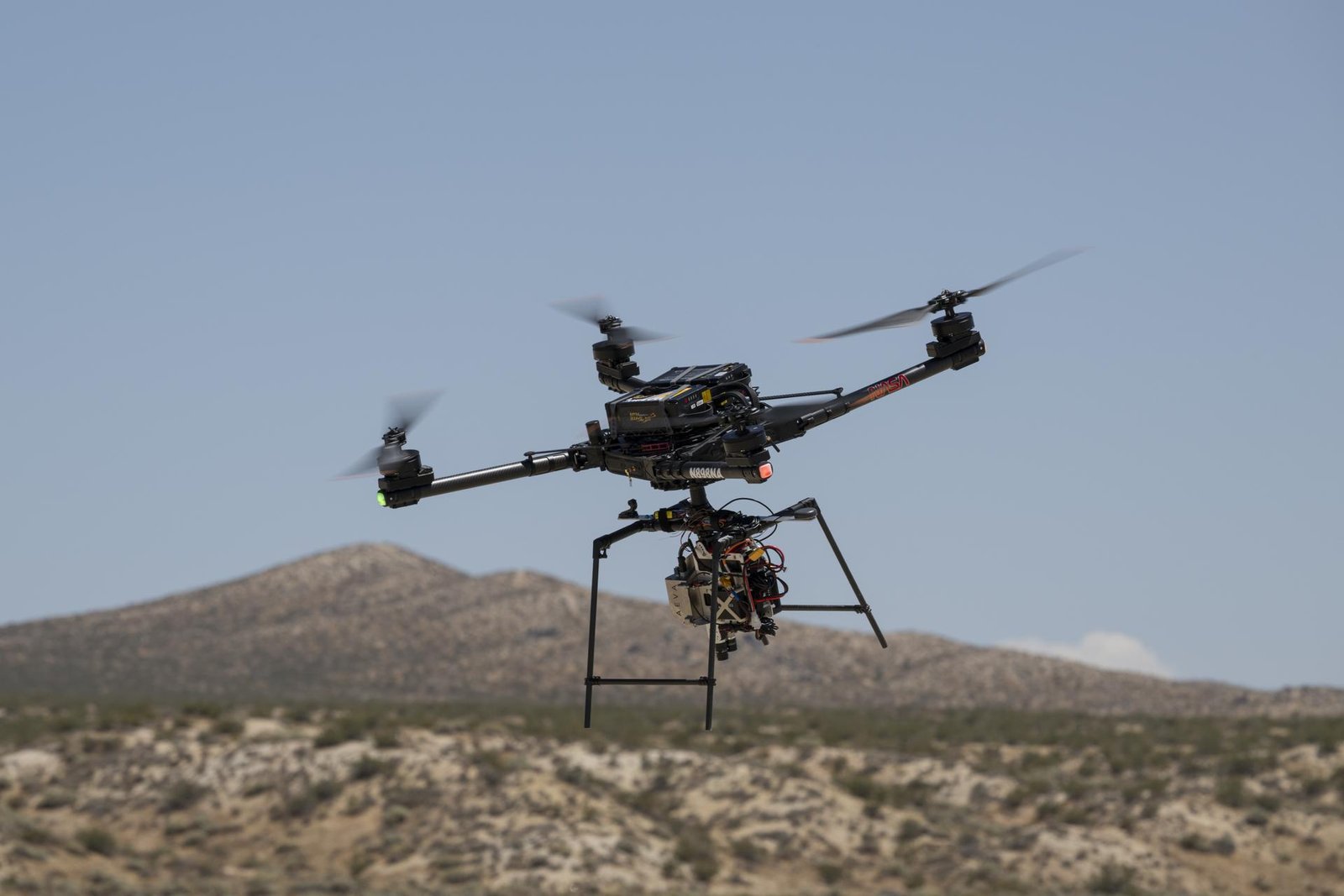
- Alta-X drone tested terrain mapping and hazard avoidance at Rogers Dry Lake.
- The system creates elevation maps and redirects vehicles away from unsafe targets.
- NASA plans industry integration, supporting future robotic, crewed lunar, and planetary missions.
NASA Navigation Experiment Shows Promise for Planetary Landings
A drone flight in California has helped NASA test technology designed to guide spacecraft toward safer landing sites on the Moon and other worlds. The experiment did not involve a spacecraft or a lunar landing. Instead, it used an Alta-X drone to rehearse parts of a descent and landing sequence under Earth-based conditions.
The test marks a step toward giving future landers more ability to assess terrain as they approach the surface. That could matter where rocks, slopes or other hazards make a planned landing point too risky.
A drone tests the landing sequence
On Aug. 27, the Alta-X flew simulated lunar descent and landing maneuvers at Rogers Dry Lake near NASA’s Armstrong Flight Research Center in Edwards, California. The drone carried NASA’s Safe and Precise Landing – Integrated Capabilities Evolution, or SPLICE, guidance, navigation and control payload.
SPLICE gathered light-detection and other sensor data to build high-resolution digital elevation maps of the terrain. Its guidance system used that information to assess potential landing areas. If it judged the target zone unsafe, the system could direct the vehicle toward a safer location.
The approach is intended to help a lander respond to hazards rather than rely only on a landing spot selected before descent. That capability may improve the chances of a soft touchdown, especially in terrain where a small shift in position could make a significant difference.
NASA’s Johnson Space Center in Houston developed the payload. Specialists at Armstrong integrated it with the drone and conducted tests in June and July. Those earlier flights checked communications, data handling, telemetry and command-and-control functions between SPLICE and the aircraft. They prepared the system for the Aug. 27 demonstration and a planned full-scale test at Voyager Technologies in Mojave, California, later that month.
SPLICE builds on earlier flight work. NASA’s Flight Opportunities project, based at Armstrong, supported tests in 2019 that followed a descent altitude and landing trajectory similar to one expected on a lunar mission. In 2020, the project demonstrated two NASA-developed precision-landing sensor systems. Those trials helped the technology advance before the latest integrated flight.
Promise, with more testing ahead
The drone demonstration gives NASA evidence that the payload’s components can work together in a flight environment. It does not, by itself, prove that SPLICE is ready to guide an operational lander. A drone test cannot reproduce every condition of a lunar or Martian descent, and the technology still needs mission-specific integration and further validation.
That distinction matters. A lander must interpret sensor data accurately, make decisions quickly and carry out a safe diversion within the limits of its design. The system’s usefulness will depend not only on its maps and guidance software, but also on how well those parts work with a spacecraft’s sensors, controls and mission requirements.
NASA has worked with commercial lunar lander providers on versions of SPLICE. Some upcoming Moon missions are expected to use data and capabilities developed through NASA programs, including work on precision landing. The agency was also coordinating with industry on access to the guidance system through its software catalog, which was planned for release that fall.
Commercial partners are evaluating possible uses beyond landing. They are considering SPLICE’s navigation capabilities for precision landing and potential extensions to autonomous surface mobility. Those applications could broaden the technology’s value, but each would require additional testing and adaptation.
The latest flight therefore represents progress, not a finished solution. By testing the system on a drone, NASA can identify integration issues and build confidence before attempting more demanding demonstrations. If later tests confirm that SPLICE can reliably assess hazards and guide a vehicle to a safer site, the technology could support robotic and crewed missions to the Moon, Mars and other destinations.
Discover More Technology Insights
Explore the future of technology with our detailed insights on Artificial Intelligence.
Stay inspired by the vast knowledge available on Wikipedia.
Space
