

Fast Facts
- Purpose Entertainment hosted an Artemis gala at Kennedy Space Center on November 6.
- The event celebrated explorers and innovators advancing humanity’s new era of spaceflight.
- It honored Artemis II’s successful completion, a historic return to deep-space exploration.
- The gala concluded America’s 250th anniversary celebrations while anticipating Artemis’ lunar return.
Astronauts Across Generations Share the Stage
A gala marks an Artemis milestone
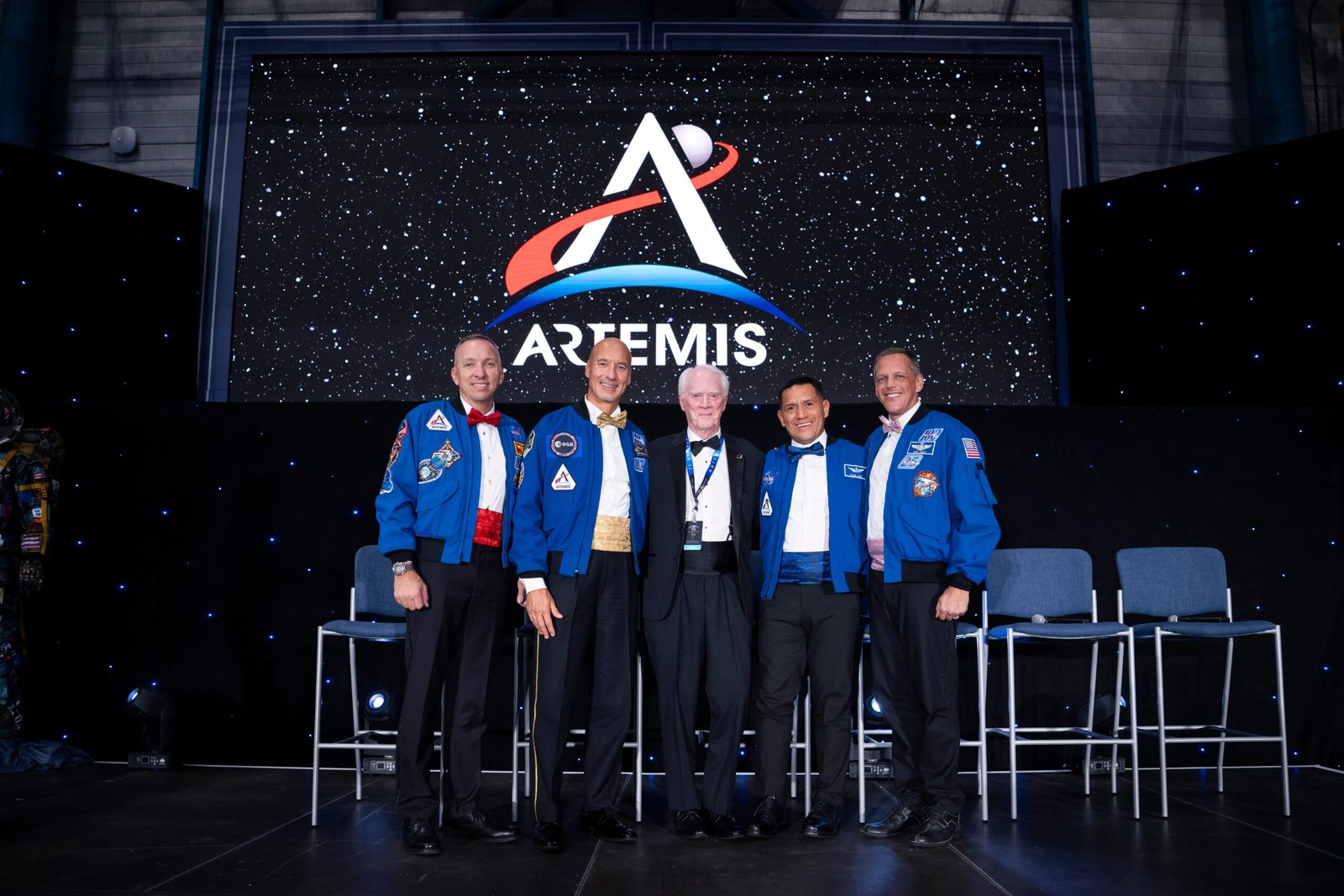
Astronauts from several generations of spaceflight shared the stage Nov. 6, 2026, at the Artemis Celebration Gala at NASA’s Kennedy Space Center Visitor Complex in Merritt Island, Florida. Purpose Entertainment hosted the event on the eve of NASA’s MAX POWER event.
The gala celebrated explorers, innovators and visionaries advancing human spaceflight. It also honored the successful completion of NASA’s Artemis II mission, a milestone in the United States’ return to deep space exploration. As a signature event marking the nation’s 250th anniversary, the gathering looked back at Artemis II and ahead to the campaign’s goal of returning humans to the lunar surface.
From left: NASA astronauts Randy Bresnik, Luca Parmitano, Russell “Rusty” Schweickart, Frank Rubio and Bob Hines appear onstage at the gala.
Purpose Entertainment/Shanna Lockwood
The lineup brought together astronauts whose careers span different periods and programs. Schweickart flew on Apollo 9, part of NASA’s early effort to develop the capabilities needed for lunar missions. Bresnik, Parmitano, Rubio and Hines represent later generations shaped by the space shuttle and international operations aboard the International Space Station.
Their shared appearance offered a human view of spaceflight’s long arc. Each generation inherits tools, knowledge and hard lessons from the one before it. Yet every new mission also brings unfamiliar demands. Artemis II’s completion marked progress, not the end of the work required to sustain exploration beyond low Earth orbit.
Looking ahead while weighing the practical work
The Artemis campaign carries major ambitions. Returning people to the lunar surface would expand the reach of human exploration and create new opportunities for science. But ambition alone cannot make a mission sustainable. Systems must work reliably, support crews, and remain practical to operate across demanding missions.
That balance matters as NASA and its partners adopt new technologies. Advanced systems can improve capability, but they also introduce costs, training needs and operational complexity. A useful innovation must do more than impress. It must solve a real mission problem and function under the conditions crews will face.
The gala was a celebration, not a technical assessment of Artemis II or the campaign’s future plans. Its significance lay in recognizing the people behind the work and the shared effort required to move from one milestone to the next. The astronauts onstage represented distinct chapters of human spaceflight, while the event pointed toward a future still being built.
Artemis II’s successful completion gave the gathering a clear reason to look forward. The next steps will depend on careful engineering, disciplined operations and decisions that connect bold goals with dependable systems. Space exploration advances through breakthroughs, but also through the practical work that makes those breakthroughs usable.
Stay Ahead with the Latest Tech Trends
Learn how the Internet of Things (IoT) is transforming everyday life.
Access comprehensive resources on technology by visiting Wikipedia.
Space
