

Summary Points
- Chandra observations revealed a hidden black hole or neutron star companion.
- This companion appears to trigger repeated eruptions from a giant unstable star.
- The distant galaxy’s star has reportedly erupted for at least fifteen years.
- New X-ray data explain the cause of these enormous recurring outbursts.
Outbursts from a Massive Star
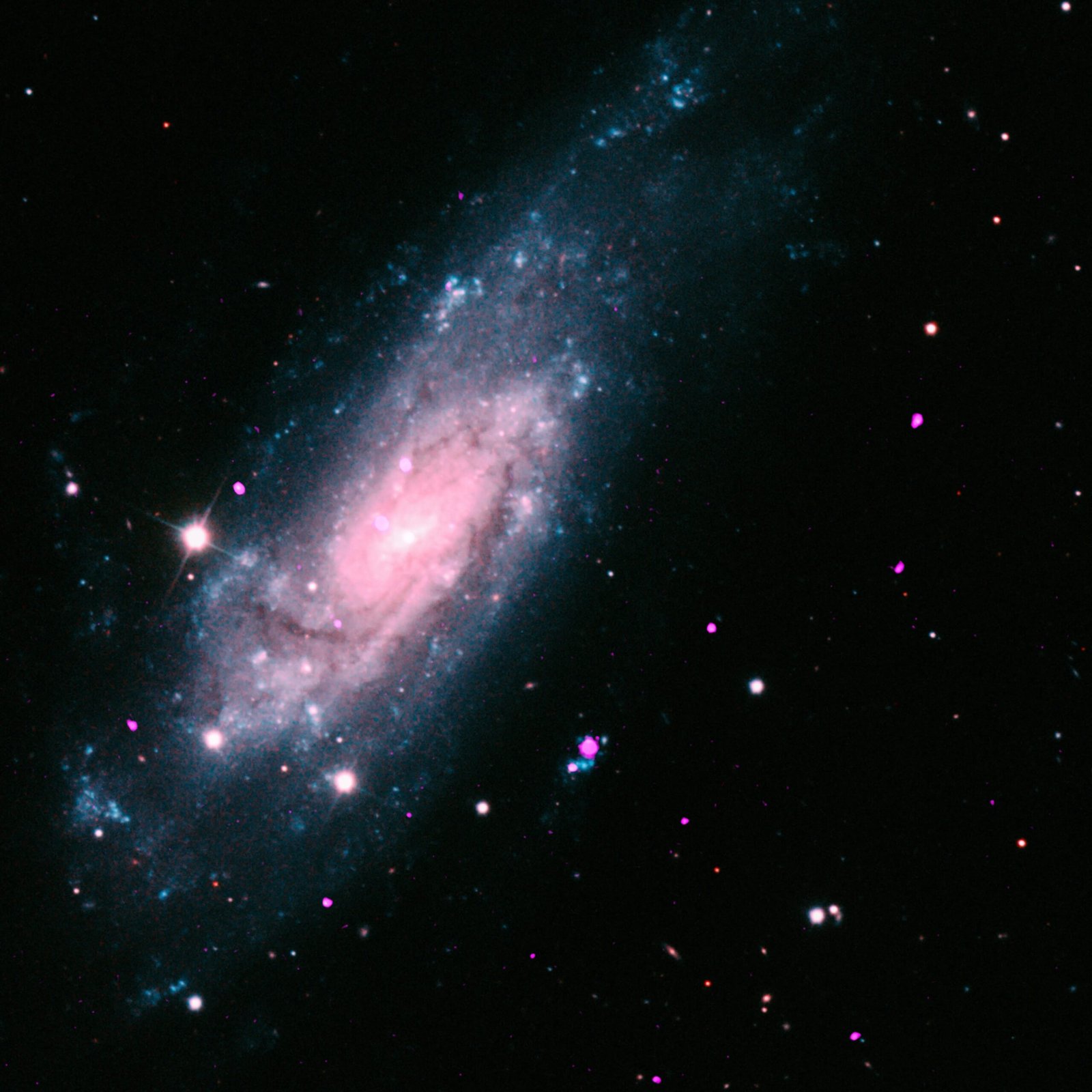
*Image credit: X-ray: NASA/CXC/Univ. of Virginia/M. Aghakhanloo et al.; Optical: SDSS; Image processing: NASA/CXC/SAO/P. Edmonds*
For at least 15 years, a giant star in a distant galaxy has erupted again and again. The repeated flares puzzled astronomers because they looked like major stellar upheavals, yet the star continued to shine. New observations from NASA’s Chandra X-ray Observatory point to a hidden partner: either a black hole or a neutron star.
The system, known as AT2016blu, shows how a companion can shape the behavior of a massive, unstable star. It also offers a reminder that dramatic changes in a star’s brightness may involve more than one object.
Clues in X-rays
Visible-light observations recorded the star’s recurring outbursts. But they could not, on their own, reveal what was driving them. Chandra detects X-rays, which can come from extremely hot material near a compact object. Its observations uncovered evidence for a black hole or neutron star near the erupting giant.
These objects are compact remnants of stars. A black hole’s gravity is so strong that light cannot escape from within its boundary. A neutron star packs a great deal of mass into a small space. Either object can pull in gas from a nearby star. As the gas heats up, it can produce X-rays.
The Chandra finding supports the idea that the companion plays a role in the repeated eruptions. The system’s outbursts may arise from interactions between the two objects, rather than from the giant star acting alone. However, the observations have not established whether the companion is a black hole or a neutron star, or fully settled the process behind each flare.
What the discovery can—and cannot—tell us
A companion object provides a plausible explanation for why the star keeps erupting. As the two bodies interact, the companion may disturb material around the giant star or draw gas toward itself. Such encounters could help trigger bursts of activity. The details remain under study, so the explanation should be treated as a developing picture, not a complete account.
The result also shows the value of combining different kinds of observations. Optical telescopes track changes in visible light, while Chandra reveals high-energy X-rays that ordinary images cannot show. Each instrument contributes a different clue. Together, they can expose hidden parts of a system that would otherwise look like a single restless star.
That approach has limits. X-ray observations can identify energetic activity, but a detection alone may not reveal the companion’s exact type or the full sequence of events. More observations over time can help test competing explanations and clarify how the orbit and stellar material shape the eruptions.
AT2016blu is not reported as a star that has exploded and vanished. Instead, it is a massive star undergoing repeated outbursts, with a compact companion now implicated in the activity. Studying systems like this may help astronomers understand how massive stars behave near the end of their lives—and how close companions can change that evolution.
Expand Your Tech Knowledge
Stay informed on the revolutionary breakthroughs in Quantum Computing research.
Stay inspired by the vast knowledge available on Wikipedia.
Space
