

Quick Takeaways
- Voyager 2 visited Neptune in 1989, the only spacecraft to do so.
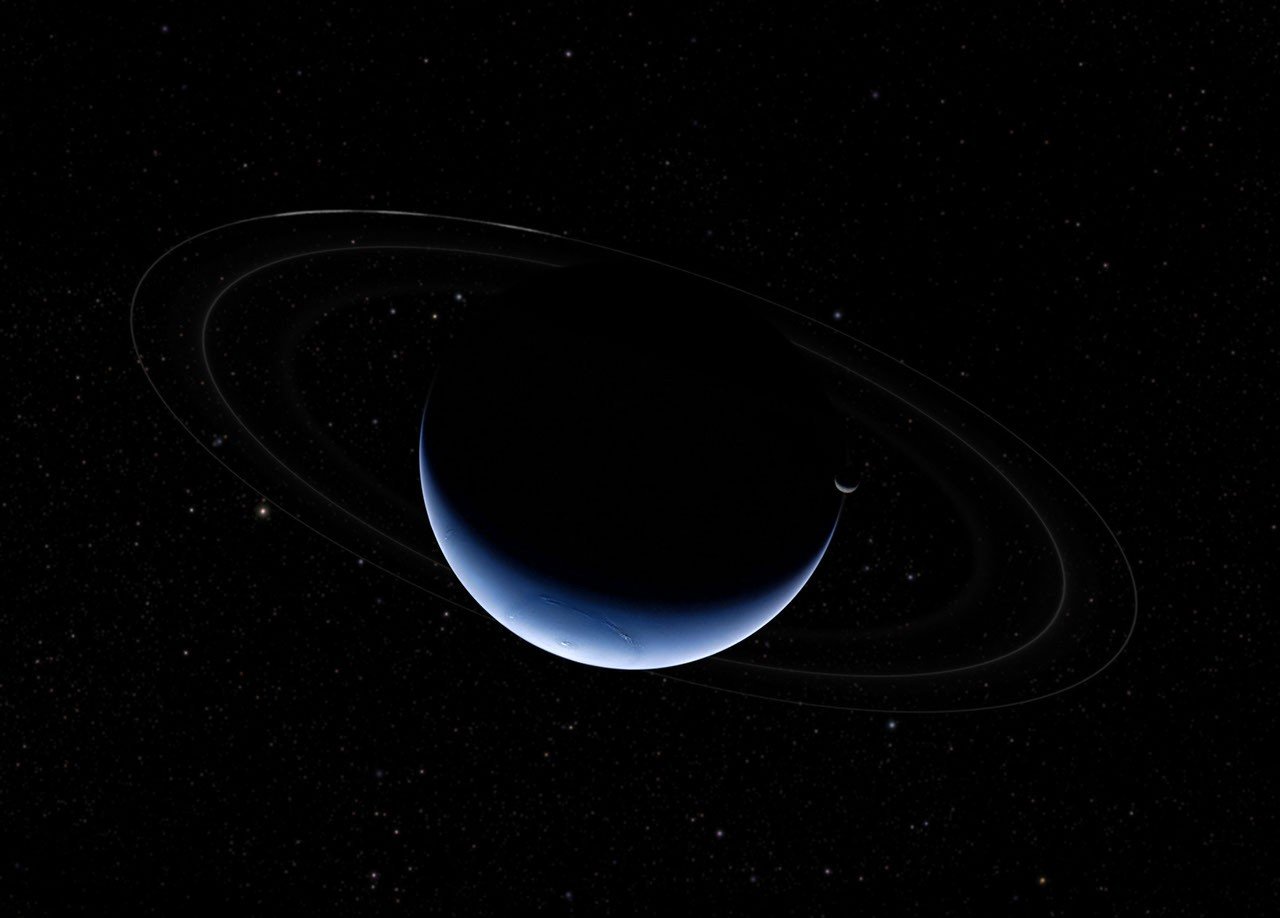
- The composite shows Neptune, Triton, and faint rings as sunlit crescents.
- Voyager revealed Neptune’s polar clouds and captured its bright ring arcs.
- Voyager 2 remains in interstellar space, still traveling outward in 2026.
APOD: 2026 November 21 – Voyager’s Neptune
A portrait from beyond Neptune
On Aug. 25, 1989, NASA’s Voyager 2 spacecraft made its closest approach to Neptune. It remains the only spacecraft to have visited this distant ice giant. Images captured during the encounter and in the days afterward became the basis for this composite view of Neptune, its largest moon, Triton, and the planet’s faint rings.
The scene looks back toward the Sun from just beyond Neptune’s orbit. Seen from that angle, Neptune and Triton appear as thin, sunlit crescents. The unusual viewpoint reveals a planet partly edged in light, rather than the familiar full disk seen from closer to the Sun.
Details in the image bring Neptune’s active atmosphere into view. Cirrus clouds and a dark band circle the planet’s south polar region. Above the pole, a cloudy vortex marks another feature in the restless atmosphere. The planet may look remote and quiet, but its clouds tell a more dynamic story.
What Voyager revealed
Voyager 2 also recorded parts of Neptune’s faint ring system, including three bright arcs. Those arcs were an important discovery: before the flyby, astronomers had evidence of incomplete rings, but had not seen the system in such detail. In this composite, the faintest ring segments are modeled rather than directly shown in the spacecraft images. That distinction matters: the picture combines observations with reconstruction to present a fuller view.
The background spans 7.5 degrees of sky. Its stars come from survey data centered on the constellation Camelopardalis, arranged to match Voyager 2’s outbound view of the Neptunian system. The result is not a single snapshot, but a carefully assembled scene that joins spacecraft images with wider sky data.
Voyager 2 is still traveling through space in 2026, now beyond the solar system’s heliosphere in interstellar space. Its Neptune encounter lasted only hours, yet the observations continue to shape how we understand the planet. The mission also shows both the power and the limits of robotic exploration: a spacecraft can gather views no ground-based instrument could provide, but at such distances, even a brief flyby must do the work of years of study.
Continue Your Tech Journey
Dive deeper into the world of Cryptocurrency and its impact on global finance.
Access comprehensive resources on technology by visiting Wikipedia.
Space
