

Essential Insights
-
Groundbreaking Measurement: MIT and Harvard researchers have directly measured superfluid stiffness in "magic-angle" graphene for the first time, enhancing understanding of its superconductivity and potential applications in quantum computing.
-
Role of Quantum Geometry: The findings suggest that the superconductivity in magic-angle graphene is primarily influenced by quantum geometry, revealing a tenfold increase in superfluid stiffness beyond conventional theories.
-
Innovative Experimental Method: The team developed a novel technique for measuring superfluid stiffness in 2D materials, overcoming challenges associated with their delicate structure by creating seamless contacts with microwave resonators.
- Expanding Research Scope: This research paves the way for further exploration of a wide range of 2D superconductors, indicating the vast potential of these materials in future technological advancements.
Physicists Measure Key Superconductivity Aspect in “Magic-Angle” Graphene
Scientists at MIT and Harvard University recently made a groundbreaking measurement of superfluid stiffness in “magic-angle” graphene, a promising superconducting material. This achievement marks the first time researchers have directly measured this property in a two-dimensional material.
Superfluid stiffness describes how easily electron pairs, known as Cooper pairs, can flow through a superconductor. Think of it like cars in a carpool lane speeding past traffic. If the density of these pairs improves, the material can potentially conduct electricity without resistance.
Magic-angle graphene consists of two atomically thin layers of graphene twisted at a precise angle. At this "magic angle," it exhibits unique properties, including unconventional superconductivity. Understanding superfluid stiffness in this material helps scientists decode the mechanism behind its superconductivity.
The results, published today in Nature, suggest that quantum geometry mainly drives superfluid stiffness in magic-angle graphene. Quantum geometry relates to how the states of electrons interact within the material. The research team created a novel experimental method to obtain this measurement, opening doors to explore other two-dimensional superconductors.
Joel Wang, a co-lead author and research scientist at MIT, emphasizes the excitement of this discovery. “There’s a whole family of 2D superconductors that is waiting to be probed, and we are really just scratching the surface,” he said.
Graphene itself first came to prominence in 2004 due to its astounding qualities. It is a single layer of carbon atoms arranged in a hexagonal lattice, known for its strength and electrical conductivity. In 2018, researchers discovered that stacking two graphene sheets at a specific angle created magic-angle twisted bilayer graphene, which allowed electrons to pair up rather than repel one another.
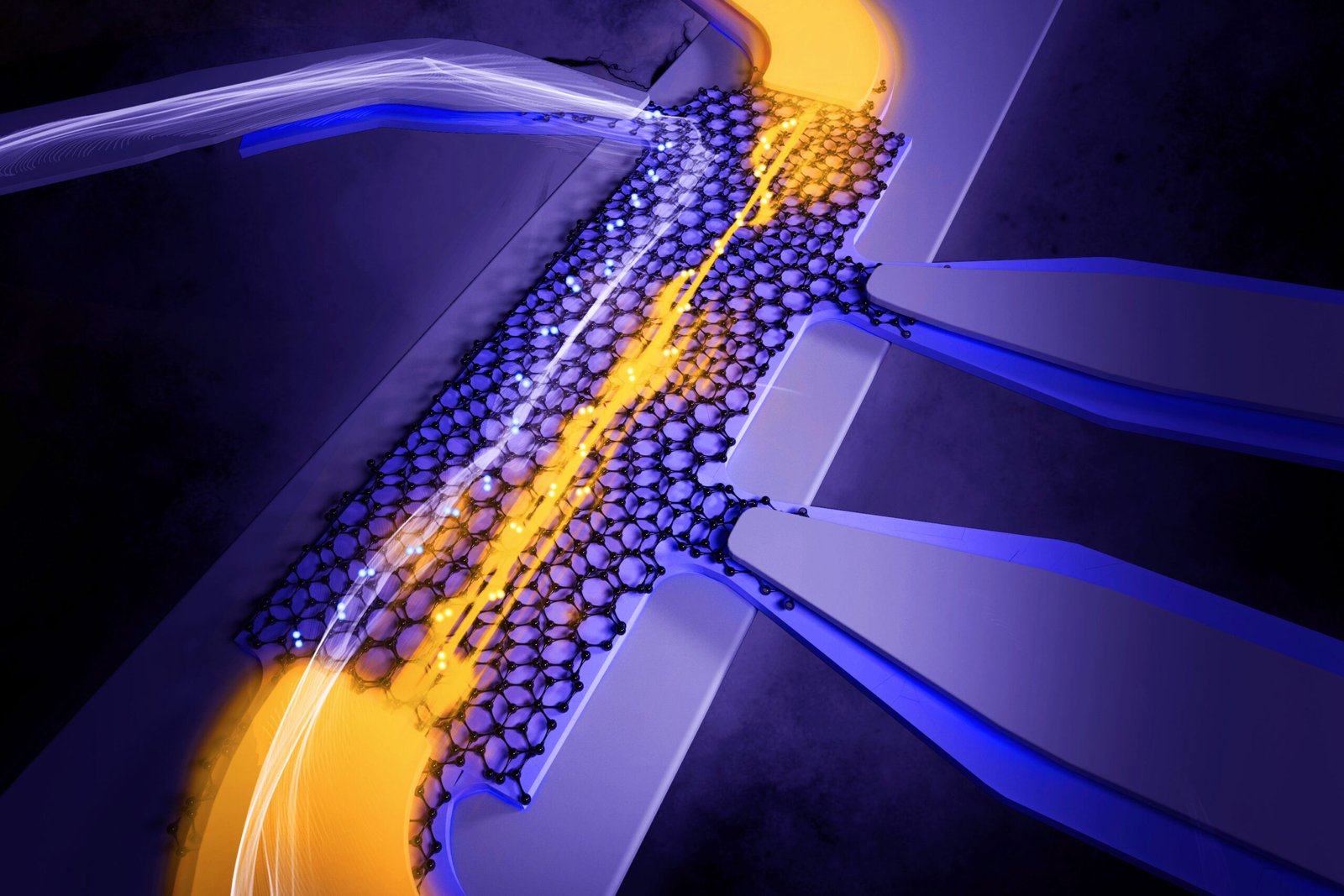
To conduct their measurements, the researchers faced challenges associated with the material’s delicate structure. They devised a new technique to attach a tiny sample of magic-angle graphene to an aluminum microwave resonator. By sending microwave signals through this setup, they measured shifts in frequency, revealing critical information about superfluid stiffness.
The team observed a tenfold increase in superfluid stiffness compared to standard expectations, linking it to the unique quantum geometry of the material. Miuko Tanaka, another co-lead author, noted that this discovery serves as strong evidence of how quantum states influence material properties.
This significant advancement in understanding magic-angle graphene not only promotes further exploration in superconductivity but also paves the way for future applications in quantum computing. Researchers hope that enhanced knowledge of these materials will lead to innovative technologies and devices, potentially transforming how we approach quantum information systems.
As the field progresses, the implications for future technological developments remain vast. Collaborating with institutions like the National Institute for Materials Science in Japan, MIT’s researchers continue to push boundaries, setting the stage for a new era in quantum materials research and technology.
Discover More Technology Insights
Dive deeper into the world of Cryptocurrency and its impact on global finance.
Access comprehensive resources on technology by visiting Wikipedia.
QuantumV1
