

Quick Takeaways
- Artemis II successfully orbited the Moon, returning astronauts safely to Earth.
- Orion’s heat shield performed well, confirming expected thermal protection during reentry.
- Modifying reentry trajectory reduced heat shield stress, improving performance over Artemis I.
- Data supports ongoing development for Artemis III, ensuring safer, more efficient lunar missions.
Thorough Analysis Confirms Artemis II Heat Shield Success
NASA’s Artemis II mission showcased the agency’s progress in sending humans around the Moon and safely returning them to Earth. This mission was a critical step in building the foundation for future crewed lunar landings. Central to this achievement was the Orion spacecraft’s heat shield, which protected the crew and systems during reentry. Now, after extensive analysis, NASA confirms the heat shield performed exactly as expected, reinforcing confidence in the design and safety of future missions.
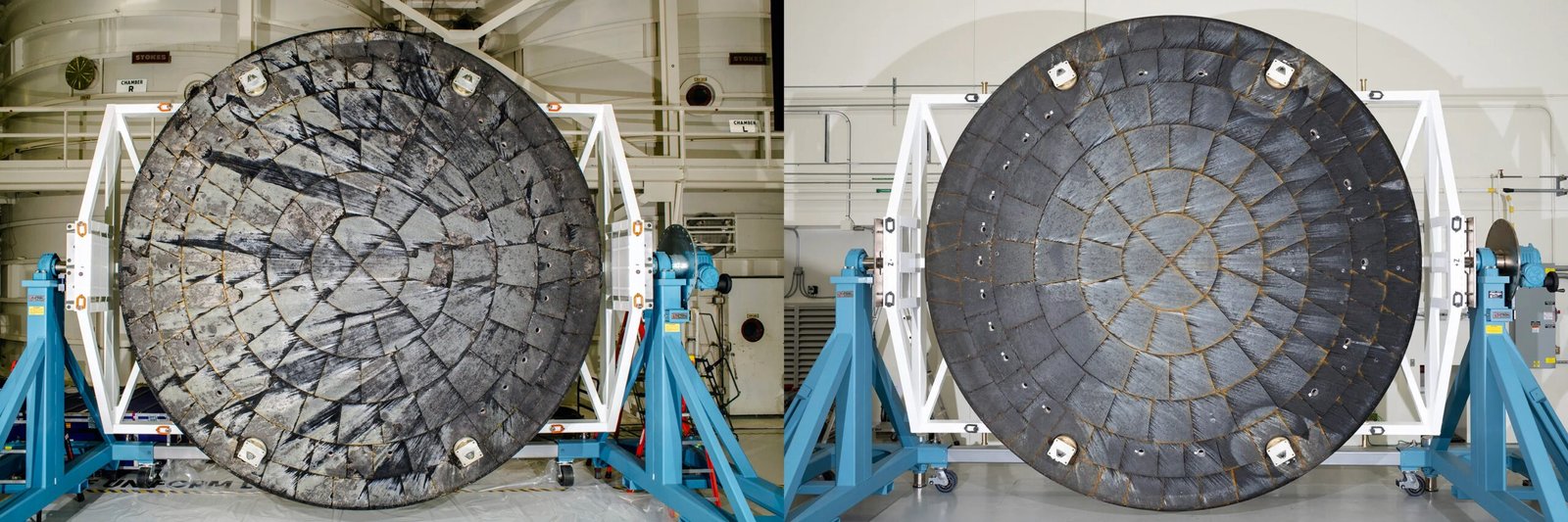
Additional engineering data from Artemis II confirmed the initial positive results from Artemis I. NASA examined how well the thermal protection system safeguarded Orion during reentry, when temperatures soared above 4,000 degrees Fahrenheit. Despite these extreme conditions, the four astronauts inside experienced comfortable cabin temperatures in the mid-70s Fahrenheit. The spacecraft reached a velocity 39 times the speed of sound, making the heat shield’s performance all the more impressive. NASA’s detailed review shows that the heat shield reduced cracking and char loss significantly compared to Artemis I. Visual inspections, including imagery from recovery divers, showed only nine spots of char loss on Artemis II’s heat shield—much lower than the 103 seen during Artemis I.
NASA used extensive ground testing and arc jet experiments to prepare the heat shield. After the flight, the Ageny examined the shield’s 186 blocks of Avcoat, an ablative material designed to absorb heat during reentry. Samples were taken for internal scans at NASA’s Marshall Space Flight Center to understand how the material behaved under extreme conditions. Laser scans of the surface are being compared to pre-flight scans to measure material erosion over time. Such detailed analysis helps improve the design, manufacturing, and durability of future heat shields.
The successful performance confirms that modifications made after Artemis I—such as shortening the maximum downrange distance during reentry—had a strong positive impact. These adjustments limited how long the heat shield was exposed to high temperatures, drastically reducing damage. The precise entry, only 192 feet from the targeted point, and splashdown just 0.59 miles from the planned site, show NASA’s refined approach is effective. The next steps include ongoing material tests and further analysis to support Artemis III and future lunar missions, with the goal of ensuring safety and reliability for astronauts traveling deeper into space.
Implications for Future Lunar Missions
The Artemis II findings demonstrate that NASA’s vehicle systems are highly resilient and capable. The consistency in heat shield performance from Artemis I to Artemis II shows the engineering design is dependable. Improvements such as the simplified and uniform application of the Avcoat blocks contribute to this reliability. Engineers also verified that features like seams and seals on both the heat shield and backshell—an outer layer made of 1,300 ceramic tiles—met safety standards, with no signs of overheating or failure.
NASA’s detailed inspections continue, with laser scans and material sampling helping scientists better understand the behavior of heat shield materials. These insights inform the development of even more advanced shields for Artemis III, scheduled for next year. Preparations are underway, including attaching and powering up the new Orion crew module, which will carry astronauts for this next phase of lunar exploration.
The upcoming Artemis III mission will bring humans farther into space, culminate in lunar surface operations, and test new systems in real conditions. NASA’s focus remains on safety, performance, and technological innovation. The agency’s research and testing demonstrate a strong commitment to learning from every mission—building a safer, more reliable path for human exploration of the Moon and beyond.
Continue Your Tech Journey
Explore the future of technology with our detailed insights on Artificial Intelligence.
Access comprehensive resources on technology by visiting Wikipedia.
Space
