

Essential Insights
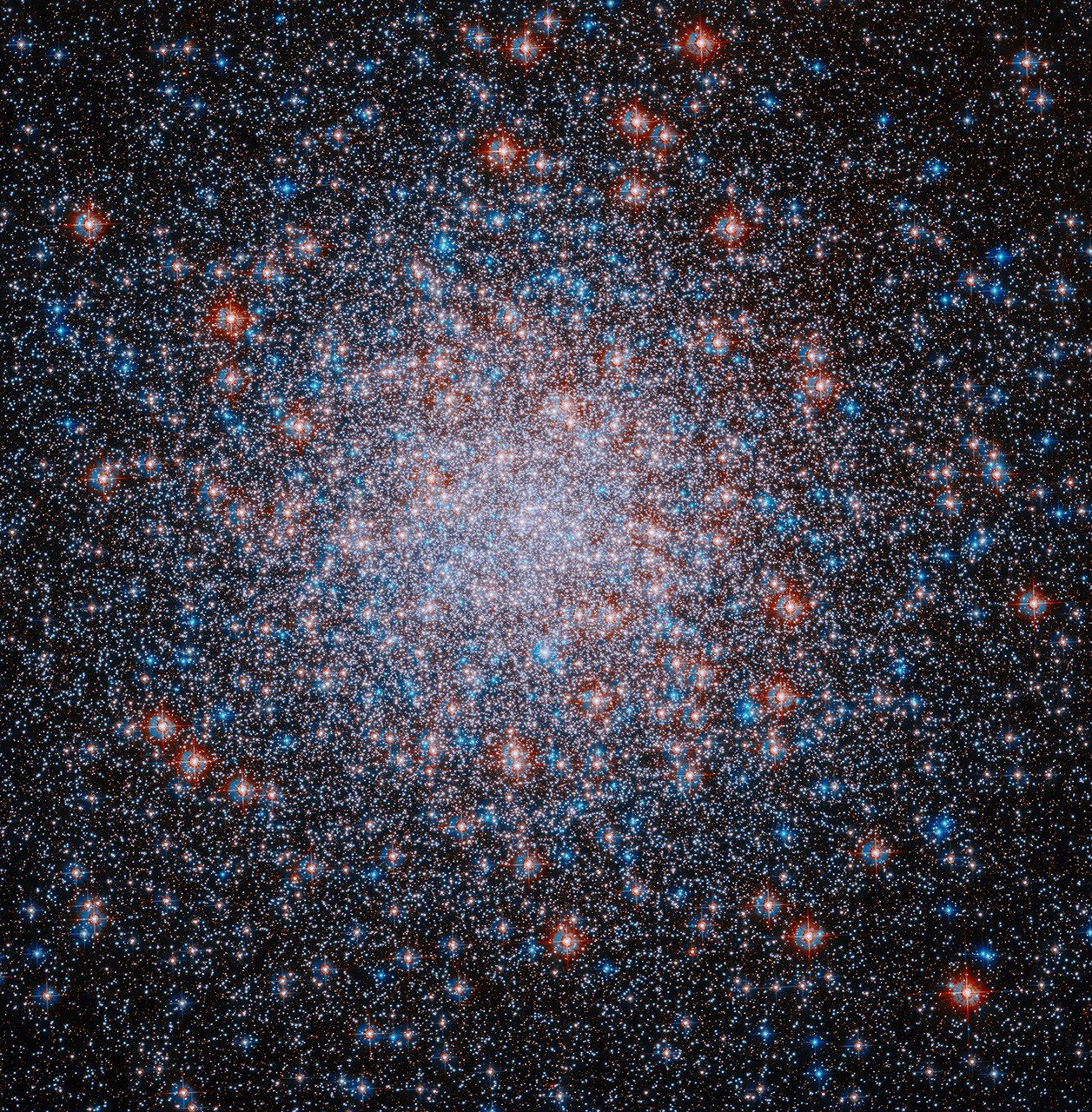
- NASA released a stunning image of over 500,000 stars celebrating America’s 250th anniversary.
- The image showcases Messier 3, a massive globular cluster in the Milky Way.
- M3 contains unique RR Lyrae variable stars, useful for measuring cosmic distances.
- Its unusual features might result from merging two globular clusters in the past.
Hubble’s Star-Spangled Discovery
NASA’s Hubble Space Telescope recently unveiled an extraordinary image showcasing more than 500,000 stars in a stunning display of red, white, and blue. This vibrant cosmic scene celebrates the United States’ 250th anniversary and highlights Messier 3 (M3), one of the Milky Way galaxy’s most massive globular clusters. Globular clusters are dense collections of stars that formed together from the same gas cloud. With around 150 known clusters orbiting the Milky Way, M3 stands out for its size and unique attributes.
M3 is not just massive; it also lies at a considerable distance from the galactic center. One of its most fascinating features is its population of over 240 RR Lyrae variable stars, the highest number found in any globular cluster in our galaxy. These ancient stars are particularly intriguing to astronomers because their brightness fluctuates in a predictable way. By analyzing these changes, scientists can determine their true brightness, which serves as a cosmic yardstick to measure distances across the universe.
Unraveling M3’s Secrets
The M3 cluster also contains approximately 70 identified “blue straggler” candidates. These stars, which shine brightly in blue hues, appear younger than their redder counterparts. They are believed to have gained mass from nearby companion stars, causing them to look rejuvenated despite their true age. This phenomenon was first identified in globular clusters, adding complexity to our understanding of stellar evolution.
The underlying origins of M3 contribute to its unique characteristics. Researchers theorize that this cluster may have resulted from the merger of two distinct globular clusters, remnants of a smaller dwarf galaxy absorbed by the Milky Way. Hubble has captured multiple images of M3, designated as NGC 5272, revealing its intricate nature. In Hubble’s visual representation, blue indicates shorter wavelengths of visible light, while red corresponds to longer wavelengths, including some near-infrared light. These colors indicate the temperature and composition of the stars—blue stars are hotter, whereas red stars are cooler.
This striking image is part of a Hubble Treasury survey aimed at studying half of the Milky Way’s globular clusters. More than 30 years of observations have established Hubble as one of NASA’s key observatories. It works alongside other space missions, such as the infrared-detecting James Webb Space Telescope and the forthcoming Nancy Grace Roman Space Telescope, to enhance our understanding of the universe’s complexities.
Expand Your Tech Knowledge
Learn how the Internet of Things (IoT) is transforming everyday life.
Stay inspired by the vast knowledge available on Wikipedia.
Space
