

Fast Facts
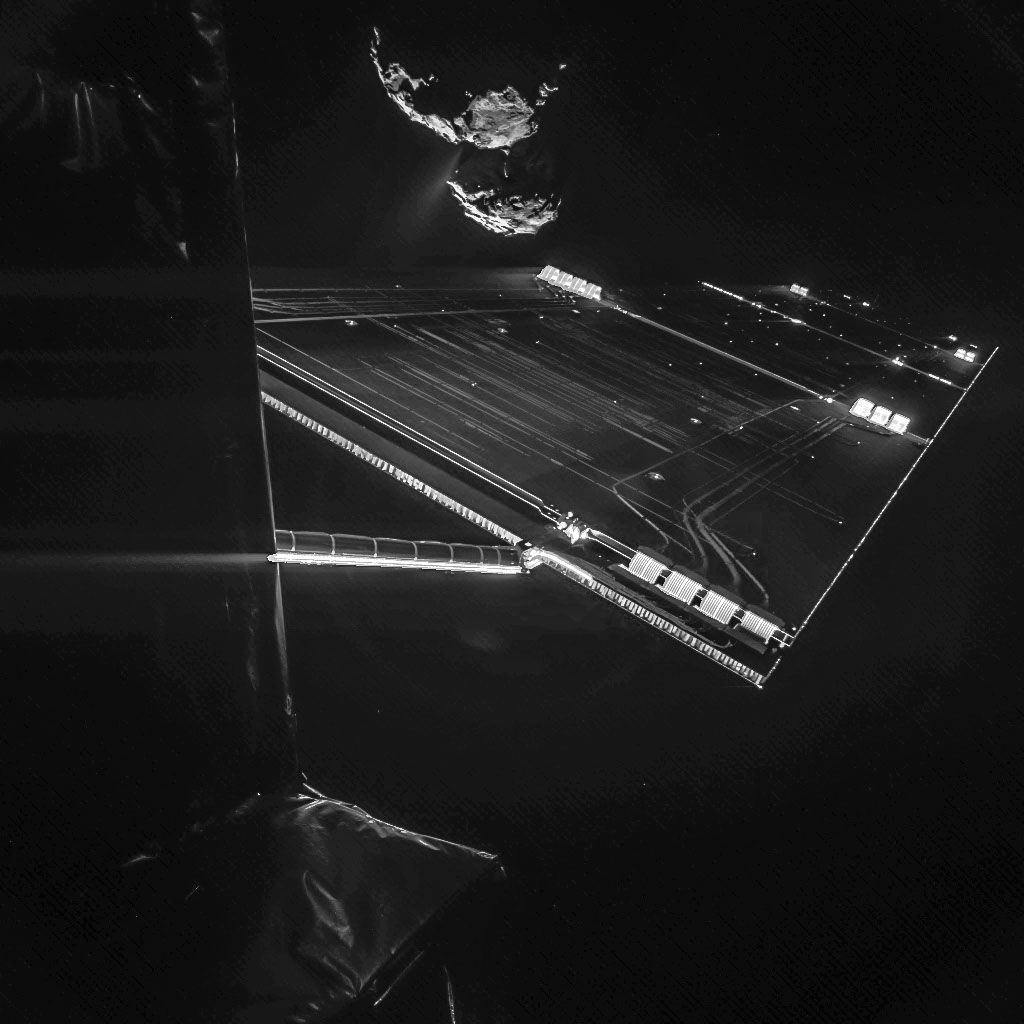
Rosetta captured this selfie on October 7, 2014, near comet 67P.
The spacecraft was 16 kilometers from the comet, 472 million from Earth.
CIVA combined exposures showing sunlight, dust, gas, and Rosetta’s bright solar array.
This was Philae’s final camera image before separation and descent began.
APOD: 2026 October 24 — Rosetta’s Selfie
A spacecraft, a comet and a flash of sunlight share the frame in this striking image from the European Space Agency’s Rosetta mission. The photograph captures a brief moment before the Philae lander left Rosetta and began its journey to the surface of comet 67P/Churyumov-Gerasimenko.
A close view from deep space
Philae’s CIVA camera system took the image on Oct. 7, 2014. Rosetta was then about 472 million kilometers from Earth and just 16 kilometers from the comet’s surface. That distance gave the camera a close view of 67P’s unusual, two-lobed nucleus.
Dust and gas stream away from the comet near the top of the frame. The activity hints at a dynamic world, not a quiet, frozen rock. A bright reflection from one of Rosetta’s 14-meter-long solar arrays adds another striking feature.
The scene presented a technical challenge. Sunlight reflecting from the array was much brighter than the surrounding landscape. To record detail across that contrast, the team combined a short exposure with a longer one. This approach preserved information in both bright and dim areas, though it required combining multiple exposures rather than relying on one.
The last view before landing
The image also documents a turning point in the mission. Philae’s chosen primary landing site lay on the visible side of 67P’s smaller lobe. This was the last picture the lander took with its camera before separating from Rosetta on Nov. 12, 2014.
After separation, Philae took another image looking back toward the orbiter, then descended toward the comet. The sequence shows how cameras can serve both scientific and practical roles: they record a destination, help teams understand a spacecraft’s surroundings and preserve a visual record of a complex operation. But cameras alone cannot eliminate the risks of landing on an irregular, active body in deep space.
Rosetta’s selfie makes those challenges visible. A solar array catches the light; cometary material streams into space; and the small lander prepares to leave its carrier. The image is both a portrait of the mission and a snapshot of its next step.
Continue Your Tech Journey
Dive deeper into the world of Cryptocurrency and its impact on global finance.
Explore past and present digital transformations on the Internet Archive.
Space
