

Quick Takeaways
- The article explains that a globular star cluster is mistaken for a comet.
- Messier 30 is a star cluster, not a comet, in Charles Messier’s catalog.
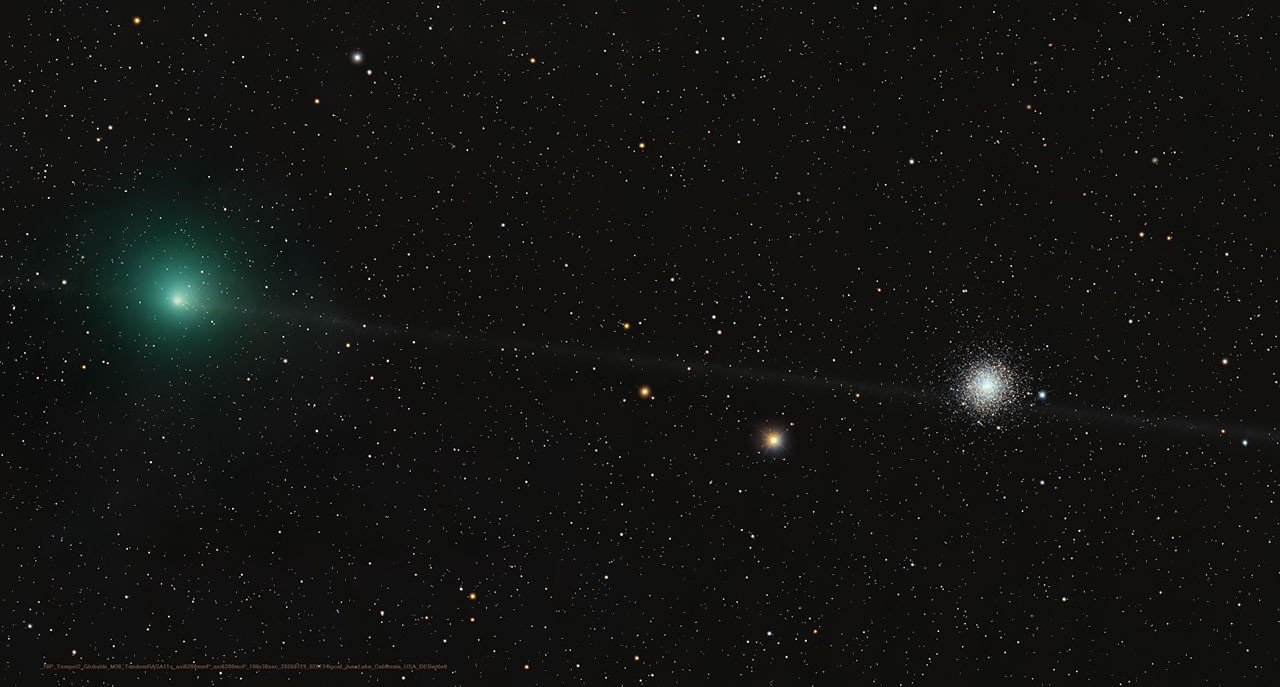
- Comet 10P/Tempel 2 appears near M30 in a recent telescopic image.
- Tempel 2’s dust trail looks like it pierces the distant star cluster.
A Clear View of a Cosmic Encounter
The recent image captured on July 29 provides a fascinating look at a close encounter between a comet and a star cluster. The comet, known as 10P/Tempel 2, appears with a faint, narrow dust trail that seems to stretch across the field of view. This trail marks the comet’s path through space, showing the dust and debris it leaves as it moves. Just nearby, the globular star cluster Messier 30, also called M30, stands out with its dense collection of stars. The comet was only about 3.5 light-minutes away from Earth during this observation. Meanwhile, Messier 30 is located approximately 28,000 light-years away. The image clearly shows the difference between a moving comet and a distant star cluster, highlighting how objects in space can appear similar but are very different in nature.
Understanding the Objects in Space
This image reminds us of the origins of the Messier catalog. The famous 18th-century astronomer Charles Messier created a list of objects that were not comets, to avoid confusing them while hunting for new comets. Messier’s list includes nebulae, star clusters, and other faint objects in the night sky. The globular cluster M30 is just one of the many objects in his catalog. Unlike comets that move rapidly across the sky, these objects stay in the same place relative to background stars. The image shows how telescopes today can easily distinguish these objects, even when they look similar to the naked eye. The proximity of Tempel 2 and M30 in this photograph offers a rare and beautiful look at the differences between a wandering comet and a fixed star cluster, illustrating the diversity of objects found in our universe.
Discover More Technology Insights
Learn how the Internet of Things (IoT) is transforming everyday life.
Access comprehensive resources on technology by visiting Wikipedia.
Space
