

Summary Points
- ESA’s Hera spacecraft captured new images showing that NASA’s DART impact carved a stadium-sized crater across Dimorphos.
- The collision sent Dimorphos tumbling and left its surrounding boulder fields largely unchanged.
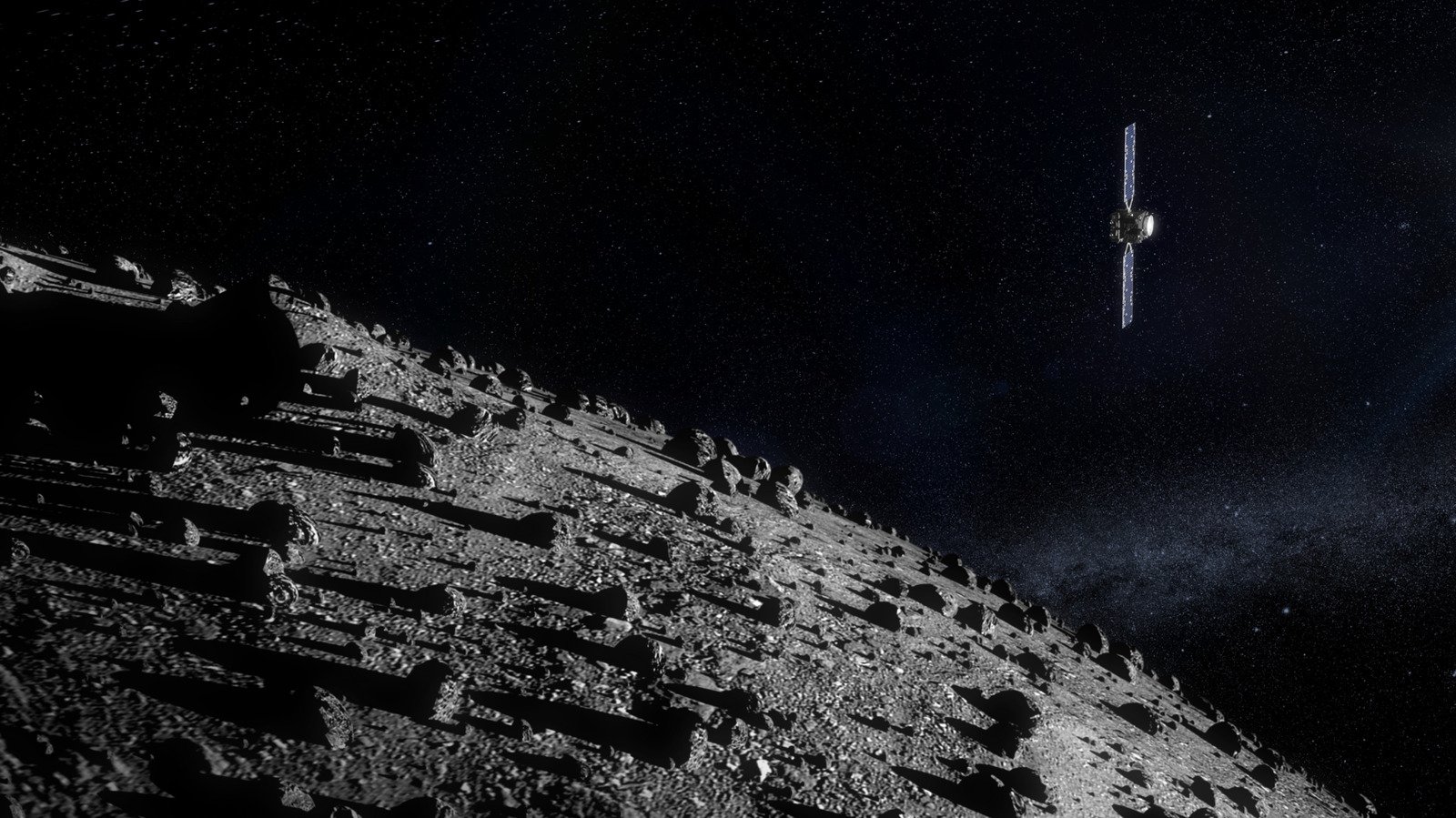
- Hera found hundreds of boulders orbiting both Dimorphos and its larger companion, Didymos.
- Hera will gather closer images and deploy CubeSats to study the asteroids’ interiors, surfaces, and surrounding dust.
A collision that changed more than an orbit
NASA’s DART spacecraft did more than nudge an asteroid off course. When it struck Dimorphos in 2022, it carved a crater that stretches across the small asteroid’s width. The European Space Agency now estimates that crater measures about as wide as a sports stadium.
That finding gives scientists a clearer picture of what a planetary-defense test can do. DART showed that a spacecraft can change an asteroid’s motion. New images from the ESA’s Hera mission reveal the physical cost of that change: a massive scar, fresh movement and a field of nearby space rocks.
Dimorphos orbits the larger asteroid Didymos. Together, the pair offered a useful test site because the smaller asteroid circles its companion. Scientists could measure changes in that orbit after impact.
The crater did not erase Dimorphos’ rugged character. Boulders still cover much of the asteroid’s surface, and the impact did not appear to rearrange those fields. Instead, the collision left a dramatic mark across the asteroid while setting it tumbling in its altered orbit.
That contrast matters. An asteroid may look solid from a distance, yet its surface can consist of loose rocks and debris. Understanding how such a body responds to a strike could help researchers design future deflection missions.
Hera turns a crash into useful data
DART delivered the impact. Hera is examining the aftermath. The ESA spacecraft used three instruments to study the asteroids from about 25 to 30 kilometers away: a black-and-white camera, a multispectral camera and a thermal infrared imager.
Each instrument adds a different view. The cameras show surface features. The infrared imager helps scientists study heat and material properties. Together, those observations can help researchers estimate how the impact changed Dimorphos and how the asteroid’s structure shaped the result.
Hera also found hundreds of boulders around Didymos and Dimorphos. These rocks may help explain how the asteroids formed and how the impact scattered material through the system.
The mission’s next steps aim to bring the picture into sharper focus. The ESA plans to move Hera closer to the asteroids for higher-resolution images of the impact site. It also plans to release two shoebox-sized CubeSats, small spacecraft designed to collect additional data.
One CubeSat, Juventas, will use radar to probe Dimorphos’ interior. It may eventually land on the surface. The other, Milani, will study dust and other material around the asteroids. These tools could reveal details that surface images alone cannot show.
A promising test, not a finished playbook
DART and Hera show how two missions can work as a team. One tests a possible defense method. The other measures the result. That approach could help scientists move from a successful demonstration toward a more dependable strategy for protecting Earth.
Still, one test cannot answer every question. Asteroids differ in size, shape and composition. A future target might respond differently, especially if it contains loosely packed rubble or has a different internal structure. Hera’s measurements can reduce that uncertainty, but they cannot eliminate it.
That is why the mission’s value extends beyond the crater. Scientists need to know how much an impact changes an asteroid’s motion, how the body absorbs the force and how much debris it releases. Those answers could shape the timing, spacecraft design and scale of a future deflection attempt.
For now, the stadium-sized scar offers a vivid reminder of what a small spacecraft can accomplish. DART changed an asteroid’s orbit. Hera is helping scientists understand the consequences. Together, the missions turn a dramatic collision into practical knowledge — and bring planetary defense a step closer to reality.
Stay Ahead with the Latest Tech Trends
Explore the future of technology with our detailed insights on Artificial Intelligence.
Stay inspired by the vast knowledge available on Wikipedia.
CellphonesV1
