

Quick Takeaways
- Earth flyby calibrates the magnetometer for studying Jupiter’s magnetic interactions and Europa’s ocean.
- E-THEMIS scans Earth infrared, preparing to locate Europa’s warm regions and potential water.
- UVS and LAMP compare Earth’s escaping atmosphere, rehearsing future observations around Europa.
- Ganymede enables Jupiter capture; Europa flybys investigate ice, geology, and habitability.
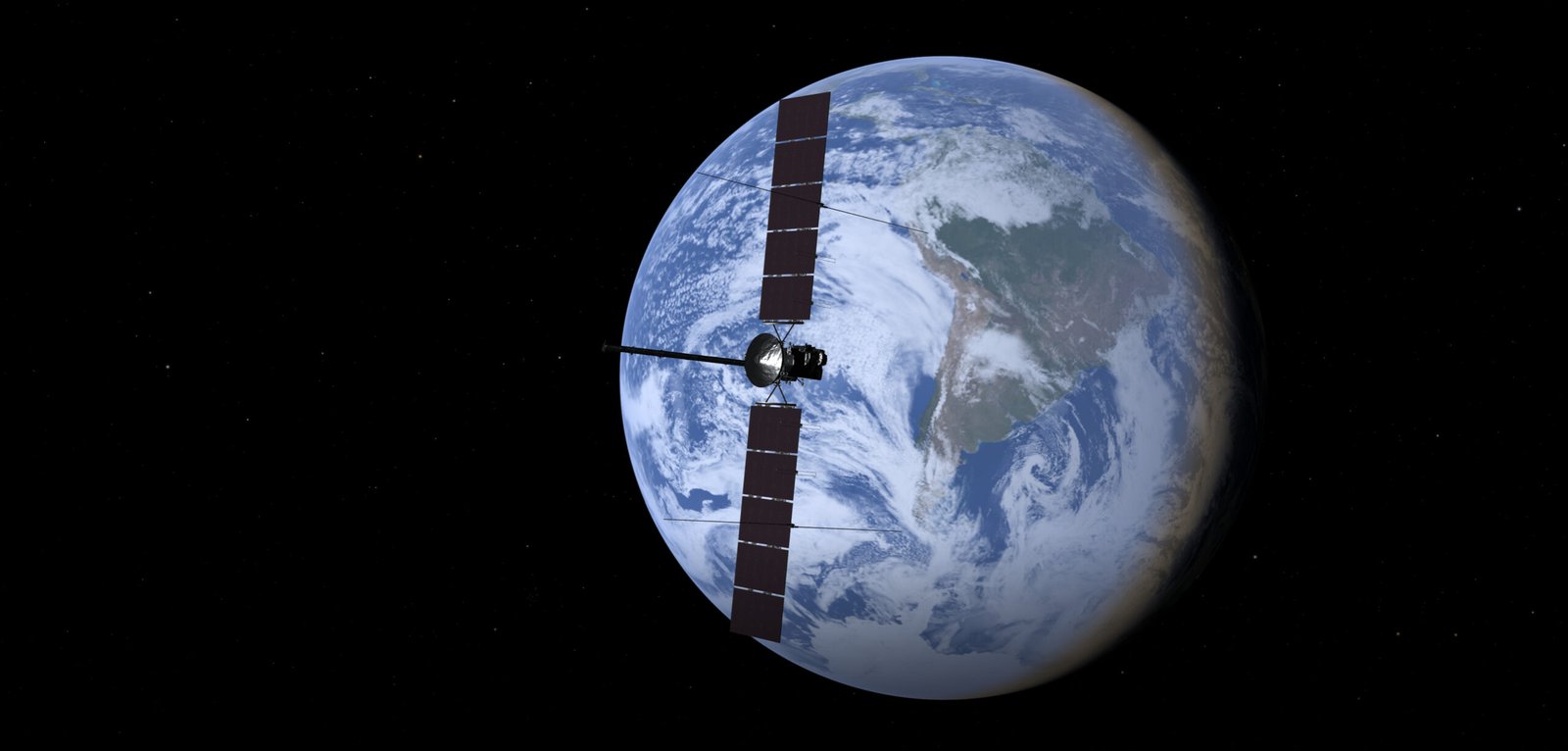
NASA’s Europa Clipper is using a close pass by Earth as more than a route toward Jupiter. The flyby gives the spacecraft’s science team a chance to test instruments against a familiar world and refine measurements before the mission reaches Europa, an icy moon that may conceal a vast ocean.
Earth offers a useful reference because its magnetic field, surface and outer atmosphere have been studied extensively. But the flyby is a calibration opportunity, not a substitute for observations at Europa. The moon’s environment is different, and the spacecraft will need to interpret its data in the intense magnetic field around Jupiter.
A familiar world puts instruments to the test
The Earth pass is especially important for Europa Clipper’s magnetometer. At Jupiter, the instrument will measure changes in the magnetic field as the spacecraft moves around the planet. Those readings could help scientists determine whether Europa has a subsurface ocean: Jupiter’s changing magnetic field may induce a response in salty water beneath the moon’s ice.
To interpret that signal, researchers need a reliable baseline. During the flyby, the magnetometer can observe Earth’s known magnetic environment. The team will use those readings to refine calibrations made before launch and during the mission. That should improve confidence in later measurements, though it cannot remove every uncertainty in a complex magnetic environment.
The spacecraft’s E-THEMIS instrument will scan Earth roughly every eight hours as Europa Clipper approaches. The thermal imager detects infrared energy, which can reveal differences in surface temperature. It captured Mars in infrared during an earlier flyby. At Europa, E-THEMIS will look for warmer areas that could point to water close to the surface — or, potentially, material that has erupted onto it. A warm spot alone would not prove that liquid water is present, but it could help researchers identify places that deserve closer study.
Europa Clipper’s ultraviolet spectrograph, Europa-UVS, will also observe Earth. The team plans to compare those observations with measurements made by NASA’s Lunar Reconnaissance Orbiter, whose LAMP instrument will view Earth during the flyby. LAMP will study the geocorona, the extremely faint outer region of Earth’s atmosphere, where atoms escape into space.
That coordinated view matters because Europa also has a tenuous atmosphere, or corona, made partly of hydrogen and other escaping atoms. Observations from different spacecraft and vantage points can help scientists test how well their instruments detect such faint material. The approach offers a practical rehearsal for studying Europa, while also giving researchers a chance to compare instruments that were built for different missions.
A calibration stop on a longer journey
Earth is a well-understood target, but it is not a perfect stand-in for Europa. The flyby can help confirm that instruments are operating as expected and sharpen the interpretation of their data. It cannot recreate Jupiter’s powerful magnetic environment or resolve questions about Europa’s ocean. Those answers will depend on repeated close encounters with the moon.
After traveling to Jupiter, Europa Clipper will make a series of flybys of Europa. Its instruments will investigate the thickness of the icy shell, examine the moon’s composition and map its geology. Together, those measurements can show how the moon works and whether conditions beneath its surface could support life. The mission is not designed to detect life directly.
The spacecraft’s journey also relies on gravity assists, which use the pull of planets and moons to change a spacecraft’s speed or direction. Such maneuvers can make a long-distance mission more practical, but they require precise navigation and timing. Once at Jupiter, Europa Clipper will follow a trajectory designed to bring it repeatedly near Europa while limiting the time it spends in the planet’s harsh radiation environment.
For the science team, the Earth flyby offers an early chance to see meaningful data from instruments built to explore a world far beyond our own. The measurements will help establish how those tools perform and how researchers should read their results. Earth is the test case. Europa is the reason for the journey.
Stay Ahead with the Latest Tech Trends
Dive deeper into the world of Cryptocurrency and its impact on global finance.
Discover archived knowledge and digital history on the Internet Archive.
Space
