

Quick Takeaways
-
Andromeda’s Significance: The Andromeda galaxy (M31) is the closest spiral galaxy to the Milky Way at 2.5 million light-years, crucial for understanding our own galaxy’s structure and dark matter through historical studies, particularly by Vera Rubin.
-
Multi-Wavelength Data: Recent composite images of M31 combine data from powerful telescopes across different wavelengths (X-ray, ultraviolet, optical, infrared, and radio), providing varied insights into the galaxy’s features, including its supermassive black hole.
-
Sonification of Data: This release includes a sonification of the multi-wavelength data, translating the light into sound, allowing a unique auditory experience of the galaxy’s structure, with pitch and volume depicting light energy and brightness.
- Tribute to Vera Rubin: The release honors Dr. Vera Rubin’s groundbreaking work in astrophysics, which established evidence for dark matter, leading to her recognition in the American Women Quarters Program, marking a significant acknowledgment of women in science.
NASA’s Chandra Shares a New View of Our Galactic Neighbor
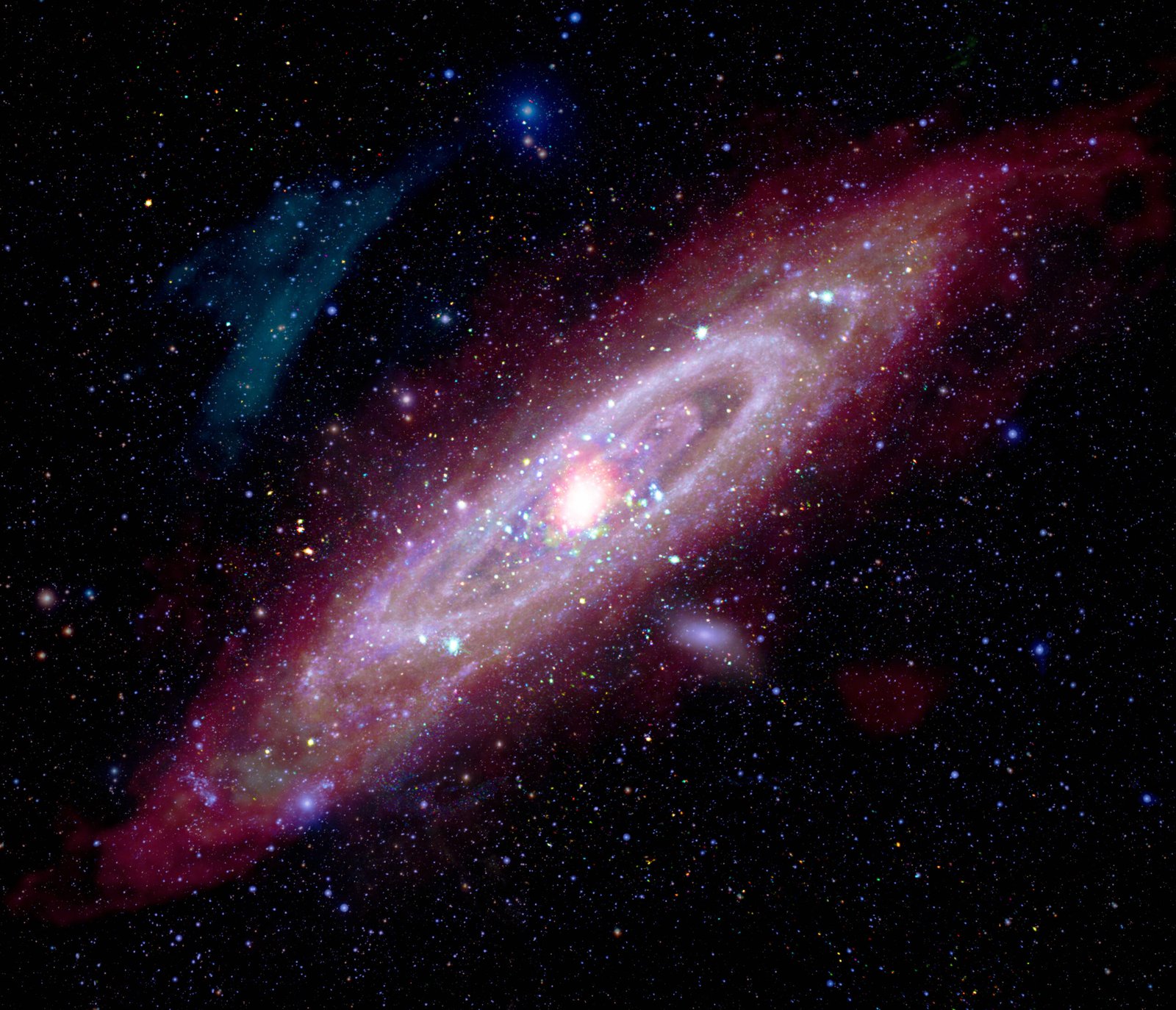
NASA’s Chandra X-ray Observatory recently unveiled stunning new images of Andromeda, our closest spiral galaxy neighbor. This release includes data from various powerful telescopes, each capturing different light wavelengths. As a result, scientists gain a multi-dimensional perspective on this galactic wonder, located about 2.5 million light-years away.
Astronomers have long studied Andromeda, officially known as Messier 31 (M31), to understand the structure and evolution of our own Milky Way galaxy. Highlights from the findings reveal the galaxy’s spiral arms rotating around a bright core. For instance, Chandra’s X-ray data visualizes high-energy radiation around Andromeda’s supermassive black hole.
Historically, Andromeda played a crucial role in discovering dark matter. In the 1960s, Dr. Vera Rubin’s research identified unseen matter influencing the galaxy’s rotation. This groundbreaking work laid the foundation for our current understanding of cosmic structures.
The new images also showcase how light from each telescope paints a different picture. For example, infrared data reveals fiery outer arms, while optical images present a hazy view. This multi-wavelength approach offers a richer understanding of galactic dynamics.
In addition to visuals, Chandra released a sonification of the data. This auditory representation converts light wavelengths into musical notes, allowing the public to experience the data in a unique way. This innovative method underscores the intersection of technology and science, making complex astrophysical concepts more accessible.
Furthermore, this release honors Dr. Rubin, whose legacy continues to inspire researchers today. In 2025, the United States Mint will feature her on a quarter, recognizing her significant contributions to astrophysics.
NASA’s efforts to observe Andromeda enhance our understanding of galaxies and their evolution. As scientists gather more data from missions like the upcoming Nancy Grace Roman Space Telescope, they hope to unlock further mysteries of dark matter and cosmic structure. This work not only advances scientific knowledge but also enriches our appreciation for the universe.
Explore the remarkable features of Andromeda through these captivating images and sonifications. This collection not only informs but also ignites curiosity about our place in the cosmos.
Continue Your Tech Journey
Learn how the Internet of Things (IoT) is transforming everyday life.
Access comprehensive resources on technology by visiting Wikipedia.
SciV1
