

Fast Facts
-
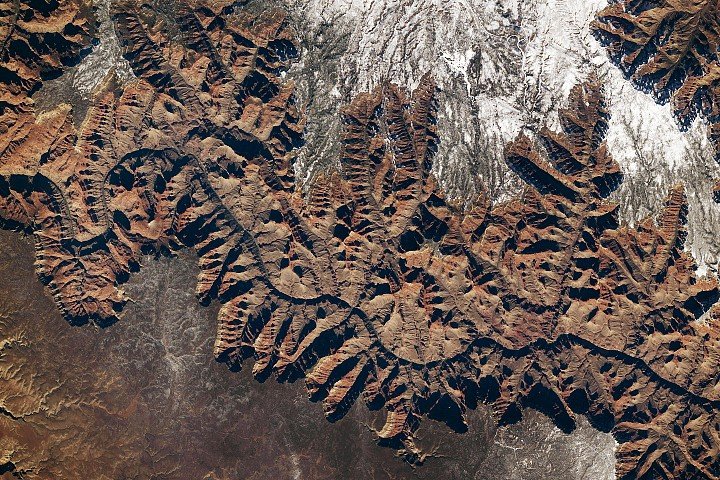
Unique Winter Display: Photos captured from the International Space Station on January 26, 2026, showcase the Grand Canyon’s snow-covered topography following a winter storm, enhancing the landscape’s visual complexity.
-
Snow Accumulation: The South Rim and North Rim of the Grand Canyon receive average winter snowfalls of 58 inches and 142 inches, respectively, often leading to hazardous conditions and park closures.
-
Visual Illusion: The striking appearance of the canyon resembling a mountain range is attributed to a phenomenon called relief inversion, where shadows and light direction create a misleading depth perception.
-
NASA’s Contribution: The images, taken by an Expedition 74 astronaut using a Nikon Z9 camera, highlight NASA’s initiative to provide accessible, scientifically valuable Earth imagery to the public.
NASA Captures Stunning Images of Snow-Covered Grand Canyon
On January 26, 2026, an astronaut aboard the International Space Station (ISS) took breathtaking photographs of the Grand Canyon, now rimmed with snow. This event followed a winter storm that brought flurries to Arizona’s high desert. As a result, the landscape transformed, creating a captivating contrast of light and shadow.
Just two days before these images, snow blanketed the area. This precipitation raised concerns, leading officials to close Desert View Drive for safety reasons. While hazardous conditions affected the South Rim, the North Rim remained closed during winter. However, once the road reopened, a layer of white still clung to the canyon’s edges.
Snow at high elevations is common in winter. The South Rim averages 58 inches annually, while the North Rim receives a staggering 142 inches. Conversely, lower elevations experience rain instead. For instance, on January 24, Phantom Ranch recorded just 0.06 inches of rainfall, while the surrounding plateau saw snowfall.
Interestingly, the photographs may create a visual trick known as relief inversion. Typically, people expect light to come from above. In this case, however, the Sun illuminated the canyon from the south. As a result, shadows may distort perceptions, making the vast canyon appear more mountainous. Snow helps clarify elevation differences by highlighting the flat areas above.
NASA took these photographs using advanced technology. The astronaut used a Nikon Z9 digital camera with a 400-millimeter lens. Images underwent cropping and enhancement for improved clarity. These efforts serve to make valuable scientific insights accessible to the public.
By facilitating these stunning visuals, NASA enhances our understanding of Earth’s geology and ecology. Scientists and enthusiasts alike can view additional images online, showcasing the beauty of our planet. This initiative not only fosters appreciation but also encourages ongoing research and technology development in Earth observation.
Expand Your Tech Knowledge
Explore the future of technology with our detailed insights on Artificial Intelligence.
Explore past and present digital transformations on the Internet Archive.
SciV1
