

Fast Facts
- Terzan 5 is reclassified from globular cluster to distinct stellar system.
- It contains multiple generations of stars, indicating more complex formation.
- James Webb and Hubble observations reveal separate stellar populations and ages.
- Findings enhance understanding of galaxy bulge formation over billions of years.
Understanding Terzan 5: A New Perspective on Stellar Evolution
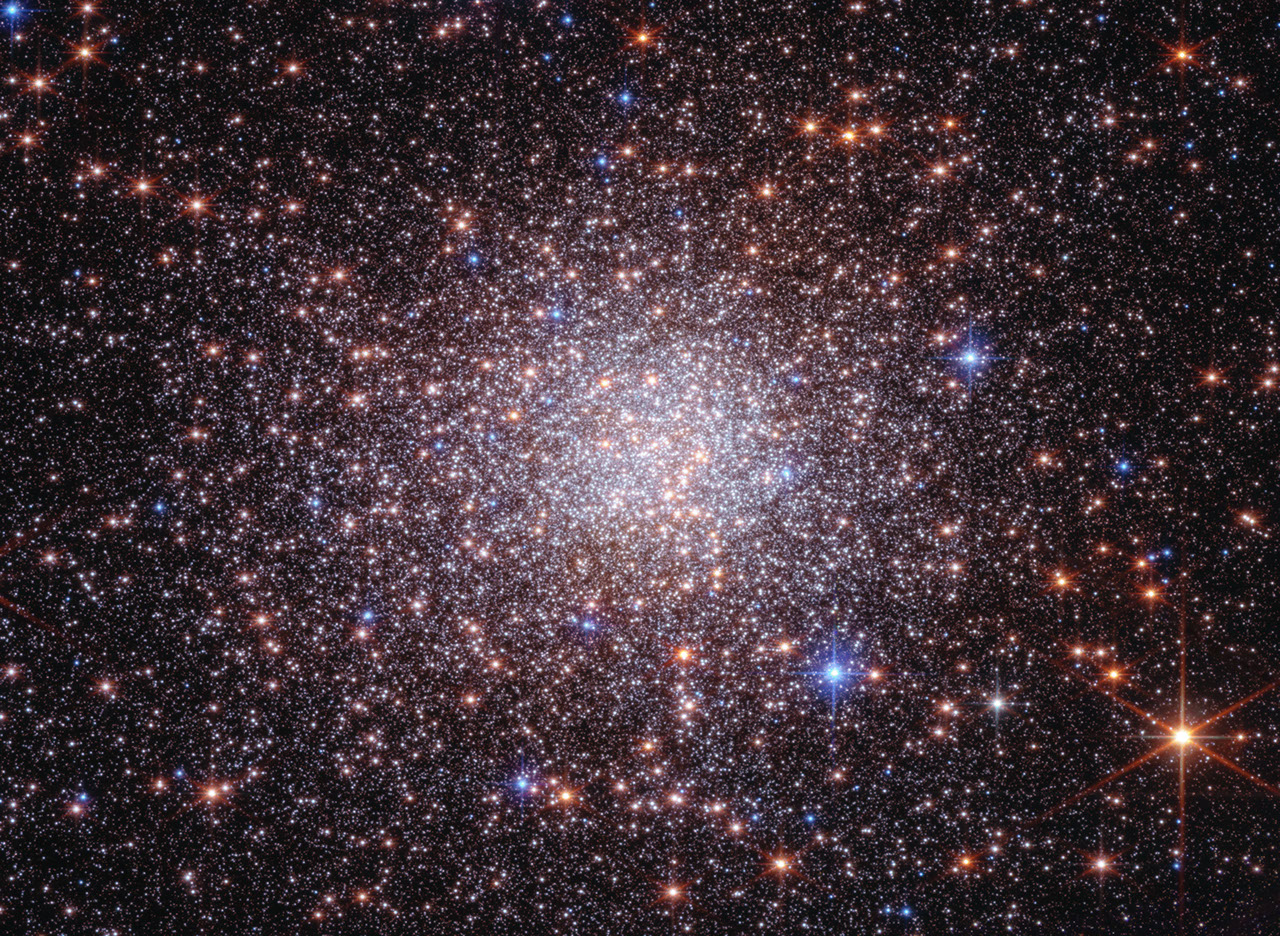
NASA’s powerful observatories, the James Webb Space Telescope and the Hubble Space Telescope, have fundamentally reshaped our understanding of Terzan 5, a unique system within the Milky Way. Originally classified as a globular star cluster, Terzan 5 now reveals itself as a complex and self-enriching stellar system with up to four distinct star populations. This discovery invites new conversations about how galaxies, particularly our own, form and evolve over time.
Globular clusters typically host a single, ancient population of stars. In contrast, findings from Webb and Hubble indicate that Terzan 5 harbors multiple generations of stars, challenging prior assumptions. Researchers concluded that its star populations include one group that formed approximately 12.5 billion years ago, alongside younger generations that appeared as recently as 2.5 billion years ago. The ability of Terzan 5 to retain its stellar identity amid the densely packed environment of the Milky Way’s central bulge is akin to a lump in a perfectly mixed batter. This anomaly provides a fossil record of stellar evolution, suggesting that Terzan 5 is a remnant of a much larger system that escaped complete merger with the surrounding stars.
The complexity of this region makes studying Terzan 5 challenging. Webb’s near-infrared observations allowed scientists to see through dense dust and identify many more stars than was previously possible. Meanwhile, Hubble’s long-term monitoring enabled the team to measure small movements of stars, a key factor in distinguishing Terzan 5’s stars from those of the Milky Way bulge. Combining the strengths of both telescopes has revealed a much richer history, showcasing Terzan 5’s role as a bulge fossil fragment and its multiple stellar generations.
Implications for Galactic Formation
The implications of this research extend well beyond Terzan 5 itself. The findings offer insights into how the bulges of galaxies like the Milky Way formed over billions of years. Astronomers now believe that early galaxies hosted large disks of gas that fragmented into clumps, forming stars that later migrated to central galactic regions. Terzan 5 serves as a contemporary example of this process, potentially providing vital evidence for how these bulges formed in galaxies across the universe.
Future research aims to examine other clusters surrounding the Milky Way’s bulge. By studying 40 to 50 additional globular clusters, scientists hope to determine whether they too possess multiple age populations. Such findings could lead to a better understanding of the diversity of galactic structures and the processes that shaped them.
Both the James Webb and Hubble Space Telescopes continue to redefine our understanding of the cosmos. Webb is revolutionizing the way we explore distant worlds and the origins of our universe, while Hubble’s decades-long legacy remains fundamental to astronomical research. Taken together, their combined efforts hold the promise of further unlocking the secrets of stellar formation and evolution, illuminating the dark corners of our cosmic history.
Discover More Technology Insights
Explore the future of technology with our detailed insights on Artificial Intelligence.
Explore past and present digital transformations on the Internet Archive.
Space
