
Close Menu
    Facebook X (Twitter) Instagram
    Thursday, May 28
    Top Stories:
    • New Species Alert: Tiny ‘Sesame’ Sea Slug Discovered in Taiwan!
    • Peking University Launches 3D Design Tool to Boost Huawei Chips
    • Hidden switch unlocks nutrient’s power to energize cells
    Facebook X (Twitter) Instagram Pinterest Vimeo
    IO Tribune
    • Home
    • AI
    • Tech
      • Gadgets
      • Fashion Tech
    • Crypto
    • Smart Cities
      • IOT
    • Science
      • Space
      • Quantum
    • OPED
    IO Tribune
    Home » Explore the Future: Indoor Testing at NASA’s Unmanned Autonomy Hub
    Space

    Explore the Future: Indoor Testing at NASA’s Unmanned Autonomy Hub

    Staff ReporterBy Staff ReporterApril 9, 2026No Comments2 Mins Read
    Share Facebook Twitter Pinterest LinkedIn Tumblr Reddit Telegram Email
    Share
    Facebook Twitter LinkedIn Pinterest Email

    Quick Takeaways

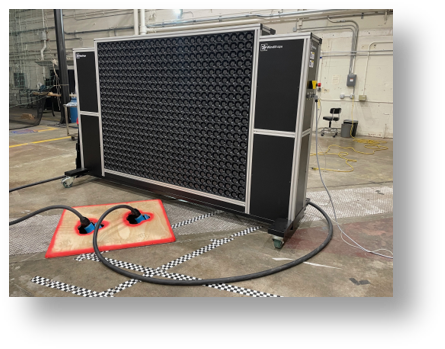
    1. Large Fan Array: The WindShaper features a 9’x7’ array of 1,134 fans arranged into 567 “wind pixels” for dynamic low-speed and hovering flight research.

    2. Wind Speed Capabilities: It generates wind speeds ranging from 0 to 16 m/s (0 to 36 mph/31 kts), with acceleration of 4 m/s² and deceleration of 2.5 m/s².

    3. Programmable Control: Each fan can be programmed individually using a simple Python API, enabling precise replication of steady winds, gusts, and wind gradients.

    4. WindProbe Integration: A companion WindProbe, utilizing an OptiTrack motion capture system, enables quick flow surveys by measuring the position and orientation of a 5-hole cone probe.

    NASA Unmanned Autonomy Research Complex Unveils Advanced Indoor Testing Facilities

    The NASA Unmanned Autonomy Research Complex (NUARC) recently launched a state-of-the-art indoor testing facility. This facility boasts a large WindShaper fan array designed for innovative flight research. With a size of 9 feet by 7 feet, it features 1,134 fans organized as 567 “wind pixels.”

    Researchers can utilize the WindShaper to create dynamic low-speed and hovering flight conditions. This capability is vital for testing unmanned aerial vehicles and exploring new autonomous technologies. Additionally, the WindShaper generates arbitrary wind gradients and gusts, enhancing the realism of flight simulations.

    For efficient flow analysis, the facility offers a companion tool called the WindProbe. This device leverages the lab’s OptiTrack motion capture system to assess airflow around test objects. By quickly locating the position and orientation of a 5-hole cone probe, the WindProbe provides vital data for researchers.

    The WindShaper enables wind speeds ranging from 0 to 16 meters per second, equivalent to 0 to 36 mph. It also facilitates acceleration and deceleration rates that mimic real-world conditions. Programmable through a simple Python API, each fan can operate independently to replicate steady winds, gusts, and various wind gradients.

    This facility represents a significant leap forward in technology development. The ability to mimic challenging environmental conditions will support advancements in unmanned systems. Moreover, these innovations promise to enhance safety and efficiency in industries from agriculture to emergency response. By ensuring reliable testing, NASA empowers engineers and researchers to push the boundaries of what’s possible in autonomous flight.

    Expand Your Tech Knowledge

    Explore the future of technology with our detailed insights on Artificial Intelligence.

    Stay inspired by the vast knowledge available on Wikipedia.

    SciV1

    Aeronautics Cosmos NASA Space VT1
    Share. Facebook Twitter Pinterest LinkedIn Tumblr Email
    Previous ArticleThick as Thieves: Get Ready to Steal the Show on PC May 20!
    Next Article Bitcoin Glitch Costs Millions as Bithumb Suits Holdout Users
    Avatar photo
    Staff Reporter
    • Website

    John Marcelli is a staff writer for IO Tribune, with a passion for exploring and writing about the ever-evolving world of technology. From emerging trends to in-depth reviews of the latest gadgets, John stays at the forefront of innovation, delivering engaging content that informs and inspires readers. When he's not writing, he enjoys experimenting with new tech tools and diving into the digital landscape.

    Related Posts

    Gadgets

    Samsung Tests Galaxy Watch 8 to Combat Muscle Loss

    May 28, 2026
    Crypto

    Ethereum Gives, Not Takes: Hoffman’s ETH Exit

    May 28, 2026
    Space

    Navigating Two Decades of Cosmic Connectivity

    May 28, 2026
    Add A Comment

    Comments are closed.

    Must Read

    Samsung Tests Galaxy Watch 8 to Combat Muscle Loss

    May 28, 2026

    Ethereum Gives, Not Takes: Hoffman’s ETH Exit

    May 28, 2026

    Navigating Two Decades of Cosmic Connectivity

    May 28, 2026

    Meteor Interrupts Volcanic Eruption in Stunning Video

    May 28, 2026

    Will AI End Your Career? Take the Quiz!

    May 28, 2026
    Categories
    • AI
    • Crypto
    • Fashion Tech
    • Gadgets
    • IOT
    • OPED
    • Quantum
    • Science
    • Smart Cities
    • Space
    • Tech
    • Technology
    Most Popular

    Streaming Giants Eye Warner Bros: A Potential Game-Changer

    October 23, 2025

    Revolutionizing Vision: Cameras Unveil Earth’s Hidden Perspective

    May 3, 2026

    Digital Asset Treasuries Hit $135B, But VanEck Warns of Risks

    October 6, 2025
    Our Picks

    Affordable E-Reader: Frustration and Untapped Potential

    February 1, 2026

    Bitcoin’s Robust Fundamentals Eclipse Short-Term Drops

    October 30, 2025

    Decades of Discovery: NASA’s Cosmic Connection from Canberra

    April 13, 2025
    Categories
    • AI
    • Crypto
    • Fashion Tech
    • Gadgets
    • IOT
    • OPED
    • Quantum
    • Science
    • Smart Cities
    • Space
    • Tech
    • Technology
    • Privacy Policy
    • Disclaimer
    • Terms and Conditions
    • About Us
    • Contact us
    Copyright © 2025 Iotribune.comAll Rights Reserved.

    Type above and press Enter to search. Press Esc to cancel.