

Quick Takeaways
-
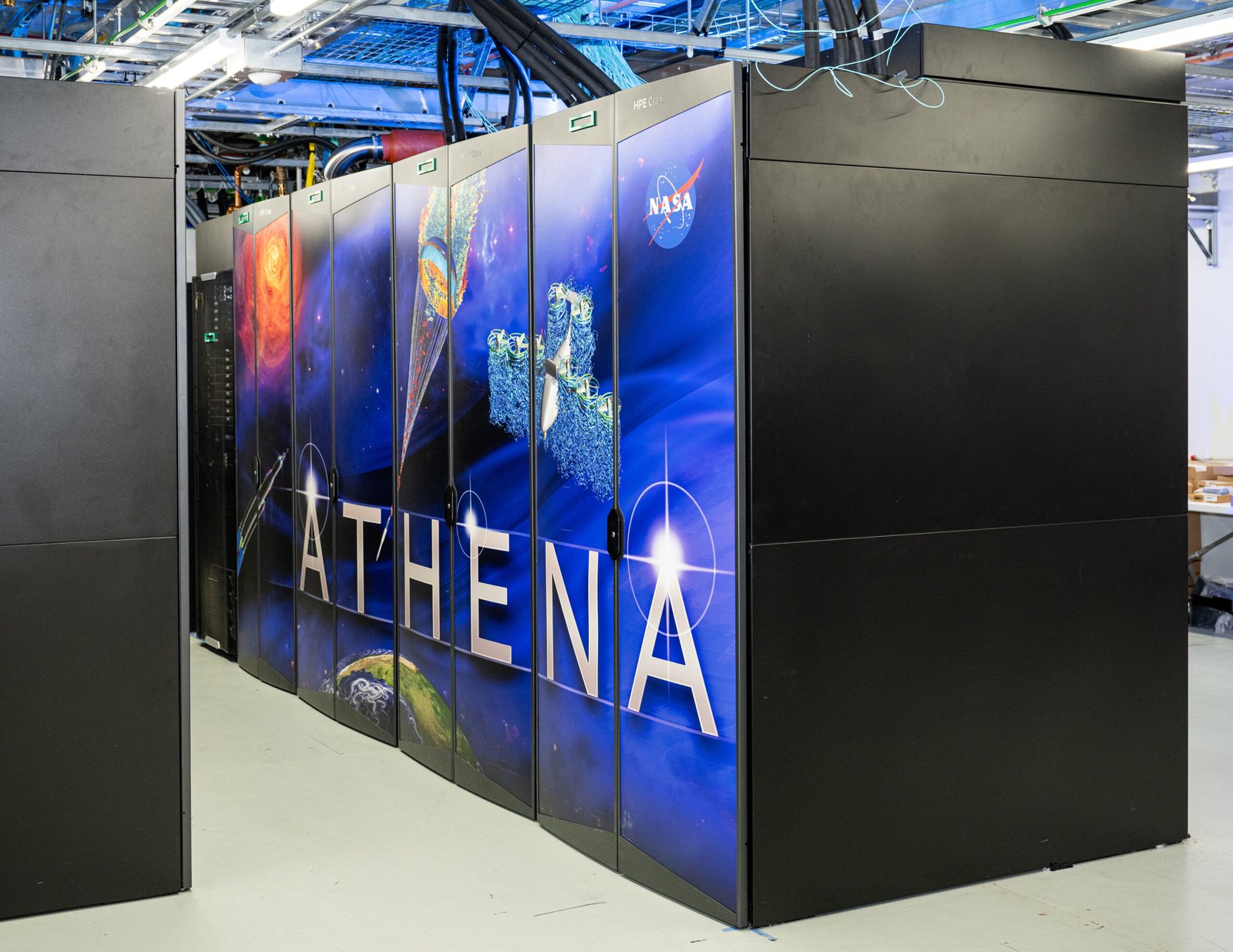
Introduction of Athena: NASA’s new supercomputer, Athena, enhances computing power for missions and research, supporting complex challenges in space, aeronautics, and science.
-
Peak Performance: Athena offers over 20 petaflops of peak performance, surpassing previous systems like Aitken and Pleiades, while reducing operational costs.
-
Critical Applications: The supercomputer aids in simulating rocket launches, designing advanced aircraft, and training AI models, accessible to both NASA and external researchers.
-
Future Expansion: As NASA invests in supercomputing, Athena represents a step toward meeting increasingly complex mission demands, laying the groundwork for future discoveries.
NASA has launched its newest supercomputer, Athena. This powerful system aims to support a new generation of missions and research projects. It is part of NASA’s High-End Computing Capability project, designed to enhance resources for tackling complex challenges in space and science.
Athena resides in the Modular Supercomputing Facility at NASA’s Ames Research Center in Silicon Valley, California. Notably, it outperforms its predecessors, Aitken and Pleiades, in both power and efficiency. The supercomputer boasts over 20 petaflops of peak performance, meaning it can make over 20 quadrillion calculations per second. Importantly, it also reduces NASA’s supercomputing utility costs.
“Exploration has always driven NASA to the edge of what’s computationally possible,” stated Kevin Murphy, chief science data officer at NASA Headquarters. With Athena, NASA can provide tailored computing resources that meet the evolving needs of its missions.
Supercomputers like Athena are crucial for NASA. They simulate rocket launches, design next-generation aircraft, and train large-scale AI models. This capability helps analyze vast datasets to uncover new scientific insights. Researchers, both within NASA and outside, can apply for time on the supercomputer.
The name Athena comes from a contest held in March 2025 among NASA’s workforce. It refers to the Greek goddess of wisdom and warfare, highlighting a tie to the agency’s Artemis program.
Moreover, NASA’s Office of the Chief Science Data Officer manages Athena. The High-End Computing Capability portfolio supports a flexible approach that combines supercomputers with commercial cloud platforms. This flexibility allows teams to choose effective computing environments for their research.
As NASA invests in advanced supercomputing, its capabilities will continue to grow. The agency recognizes that as exploration extends further into the universe, quick, efficient, and intelligent computing will become increasingly vital. With Athena, NASA is establishing a digital foundation for future discoveries.
For more information on high-end computing at NASA, visit their website.
Expand Your Tech Knowledge
Learn how the Internet of Things (IoT) is transforming everyday life.
Stay inspired by the vast knowledge available on Wikipedia.
SciV1
