

Fast Facts
-
Milestone Achieved: NASA’s Nancy Grace Roman Space Telescope has successfully completed vibration testing, simulating launch conditions and proving it can withstand extreme shaking.
-
Testing Process: The team conducted complex vibration tests that mimic conditions during launch, gradually increasing forces to 125% of expected levels.
-
Assembly Progress: The telescope’s core and outer portion are nearing completion, with plans to connect both assemblies by November 2023 and finalize construction by the end of the year.
- Launch Timeline: Roman is on track for launch potentially as early as fall 2026, with final tests planned to ensure operational readiness for deep space exploration.
Core Components for NASA’s Roman Space Telescope Pass Major Shake Test
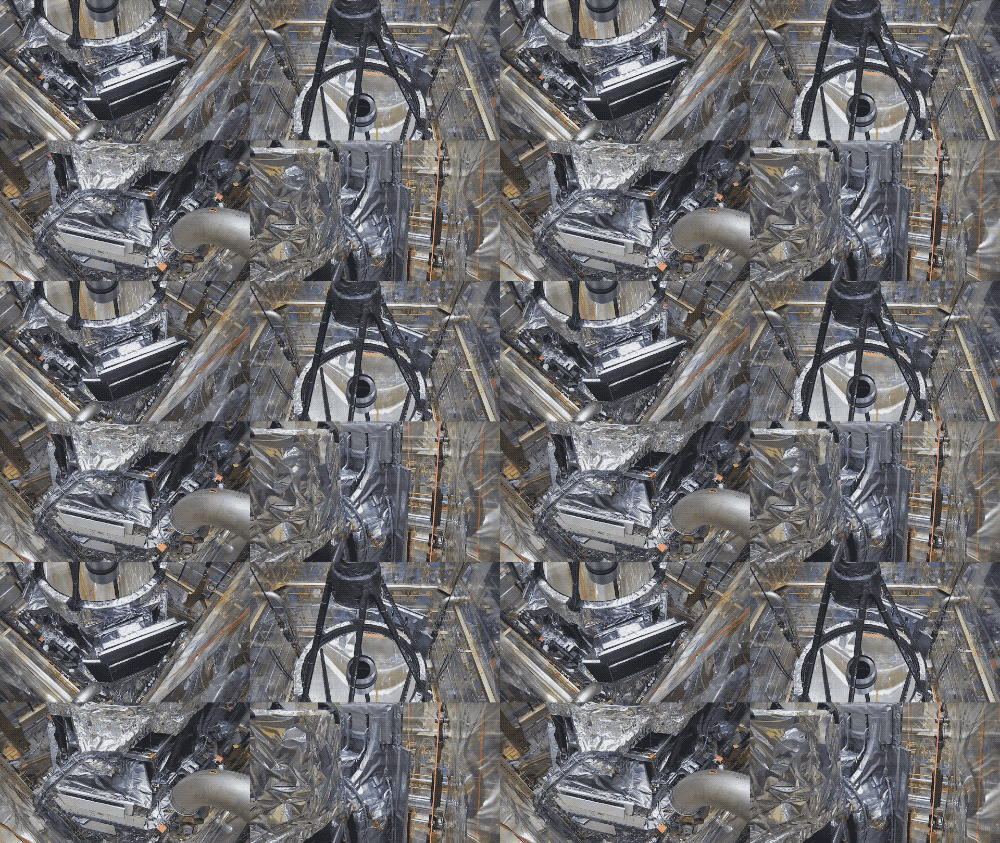
The core portion of NASA’s Nancy Grace Roman Space Telescope has successfully completed vibration testing. This achievement ensures it can endure the severe shaking from launch. Passing this crucial milestone brings the telescope closer to solving key questions about dark energy and other cosmic mysteries.
Experts liken the test to the intensity of a strong earthquake. However, the procedure differs significantly. Cory Powell, a lead structural analyst at NASA’s Goddard Space Flight Center, explained the process: “We sweep through our frequencies one at a time, starting with very low amplitudes and gradually increasing them.”
For this test, NASA simulated launch conditions as accurately as possible. “We filled the propulsion tanks with about 295 gallons of deionized water to mimic propellant loading during launch,” said Joel Proebstle, the test’s leader. This testing series pushed the components to experience forces 125 percent greater than expected during launch.
This milestone is part of a broader assessment phase for the nearly complete Roman Space Telescope. Currently, it consists of two primary assemblies: the inner core (which includes the telescope, instrument carrier, and spacecraft) and the outer structure (which features the outer barrel assembly and solar array sun shield).
After passing the vibration tests, the core components will return to the clean room at Goddard for thorough inspections. Technicians will verify proper alignment and ensure that the high-gain antenna can deploy correctly. Following this, they will conduct further electronics tests and a thermal vacuum assessment to confirm performance in space’s harsh environment.
Simultaneously, technicians are advancing work on the telescope’s outer portion. They recently installed the test solar array sun shield and verified its temperature control capabilities during a thermal vacuum test. As they continue to install the flight solar panels, the team remains on track to connect both major parts in November. This assembly will result in a fully operational observatory by year-end, poised for final testing.
The Nancy Grace Roman Space Telescope is set to launch by May 2027, with hopes for an earlier launch as soon as fall 2026. This innovative project illustrates the strides made in technology development that aim to deepen our understanding of the universe. With contributions from various NASA centers and industry partners, the endeavor embodies collaboration that can lead to significant advancements in both science and technology.
Continue Your Tech Journey
Explore the future of technology with our detailed insights on Artificial Intelligence.
Access comprehensive resources on technology by visiting Wikipedia.
SciV1
