

Essential Insights
- NGC 206 lies within the dusty arms of neighboring Andromeda galaxy.
- Andromeda, also called M31, is approximately 2.5 million light-years away.
- Bright blue stars show NGC 206 is young, under ten million years.
- It spans about 4,000 light-years, matching giant stellar nurseries elsewhere.
APOD: 2026 November 13 – NGC 206 and the Star Clouds of Andromeda
A young association in a nearby galaxy
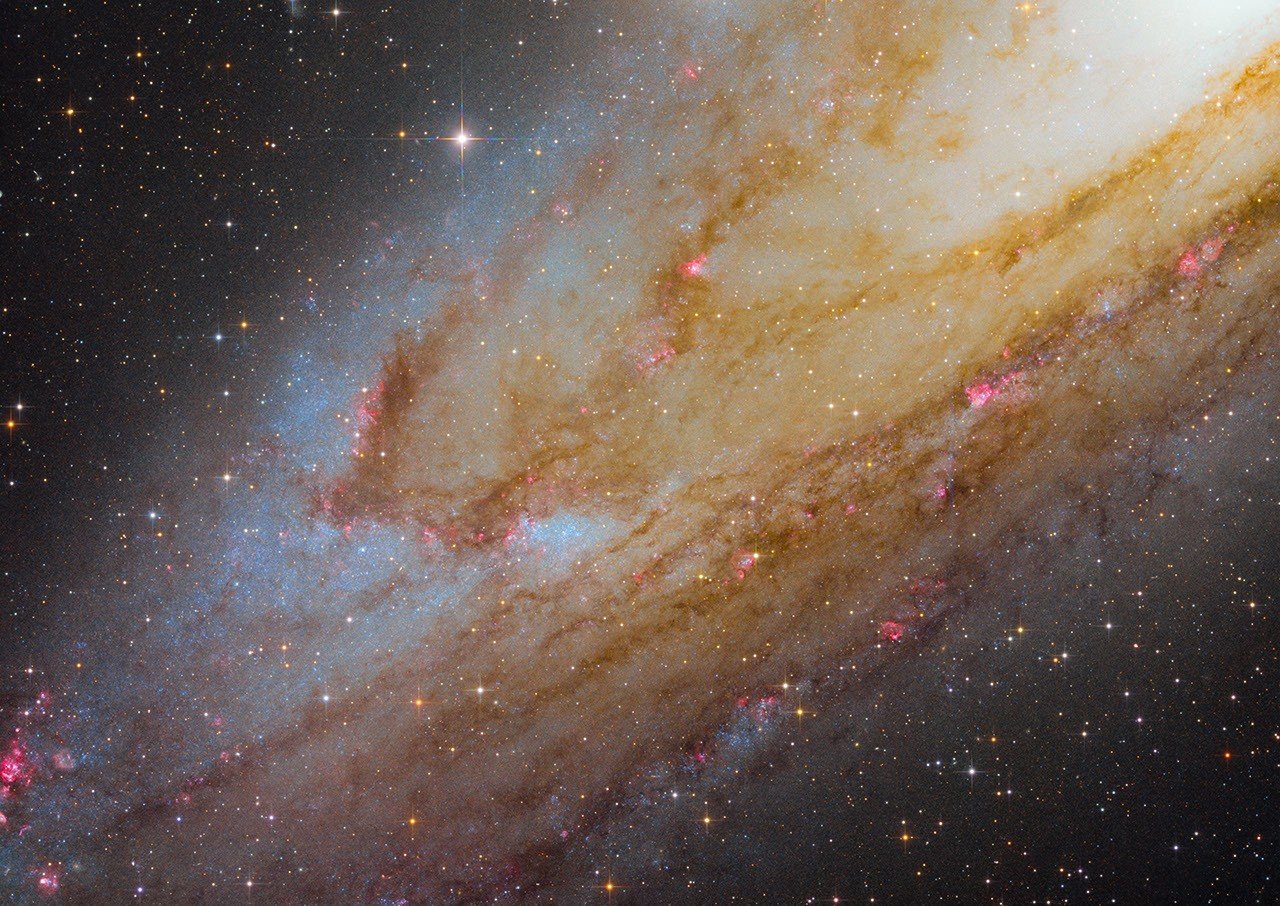
NGC 206 shines amid the dusty spiral arms of Andromeda, also known as M31. The galaxy lies about 2.5 million light-years from Earth. In this detailed view of its southwestern disk, NGC 206 stands out against clouds of stars and pinkish regions where new stars are forming.
The association’s bright blue stars reveal its youth. Its youngest massive stars are less than 10 million years old. NGC 206 is not a compact cluster like many familiar groups of young stars in the Milky Way. It stretches roughly 4,000 light-years across, making it a vast stellar association embedded in its galaxy’s disk.
Reading the structure of a star cloud
That scale puts NGC 206 alongside some of the largest stellar nurseries nearby. It is comparable in size to NGC 604 in the spiral galaxy M33 and the Tarantula Nebula in the Large Magellanic Cloud. These regions offer astronomers a view of star formation on a grand scale: young, massive stars set within broad stretches of gas, dust and neighboring stars.
Sharp images help reveal how those components are arranged, but the picture is more than a technical display. Its detail makes a faraway galaxy’s structure easier to see, while the immense distance remains a reminder of the limits of any single view. NGC 206 is a distinct bright feature, yet it belongs to the much larger system of Andromeda’s spiral arms and star-forming regions.
Tomorrow’s picture: pixels on the Moon.
Discover More Technology Insights
Learn how the Internet of Things (IoT) is transforming everyday life.
Access comprehensive resources on technology by visiting Wikipedia.
Space
