

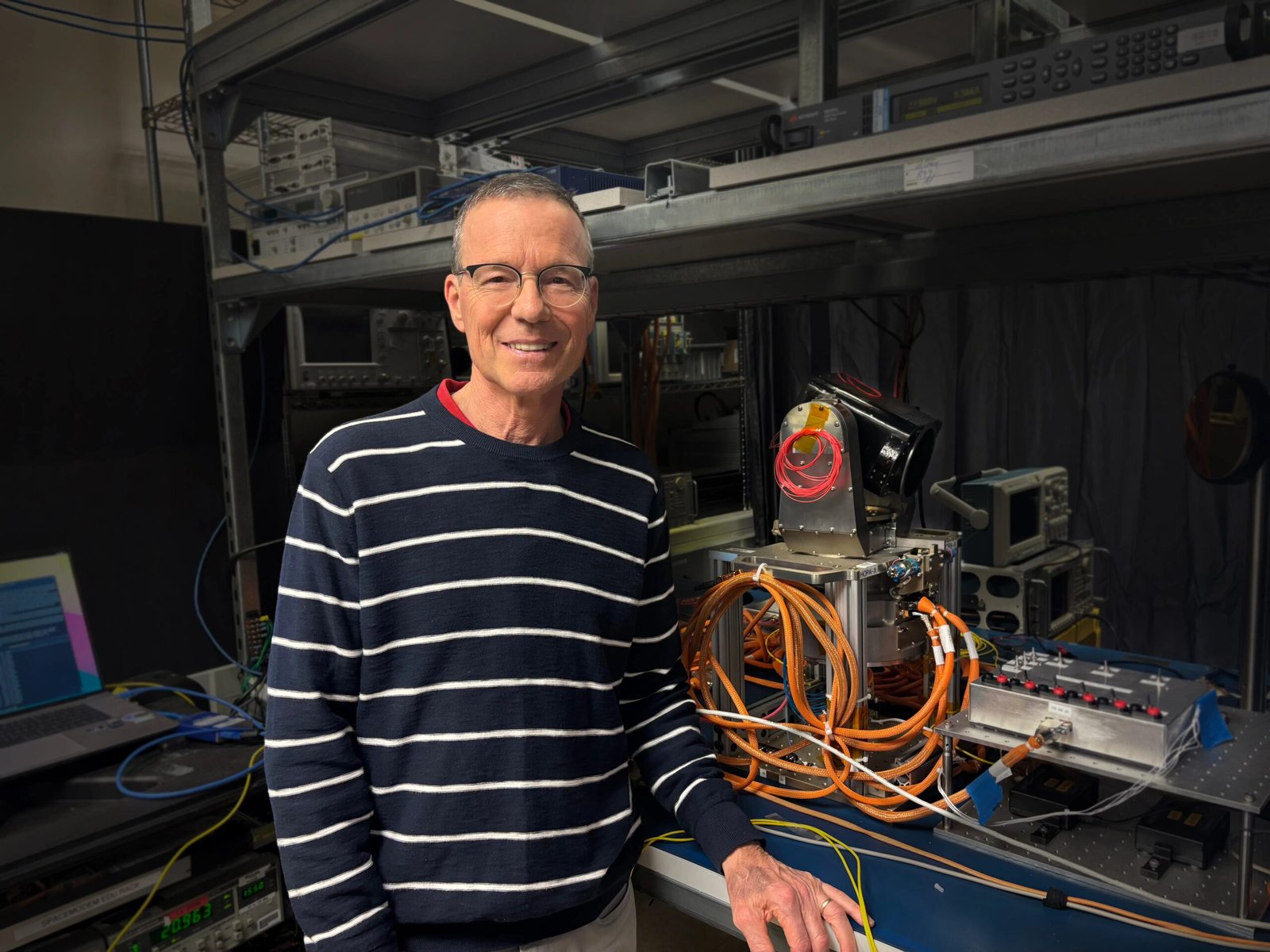
Top Highlights
-
Childhood Inspiration: Peter Rossoni’s journey to NASA began as a child watching Apollo missions, ultimately leading him to become the flight manager for the Orion Artemis II Optical Communications System.
-
Revolutionary Technology: Orion’s laser communications system, utilized for the first time in a crewed deep space mission, transferred over 450 gigabytes of data to Earth, enhancing communication capabilities significantly.
-
High-Performance Data Transfer: The system achieved downlink speeds up to 260 megabits per second, allowing for the rapid transmission of high-definition content, crucial for astronaut support and exploration safety.
-
Collaborative Success: Rossoni emphasized the importance of merging traditional communication methods with advanced laser systems, ensuring robust connectivity for mission success in the demanding deep space environment.
NASA’s Artemis II Mission: A Leap Forward in Space Communication
NASA’s Artemis II mission marks a new era in space exploration. In April 2026, the mission sent astronauts on a journey around the Moon. At the forefront of this initiative was Peter Rossoni. As the flight manager for the Orion Artemis II Optical Communications System, he played a crucial role in enhancing communications.
As a child, Rossoni watched the Apollo missions with awe. His fascination with space and science paved his path to NASA. Today, he oversees a groundbreaking laser communications system that connects astronauts to Mission Control on Earth.
The Artemis II mission featured an optical terminal aboard the Orion spacecraft. This system broadcasted vital information, including video and data, back to Earth. In total, it transmitted over 450 gigabytes of data—equivalent to about 100 high-definition movies. This capability enhances how astronauts communicate and share findings during deep space missions.
Throughout the roughly 10-day mission, Rossoni collaborated with a dedicated mission control team. He ensured seamless data flow from the optical system to the Johnson Space Center in Houston. He stated, “Communications is an important pillar of exploration.” This technology provides a reliable link back to Earth, crucial for long-duration space travel.
Laser communications use infrared light to transfer vast amounts of data quickly. With speeds reaching 260 megabits per second, the system could send a full-length 4K movie from the Moon to Earth in just one minute. Rossoni expressed his excitement, saying, “High-performance communications is a key element of exploration infrastructure.”
Implementing the optical system alongside traditional radio communication was challenging. However, the team found innovative solutions that allowed both systems to work in harmony. This development increased the communication capacity by up to 100 times, improving the connection between astronauts and their support teams.
Extensive testing preceded the launch. Rossoni and his team conducted simulations to ensure operational readiness. They confirmed that the system would function smoothly during the mission. As the optical communications system activated successfully, Rossoni experienced a deep sense of fulfillment. He remarked, “It kept growing as the mission progressed, with more and more objectives achieved.”
NASA’s Artemis II mission showcases how advancements in communication technologies will shape the future of space exploration. With improvements in data transmission and increased safety, the mission represents a significant step toward more complex and extended human activities beyond Earth.
Expand Your Tech Knowledge
Learn how the Internet of Things (IoT) is transforming everyday life.
Explore past and present digital transformations on the Internet Archive.
SciV1
