

Fast Facts
-
Revolutionary AI Development: Generalist AI’s Gen-1 model significantly enhances robotic capabilities, enabling tasks like folding laundry and repairing devices, marking a crucial leap toward practical household robots.
-
Versatile Robotics Platform: Gen-1 serves as a universal brain for various robotic systems, not limited to just humanoid forms, promising wide applicability across industries.
-
Data-Driven Learning: Unlike previous models, Gen-1 was trained using real human interaction data, providing robots with enhanced physical common sense and adaptability in dynamic environments.
-
Impressive Success Rates: The model has shown remarkable improvement in task completion rates—99% success in servicing vacuum cleaners and assembling boxes—along with the ability to improvise, setting a new standard in robotics.
Robots Learn to Stuff Cash with Precision
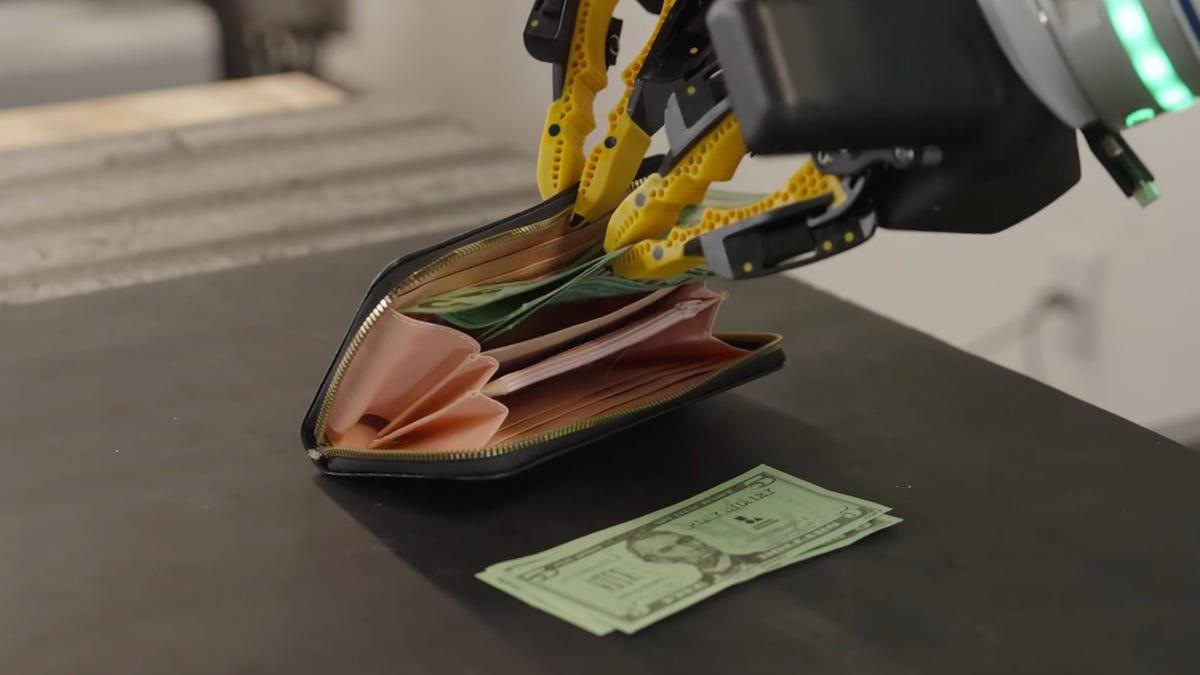
In 2026, robots are advancing rapidly. Improved dexterity marks a significant leap forward in creating useful household helpers. Recently, California-based Generalist AI launched Gen-1, an AI model that enables robots to perform diverse tasks. These include folding laundry, stacking boxes, and, notably, stuffing cash into wallets.
Generalist AI’s co-founder, Pete Florence, shared insights into the technology’s evolution. “Gen-1 is designed to be the brain of any robot,” he explained. It can operate on various robotic platforms, including humanoids and industrial arms. This flexibility highlights its broader potential.
Boston Dynamics and Honor have also unveiled robots that mimic human movements closely. Experts predict the market for robots could reach $5 trillion by 2050. This growth will occur across industries like retail, hospitality, and healthcare, eventually moving into our homes.
Training robots involves more than just basic commands. Successful robots must navigate a human-designed world intuitively. Traditional models depended on teleoperated data, but Gen-1 uses a novel approach. The team developed “data hands,” which gather real-time feedback on human interactions with objects.
Florence elaborated on this technique. “We captured the nuances of human dexterity,” he said. This data equips robots with a physical understanding, allowing them to adapt during tasks.
Videos from Generalist AI showcase Gen-1’s abilities. In one instance, a robot retrieves cash from a wallet and puts it back—a challenge that often frustrates humans. Despite the paper’s flimsiness, the robot manages remarkably well. Other tasks include sorting and folding socks, filling a pencil case, and assembling oranges in a pyramid shape.
Gen-1’s success rate impressively exceeds its predecessor. It achieves a 99% success rate in servicing robot vacuum cleaners, compared to 50% previously. Also, box folding and phone packaging present similar success improvements.
Notably, robots usually follow rigid task instructions. However, Gen-1 introduces a level of improvisation unheard of in earlier models. For instance, a robot might use its two hands to adjust an awkwardly placed part, even if it has only trained with one.
This adaptability is crucial for a robot’s reliability. “We’re witnessing significant progress,” Florence stated. Researchers are optimistic about the future. As robots become more versatile, everyday tasks may soon become easier and more efficient. The dream of having a truly helpful household robot inches closer to reality.
Continue Your Tech Journey
Stay informed on the revolutionary breakthroughs in Quantum Computing research.
Explore past and present digital transformations on the Internet Archive.
FashionTechV1
