

Fast Facts
-
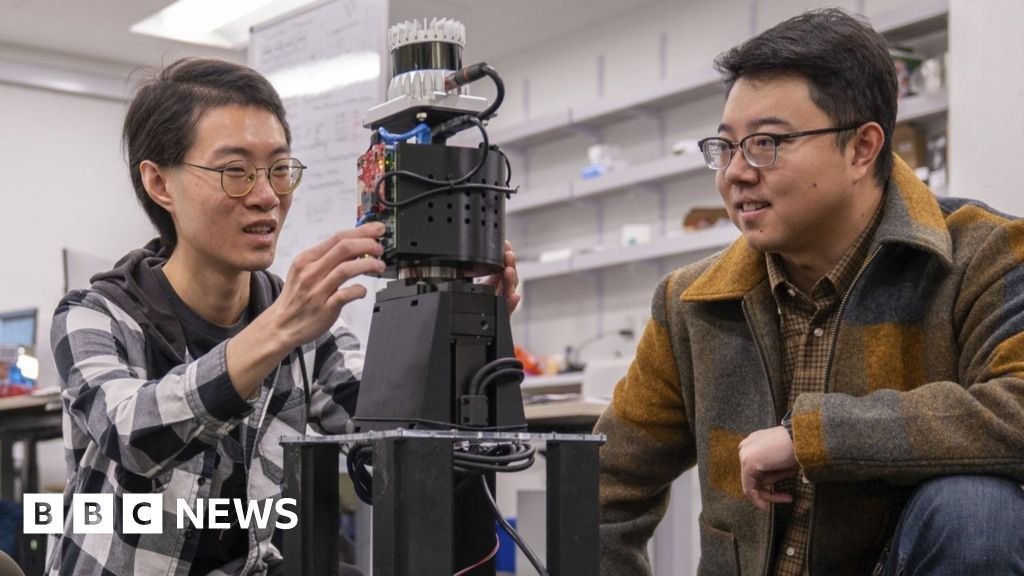
Innovative Radio Vision Technology: Prof. Mingmin Zhao and his team at the University of Pennsylvania are developing a pioneering robot vision system that uses radio waves to enable robots to "see" through smoke, rain, and around corners, significantly enhancing visibility in challenging environments.
-
AI-Driven 3D Imaging: The robot utilizes an onboard AI to create a 3D view of its surroundings by analyzing reflections of radio waves, aiming to achieve superhuman vision capabilities that surpass traditional optical sensors.
-
Versatile Applications: Beyond search-and-rescue missions, the technology has potential military and security applications, such as detecting concealed weapons and monitoring sensitive areas, prompting discussions around its implications for privacy and safety.
- Evolving Methods: Alternatives to the spinning array method include continuous sensing algorithms likened to echolocation, indicating a trend towards more efficient and comprehensive radio-based imaging systems in robotics and autonomous vehicles.
Seeing Beyond the Smoke: The Future of Radio Vision Technology
Recent advances in radio wave technology offer exciting possibilities for robotics and autonomous vehicles. Scientists at the University of Pennsylvania have developed innovative systems that allow robots to see through challenging conditions, such as smoke and rain. With these advancements, a robot might navigate a fire or locate a person trapped in rubble with greater efficiency.
Professor Mingmin Zhao leads this remarkable research. He envisions a future where robots gain "superhuman vision." This system employs radio waves to create three-dimensional maps of surroundings. Unlike traditional sensors, radio waves easily penetrate smoke because they are longer in wavelength than visible light. This capability allows robots to operate in scenarios where human vision or standard cameras fail.
The team’s experiment did not go as smoothly as planned. A smoke machine triggered a fire alarm, creating a humorous but minor setback. Yet, this incident highlighted an important truth: innovation often encounters unexpected challenges. The team continued to refine their technology, demonstrating perseverance and creativity.
Moreover, these robots do not only rely on passive imaging. They utilize artificial intelligence to process incoming data, tailoring the information into actionable insights. This combination of AI and radio waves can detect concealed weapons and even recognize changes in a room over time. For instance, if an object were moved, the robot could recognize this change based on its previous data.
Radio vision technologies present significant opportunities beyond emergency services. Military applications are already emerging, with some forms capable of detecting movements through walls and doors. However, ethical considerations are paramount. As technologies advance, understanding the balance between security and privacy becomes increasingly crucial.
While the potential for misuse exists, the promise of beneficial applications is profound. Search-and-rescue missions, disaster response, and law enforcement could all benefit from enhanced robotic vision. Additionally, new companies, like Wavsens, are innovating by developing algorithms that allow robots to "listen" to radio waves, creating a fuller picture without needing to spin antennas.
Furthermore, alternatives such as terahertz waves have opened new avenues for exploration, including chemical analysis and material inspection. As researchers delve deeper into the electromagnetic spectrum, they continue to unveil diverse possibilities.
With these advancements, the barriers that once limited robotic vision are falling. The capacity for machines to see beyond smoke and around corners holds incredible potential. Society must navigate the intersection of technology and ethics carefully. If harnessed wisely, these innovations can transform rescue efforts, improve safety, and lead us into a future where technology enhances human capabilities in profound ways.
Continue Your Tech Journey
Learn how the Internet of Things (IoT) is transforming everyday life.
Stay inspired by the vast knowledge available on Wikipedia.
AITecv1
