

Essential Insights
- MIT researchers developed “ski jump” photonic structures that can precisely beam light from chips into free space, enabling new applications like high-resolution displays and quantum computing.
- The structures are created from layered materials that curl upward when cooled, allowing scalable control of thousands of laser beams simultaneously.
- The technology can project detailed, full-color images at microscopic scales, promising advances in augmented reality, compact displays, and optical systems.
- Applications extend to lightweight Lidar sensors, faster 3D printing, and scalable quantum systems, with future plans to enhance system size, robustness, and integration.
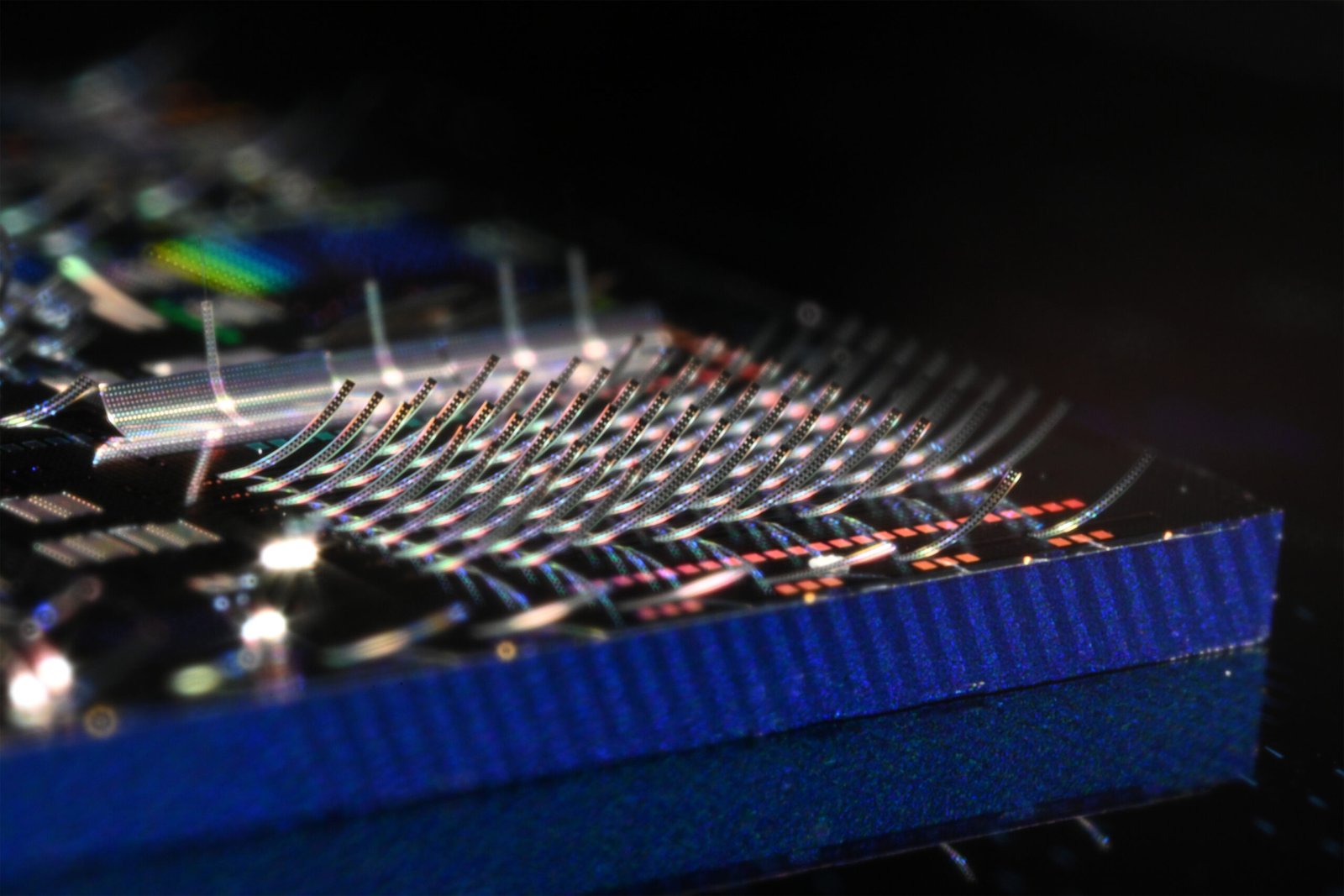
MIT researchers have developed a new photonic device that can efficiently beam light into free space. This breakthrough could significantly impact future technology. Unlike traditional chips, which keep light confined inside, this device directs thousands of tiny light beams outward.
The device features small, curved structures that resemble ski jumps. These structures are carefully engineered to control the direction and color of light. As a result, the chip can produce detailed, full-color images. In tests, the team projected images as small as half a grain of salt. This could lead to lighter, more compact displays and augmented reality glasses.
Furthermore, the device has promising applications in quantum computing. It can control many quantum bits, or qubits, at once. This capability might improve the speed and scale of quantum computers in the future.
The innovation came from a new fabrication method. The team used two different materials that expand differently when cooled. This difference causes the structures to curl upward, forming the ski jumps. This design allows precise control over light beams.
The researchers also demonstrated how the device can paint images by adjusting the light’s color and density. Since the light beams are tiny, they can create high-resolution displays. This technology could also fit on small robots, improving sensors like Lidars. Additionally, it might speed up 3D printing processes that use lasers to build objects.
Looking ahead, the team aims to expand the system’s size and test its durability. They believe this technology might open the door to new lab-on-chip devices and micro-robots. Overall, the development showcases a major step forward in photonics, with many potential uses on the horizon.
Discover More Technology Insights
Learn how the Internet of Things (IoT) is transforming everyday life.
Discover archived knowledge and digital history on the Internet Archive.
QuantumV1
