

Fast Facts
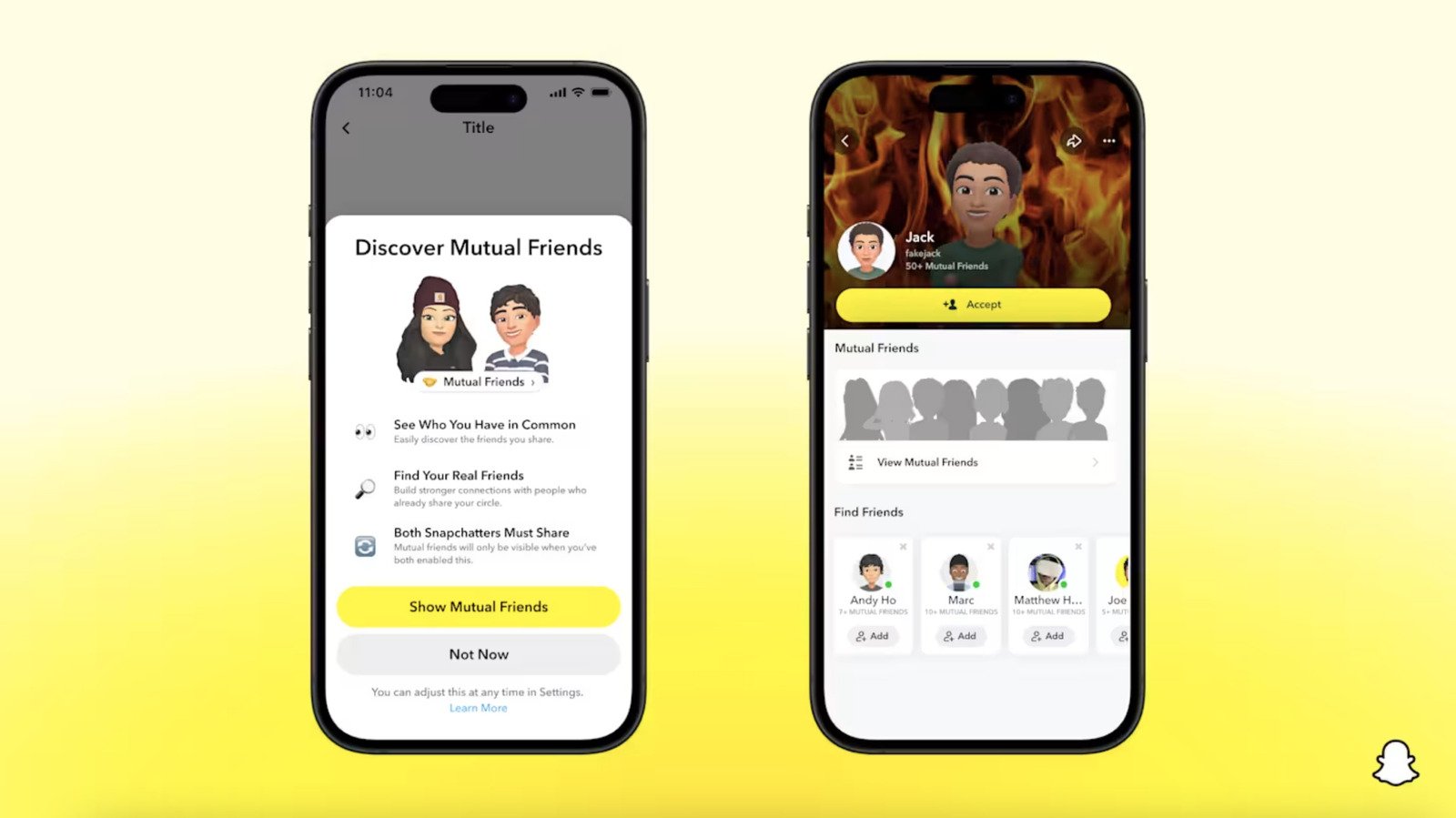
- Snapchat has launched Mutual Friends, letting users see shared connections directly on another person’s profile.
- The feature is off by default and works only when both users opt in.
- It’s available on iOS and Android in the US, Australia, France and Sweden; a wider rollout hasn’t been announced.
- The launch adds to Snapchat’s recent updates, including event-planning tools and paid storage options.
Snapchat Has Finally Made It Easy to Check an Account’s Mutual Friends
A Long-Awaited Shortcut for Social Context
Fifteen years after Snapchat launched, the app has added a feature that many users may consider overdue: Mutual Friends. It lets people see which friends they share with another account, right from that person’s profile.
The idea is simple. A new account sends you a friend request. Before you decide what to do, you can check whether anyone you know connects you to that person. A shared friend may offer useful context. No shared friends may leave you with more questions.
Still, the feature won’t make the decision for you. A short list does not prove that an account looks suspicious. And a long one does not mean you must accept a request. Instead, the list gives you one more detail to weigh alongside the profile and your own comfort level.
That small addition could make a familiar social choice feel less like guesswork. It may also help people find a middle ground between accepting every request and rejecting anyone they don’t recognize.
Privacy Depends on Both People
Snapchat displays mutual friends directly on a user’s profile, but the feature comes with an important limit: Both people must opt in. Snapchat turns the setting off by default, then invites users to enable it through a prompt.
That approach gives Snapchatters a choice. Some people want more context when they meet new contacts online. Others prefer to keep their social circles private. Requiring both accounts to enable the feature respects that difference, though it also means users may not always see shared friends.
The result feels practical, not intrusive. Mutual Friends can help people make more informed choices without automatically exposing everyone’s connections. At the same time, users should remember that a shared-friend list offers only a partial picture. It cannot confirm someone’s identity or guarantee that a connection will lead to a safe interaction.
For now, Snapchat offers Mutual Friends in the United States, Australia, France and Sweden. The feature works on both iOS and Android. Snapchat has not announced when it will reach other countries.
One Piece of a Broader Snapchat Push
Mutual Friends arrives as Snapchat adds more ways to use its app. The company has also introduced an event-planning tool and a paid storage option. Those additions point to a broader effort: Snapchat wants users to do more than send disappearing photos and messages.
That strategy appears to have found an audience. Snapchat says more than 30 million people subscribe to Snapchat+ and related plans. Paid features can give a platform new ways to grow, although they also raise a familiar question: Which tools should remain free, and which ones belong behind a subscription?
Mutual Friends addresses a more basic need. It adds context to a routine interaction, without asking users to learn a complicated system. That matters on a platform where people often decide quickly whether to welcome someone into their network.
The feature will not solve every problem that comes with online connections. But it gives users a clearer view of one useful detail, while letting them choose whether to share their own. For a social app built around quick decisions and personal boundaries, that balance makes the update a welcome one.
Stay Ahead with the Latest Tech Trends
Learn how the Internet of Things (IoT) is transforming everyday life.
Access comprehensive resources on technology by visiting Wikipedia.
CellphonesV1
