

Fast Facts
- Deep imaging reveals complex structures and a violent history in M104.
- The galaxy’s dust lane gives it the appearance of a hat.
- Extended halo with unresolved stars shows past collisions and galaxy mergers.
- Light from the Sombrero takes 30 million years to reach Earth.
APOD: 2026 October 5 – M104: The Sombrero Galaxy’s Tidal Streams
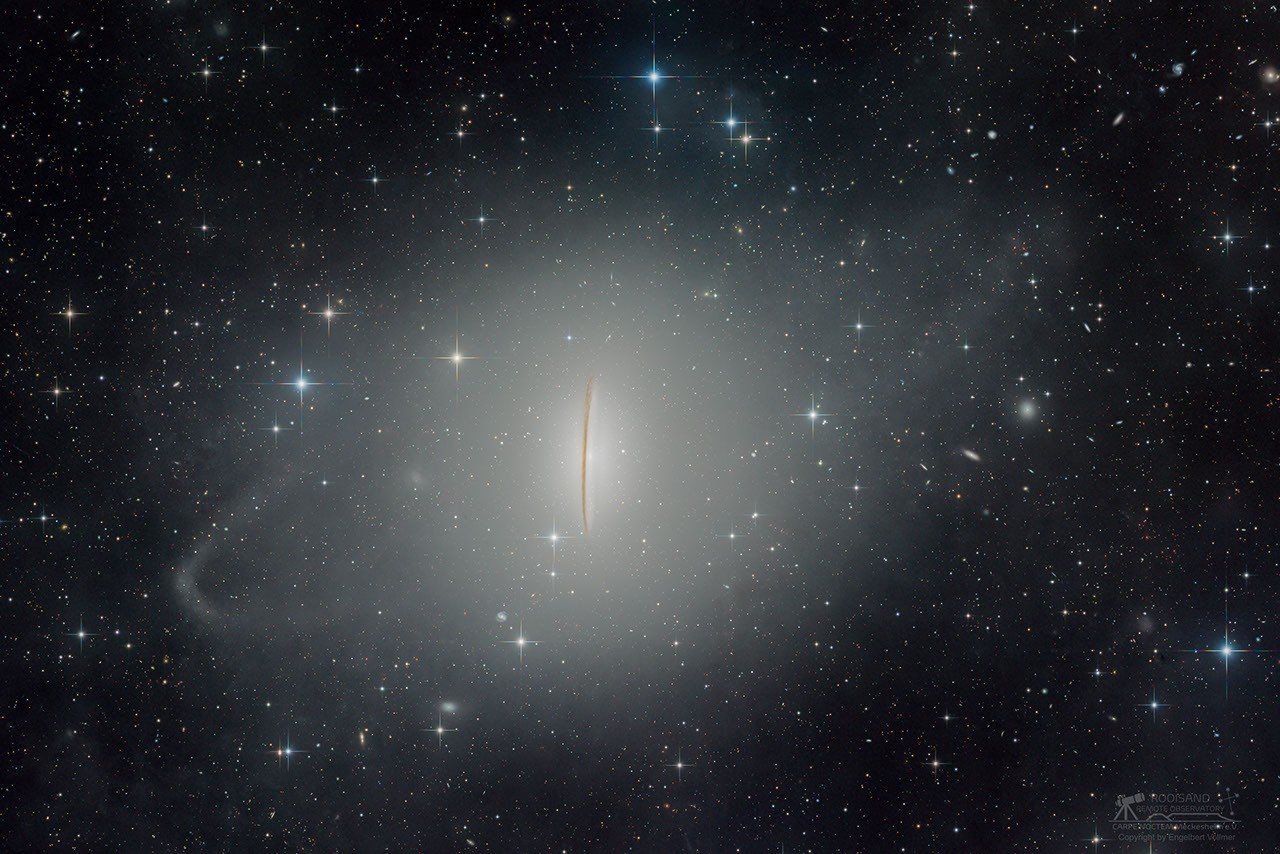
On October 5, 2026, NASA’s Astronomy Picture of the Day (APOD) showcased an incredible deep image of the Sombrero galaxy, also known as M104. This stunning shot reveals surprising details that tell a story of a galaxy with a complex past.
The Beautiful Yet Complex Features of M104
The Sombrero galaxy earned its name because of its appearance in short exposures, where it resembles a wide-brimmed hat. Its most recognizable feature is a dark band of dust that encircles the bright central region, creating a distinct “brim.” In longer exposures, the galaxy’s true complexity appears. A bright, faint halo extends far beyond the main disk, filled with countless unresolved stars. This halo shows signs of past interactions, including a diagonal ring of stars and other structures. These features suggest that M104 did not form in isolation but experienced violent events in its history. Studies indicate it likely collided or merged with smaller galaxies, shaping its current appearance. The image was taken over seven days from Namibia, capturing light that takes about 30 million years to reach Earth. The galaxy itself spans around 150,000 light-years across, making it one of the larger galaxies visible from our viewpoint.
Discoveries from the Deep Image and Cosmic Context
The deep image uncovers tidal streams—stretches of stars and matter pulled out of smaller galaxies during collisions. These streams provide strong evidence that M104 has experienced multiple mergers over billions of years. Such events are common in galaxy evolution, helping galaxies grow and change shape over time. The presence of a star-rich, hazy halo challenges earlier perceptions of the galaxy as a simple, orderly structure. Instead, it emerges as a cosmic relic shaped by chaos and collision. The image from Namibia highlights the importance of long-term observation and advanced imaging techniques in uncovering galaxy secrets. It reminds us that even a galaxy with a “hat-like” appearance has a layered history written across its dust lanes and stellar streams.
The featured image also sparks curiosity about what celestial sights appeared on your birthday, as APOD often showcases different visual wonders daily. The next day’s image promises a “smile,” suggesting another captivating view of the universe awaits observation.
Expand Your Tech Knowledge
Learn how the Internet of Things (IoT) is transforming everyday life.
Explore past and present digital transformations on the Internet Archive.
Space
