

Summary Points
Jim Green discusses planetary exploration’s history, current work, and future missions.
Robots lead missions into space’s darkest, scariest places, often before humans.
Green believes scientists may discover extraterrestrial life in the near future.
The episode also highlights Estes’ $149.99 launchable Falcon 9 model rocket.
Why robots lead the way
Robots often arrive before people when space agencies explore unfamiliar worlds. They can travel into places that are too distant, hazardous or costly for human crews. Episode 235 of This Week In Space, “Robots in Dark and Scary Places,” explores how robotic missions have shaped planetary science and what they may discover next.
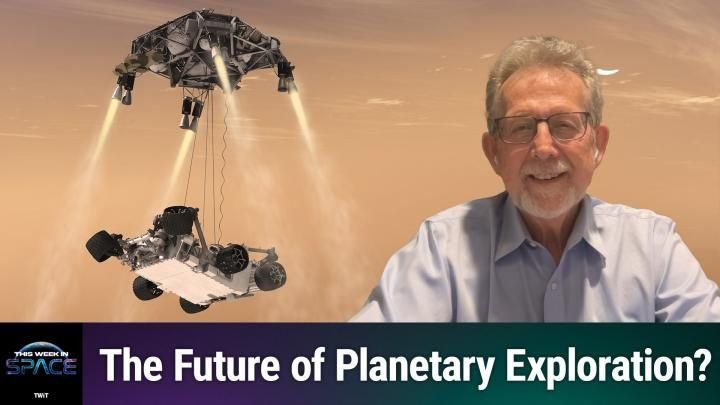
The episode features Dr. Jim Green, NASA’s former chief scientist, in a conversation about the past, present and future of planetary exploration. He has long supported NASA’s science programs and argues that life beyond Earth could be found in the near future.
That possibility gives robotic missions a clear purpose. Rovers, landers and orbiters can examine environments where signs of life might survive. They can collect measurements, photograph terrain and test materials without putting astronauts at risk. Their work can also help scientists decide which locations deserve closer study.
But sending a robot is not a simple substitute for sending a person. Spacecraft must operate across vast distances, often with limited power and intermittent communication. A machine may need to make decisions on its own when instructions from Earth take too long to arrive. It also has to withstand severe temperatures, radiation and unfamiliar terrain.
These limits shape what a mission can accomplish. Robots can gather valuable data, but they cannot perform every task with the speed and flexibility of a trained human. Building reliable systems and getting them to another world takes time and substantial investment. Mission planners must weigh those costs against the scientific value of each destination.
The discussion points to a central tension in exploration: Robots can reach places humans cannot yet visit, but their abilities remain bounded by engineering and budgets. Their strongest role may be to reduce uncertainty, map risks and prepare the way for more ambitious missions.
What comes next for planetary exploration
The search for life beyond Earth is a powerful reason to keep exploring. Still, the search requires patience and careful evidence. A promising reading or unusual sample does not, by itself, prove that life exists. Scientists need measurements they can verify and interpret in context. Robotic missions can provide that evidence, one observation at a time.
Green’s optimism offers a hopeful view of what future missions might reveal. At the same time, the episode’s focus on robotic exploration underscores how much remains unknown. Discoveries depend not only on advanced technology, but also on mission planning, funding and the ability to bring reliable instruments to challenging environments.
The episode also includes space news and a featured model rocket: Estes’ scale Falcon 9. The launchable model is listed at $149.99. Buyers can use the code IN-COLLECTSPACE at checkout for 10% off, through a promotion with collectSPACE.com.
“This Week In Space” examines the changing space age, from renewed interest in the moon to plans for exploring other planets. The show releases new episodes on Fridays and is available through TWiT. Listeners can download or subscribe at twit.tv/shows/this-week-in-space; an ad-free option is available through Club TWiT.
Episode 235 is a reminder that exploration often begins with machines built to enter the unknown. Their reach is impressive, but their limits matter, too. Each mission adds evidence, experience and a clearer view of what it may take to explore farther.
Stay Ahead with the Latest Tech Trends
Explore the future of technology with our detailed insights on Artificial Intelligence.
Explore past and present digital transformations on the Internet Archive.
Space
