

Top Highlights
- Space’s vastness challenges our understanding and game developers’ design strategies.
- Games balance realism with fun, making space exploration exciting yet manageable.
- “Elite Dangerous” uses 1:1 scale, while “X4: Foundations” compresses distances creatively.
- Developers leverage technology to simulate awe-inspiring space without overwhelming players.
Space is incomprehensibly vast. With an observable universe spanning roughly 93 billion light-years, the challenge of modeling this complexity in video games becomes clear. Even our own Milky Way galaxy extends 100,000 light-years and houses hundreds of billions of stars. Therefore, it is no surprise that space games struggle when it comes to representing the immense scale of the universe. This challenge persists even as technology advances.
The Artemis 2 mission’s Orion module reached speeds of about 25,000 mph. Even at that pace, it would take over 80,000 years to reach Alpha Centauri, the closest star to Earth. Developers face the task of capturing the awe of space while designing manageable gameplay spaces. How can they make players feel the grandeur of the universe while keeping the experience engaging?
Scaling the Universe
Astrophysicist Dr. Jeffrey Bennett emphasizes the scale issue in space games. “On a 1 to 10 billion scale—where the Sun is a grapefruit—Earth is a tiny ballpoint pen, situated roughly 15 meters from the Sun,” he explains. This scale makes it clear that reaching our nearest stars would resemble a cross-country trek on foot rather than a quick flight. Many science fiction games misrepresent this scale, often making interstellar travel appear far too accessible.
The sheer magnitude of the universe means that simulating even a fraction would push current hardware capabilities to their limits. Developers employ various techniques, such as level-of-detail scaling and procedural generation, to create an illusion of vastness. This approach helps to mask the emptiness of space while maintaining clarity and performance.
Bennett also notes that the depiction of asteroids in games often exaggerates the challenges of maneuvering through them. In reality, even in the most crowded regions of the asteroid belt, rocks are spaced hundreds of thousands to millions of kilometers apart. Standing on an asteroid would likely make it impossible to see another asteroid without sophisticated equipment. By simplifying these complexities, developers risk distorting players’ understanding of real astronomical phenomena.
Creative Solutions in Game Design
Game developers face a design conflict: they must create immersive experiences that feel vast yet don’t lead to tedious, uninterrupted flight times. Bernd Lehahn, founder of Egosoft, highlights the importance of balancing densely populated areas with more sparse regions, allowing for exploration and sense of adventure.
Lehahn’s studio has grappled with this dilemma since its inception with the X franchise. “There should be room for both extremes,” he asserts. Their title “X4: Foundations” utilizes various methods to create a sense of distance. Features like jump gates, teleportation, and time acceleration help compress travel time, while engaging gameplay keeps players occupied during longer stretches.
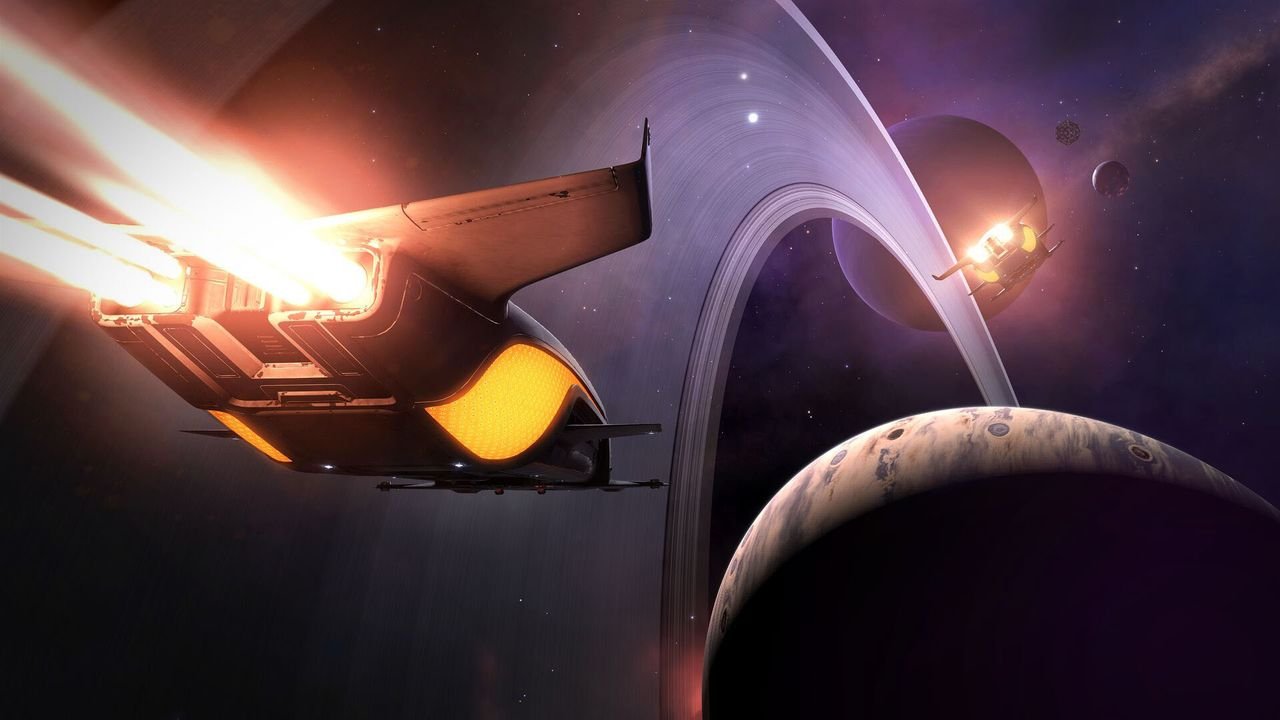
Frontier Developments takes a different approach with “Elite Dangerous,” offering a 1:1 scale representation of the Milky Way. Their Stellar Forge technology generates star systems based on real astronomical data. This ambitious design involves not only creating a massive galaxy but also detailed planetary surfaces and interiors for exploration.
Despite these advancements, even “Elite Dangerous” has challenges. Players often embark on lengthy journeys, facing the potential for unforeseen complications, like damage to their ships. Balancing the immense universe with playable content takes careful consideration and smart design.
Ultimately, space games do not fail to capture the universe’s scale due to a lack of imagination. The task requires carefully crafted mechanics that strike a balance between fun and realism. The vastness of the cosmos presents a nearly infinite challenge, yet it is vital that players feel the wonder of exploration while navigating these digital realms.
Stay Ahead with the Latest Tech Trends
Explore the future of technology with our detailed insights on Artificial Intelligence.
Explore past and present digital transformations on the Internet Archive.
Space
