

Top Highlights
-
Chaotic Black Hole Dynamics: The borderlands of black holes are characterized by chaotic behavior, with varying rates of matter accretion and intense radiation emissions, complicating predictions of dynamic events.
-
Advanced Modeling Techniques: Researchers from the Flatiron Institute created detailed simulations that rely on complex data rather than simplifications, accurately modeling the interactions of gas, light, and magnetic fields around stellar-mass black holes.
-
Key Findings: The study reveals that gas disks around rapidly accreting black holes become denser at the center, leading to powerful jets of gas influenced by magnetic fields, while also producing a narrow funnel that efficiently captures material and emits concentrated radiation.
-
Broader Applications: The innovative approach based on Einstein’s general relativity may extend to understanding other black holes, including the supermassive Sagittarius A*, and help unravel mysteries like the low X-ray emissions from ‘little red dots.’
Researchers Use Supercomputers to Unravel Black Hole Mysteries
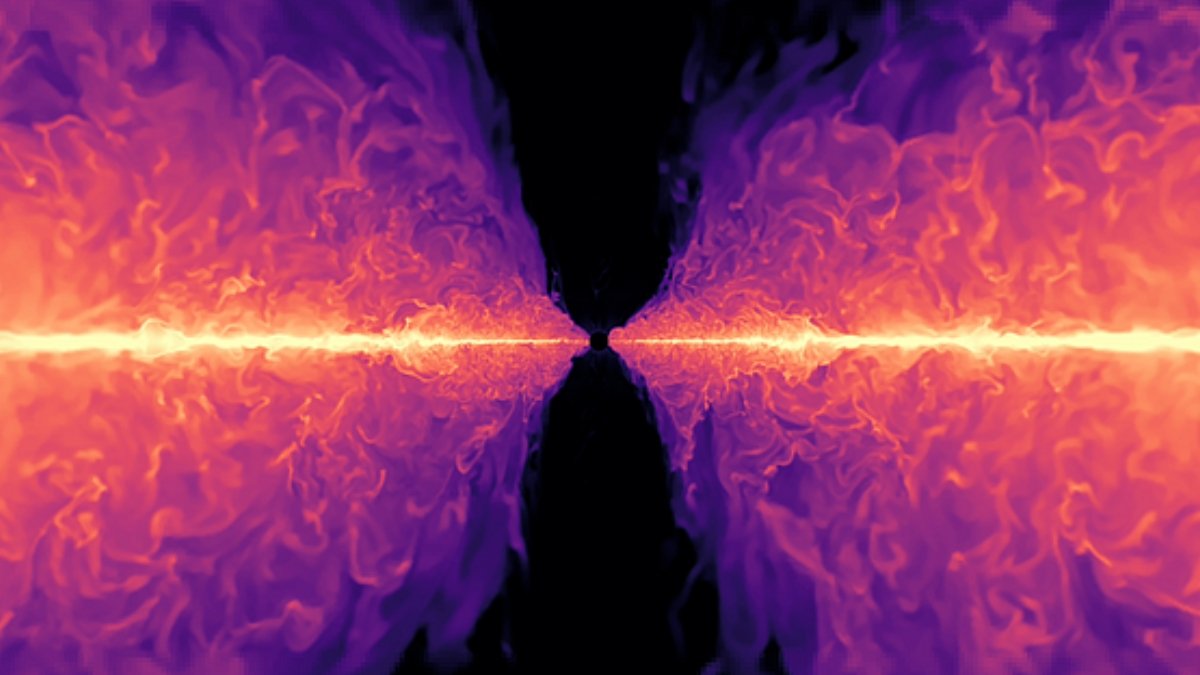
NEW YORK — Recent advancements in supercomputing have led to groundbreaking insights about black holes. A research team from the Flatiron Institute in the U.S. unveiled detailed simulations that depict how these cosmic giants consume and expel matter.
Traditionally, scientists faced challenges predicting the chaotic environments surrounding black holes. However, this study employs two powerful supercomputers and complex data, avoiding past simplifications that led to inaccurate predictions. According to astrophysicist Lizhong Zhang, “This is the first time we’ve been able to see what happens when the most important physical processes in black hole accretion are included accurately.”
The new model illustrates how gas around a rapidly spinning black hole becomes denser in the center. In addition, it depicts how jets of gas shoot outward, driven by magnetic fields. These findings align with ongoing observations of various black hole systems, enhancing our understanding of their behavior.
Researchers noted that as black holes attract more material, they form thick accretion disks. These disks absorb radiation and release energy through winds and jets. The simulations also revealed a unique funnel structure that rapidly consumes material while generating a beam of radiation visible only from certain angles.
Additionally, the study highlights the role of magnetic fields in influencing the flow of gas toward the black hole. Zhang remarked, “Ours is the only algorithm that exists at the moment that provides a solution by treating radiation as it really is in general relativity.”
Moving forward, the team plans to adapt their simulations to explore other types of black holes, including Sagittarius A*, the supermassive black hole at the center of the Milky Way. Their work could also help clarify recent discoveries of mysterious ‘little red dots’ that emit unexpected X-ray radiation.
This research, published in The Astrophysical Journal, contributes significantly to our understanding of black hole dynamics. Moreover, it showcases the power of supercomputers in advancing scientific knowledge, creating exciting possibilities for future explorations of the universe.
Stay Ahead with the Latest Tech Trends
Learn how the Internet of Things (IoT) is transforming everyday life.
Explore past and present digital transformations on the Internet Archive.
QuantumV1
