

Essential Insights
- NASA’s New Horizons spacecraft awakened after nearly a year of hibernation.
- It is 5.9 billion miles from Earth, ready to transmit data.
- All status reports during hibernation indicated the spacecraft was healthy.
- New Horizons will soon resume scientific operations and data collection.
New Horizons Wakes from Hibernation
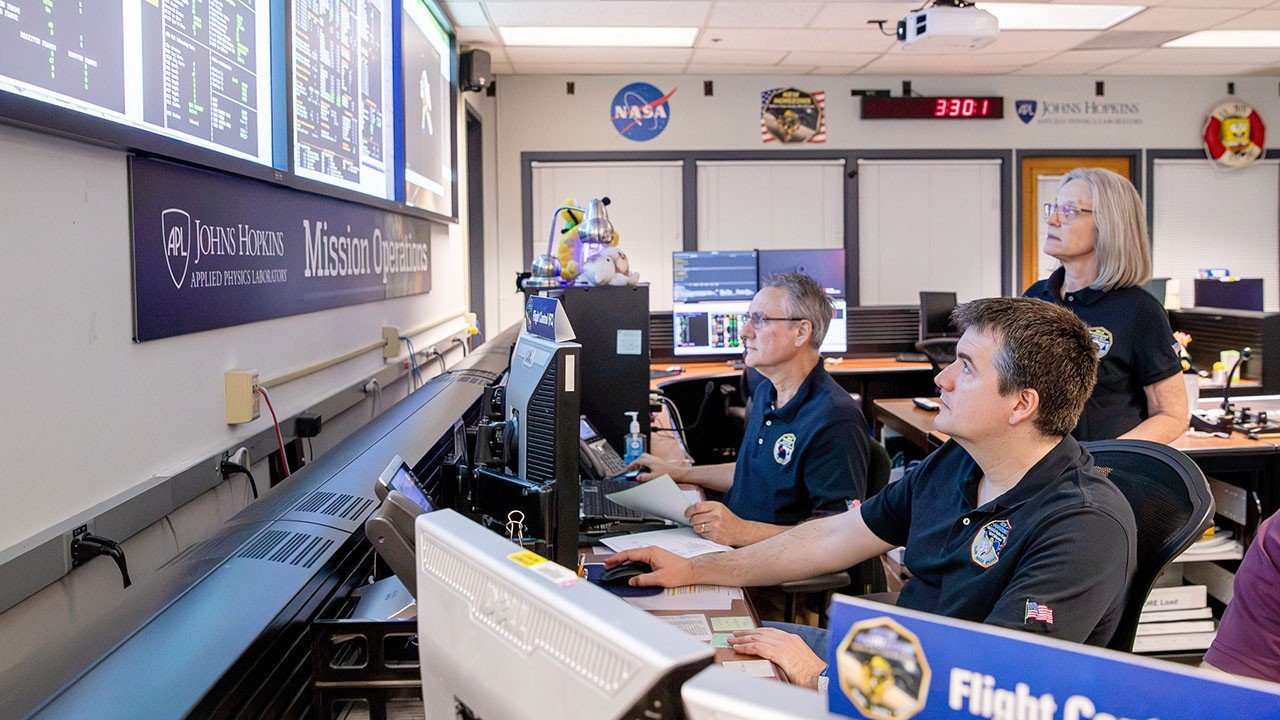
NASA’s New Horizons spacecraft has officially emerged from its longest hibernation period, lasting nearly a year. After 321 days in hibernation, the spacecraft is healthy and ready to transmit valuable science data collected in the Kuiper Belt, far beyond Pluto. On June 23, flight controllers at the Johns Hopkins Applied Physics Laboratory (APL) confirmed the spacecraft’s successful awakening. Commands sent last July prompted New Horizons to wake up, and from its distance of approximately 5.9 billion miles from Earth, the data took about 8 hours and 52 minutes to travel back to mission control.
New Horizons typically enters a hibernation mode during long stretches of its journey to conserve resources. During this time, it operates autonomously, continuing to gather data from its heliospheric plasma sensors and dust detector. Mission operations manager Alice Bowman reported that the spacecraft sent weekly status updates throughout its hibernation. Each report indicated that all systems were functioning normally, demonstrating the reliability of the spacecraft’s design and mission protocols.
Data Collection and Future Plans
As New Horizons resumes its science operations, the team will begin downlinking health and safety data first, followed by data from its scientific instruments. In about three weeks, the onboard Alice ultraviolet spectrograph will analyze hydrogen gas distribution in the outer heliosphere. Other instruments, including the Solar Wind at Pluto and the Venetia Burney Student Dust Counter, will continue their vital measurements. This extensive dataset promises to enhance our understanding of the solar system.
Recently, upgrades to ground-system software have been completed, facilitating future operations of the spacecraft. These enhancements are essential as New Horizons operates with updated autonomy logic to account for reduced solar power and longer communication delays. This careful technological planning allows the mission team to continue exploring the remote regions of our solar system.
New Horizons has already made significant contributions since its launch in January 2006. It holds the record for the fastest launch and has conducted groundbreaking flybys, including Jupiter in 2007 and Pluto in 2015. Its exploration of Kuiper Belt object Arrokoth in January 2019 marked another historic milestone. As the mission progresses, the team anticipates gathering new insights that will deepen our knowledge of these distant celestial bodies and the outer heliosphere.
For more detailed information on NASA’s New Horizons mission, visit: NASA Science.
Discover More Technology Insights
Learn how the Internet of Things (IoT) is transforming everyday life.
Stay inspired by the vast knowledge available on Wikipedia.
Space
