

Summary Points
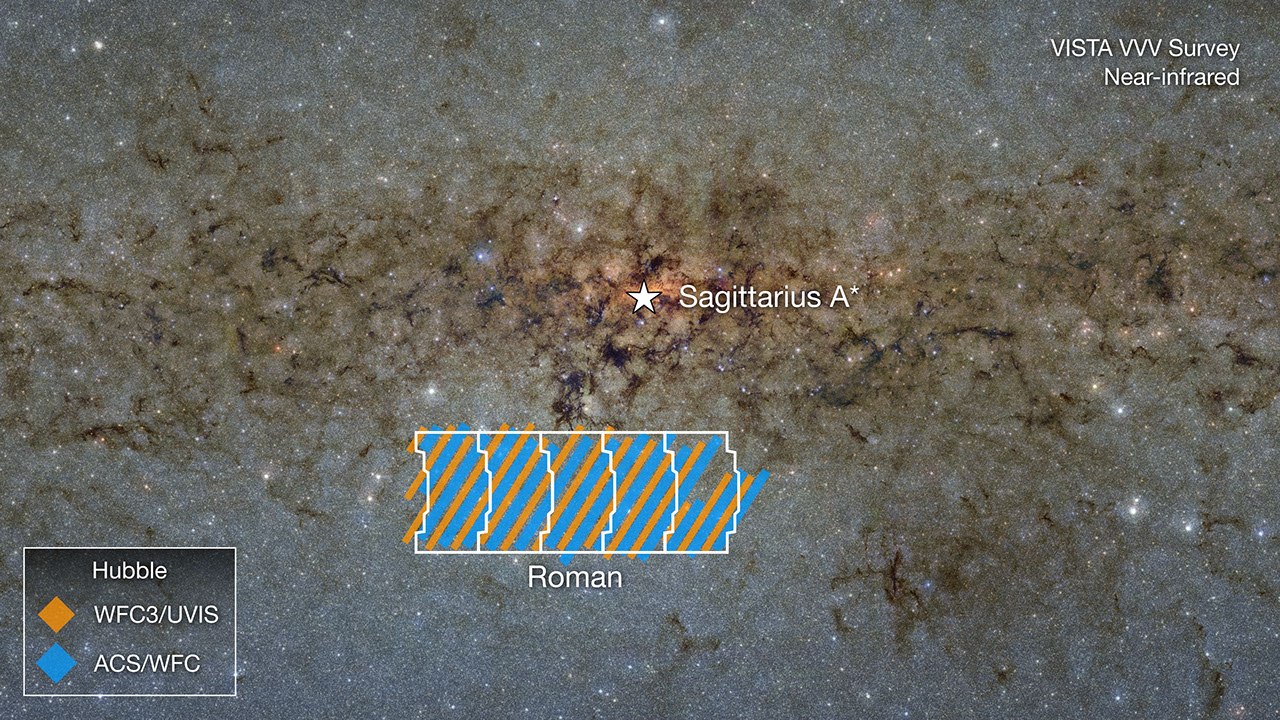
- The galactic bulge around Sagittarius A* will be studied by Roman Telescope.
- Hubble Telescope data will enhance Roman’s observations of stars and planets.
- Roman aims to detect rogue planets and various astronomical phenomena.
- Hubble’s survey will create a detailed star catalog exceeding 200 million objects.
The Importance of the Galactic Bulge Time-Domain Survey
NASA’s Hubble Space Telescope has long served as a critical tool for studying the Milky Way, especially its galactic bulge. This region, dense with stars and cosmic phenomena, surrounds Sagittarius A*, the supermassive black hole at the center of our galaxy. Recently, Hubble has been repurposed to lay the groundwork for future observations by the Nancy Grace Roman Space Telescope. The upcoming Roman mission aims to study a vast area of the galactic bulge, increasing both the scale and speed of observations compared to its predecessors.
Roman’s Galactic Bulge Time-Domain Survey will cover approximately 1.7 square degrees—about the same area as 8.5 full moons. With plans to take snapshots every 12 minutes across six observing seasons, this survey is poised to detect a variety of celestial objects. Of particular interest are rogue planets, isolated neutron stars, and even black holes similar in mass to our Sun. The mission’s primary focus will be on microlensing events, where light from distant objects is distorted by the gravitational field of closer objects. This method allows astronomers to identify exoplanets lurking amid the dense star population.
To make the most of Roman’s capabilities, astronomers utilized Hubble to observe regions overlapping with Roman’s survey. By gathering data months or years before Roman’s targeted observations, scientists hope to decipher which stars and planets participate in microlensing events. A proactive approach allows astronomers to distinguish between overlapping starlight, making it easier to study their properties during lensing events. This strategy enhances the reliability of data regarding the masses and characteristics of planets discovered in the galactic bulge.
The Impact of Hubble’s Precursor Data
The survey conducted by Hubble will significantly enrich our understanding of stars within the galactic bulge. The data will create a catalog of around 20 to 30 million point sources, enhancing the framework for Roman’s broader catalog, which may soar to between 200 and 300 million sources. This expansion will allow for deeper images of the sky, potentially revealing treasure troves of information about the formation and evolution of planetary systems.
In addition to discovering new celestial bodies, Hubble’s data will help astronomers understand areas of extinction—regions where gas and dust obstruct light. Mapping these areas is crucial for identifying stars that are otherwise hidden. The groundwork laid by Hubble aims to facilitate a more precise characterization of exoplanet host stars, improving the understanding of their environments and conditions.
Roman’s mission, expected to launch in early September 2026, will build upon Hubble’s extensive legacy. The combination of their efforts represents a significant leap in observational astrophysics, capturing details that were previously unattainable. This collaboration is essential for unraveling the mysteries of our galactic neighborhood and provides a clearer picture of the universe as a whole. Through careful planning and strategic data collection, researchers are poised to make groundbreaking discoveries that could reshape our understanding of the cosmos.
Expand Your Tech Knowledge
Stay informed on the revolutionary breakthroughs in Quantum Computing research.
Explore past and present digital transformations on the Internet Archive.
Space
