

Top Highlights
- Griffin-1 spacecraft passed space environment and launch simulations successfully.
- It will deliver 1,100 pounds of cargo to lunar south pole.
- Testing included thermal, vacuum, vibration, and electromagnetic assessments.
- Ready for launch aboard SpaceX Falcon Heavy later this year.
NASA JPL Testing Readies Voyager Technologies Lander for Moon Mission
NASA’s Jet Propulsion Laboratory (JPL) has completed critical testing on a new commercial lander that will play a key role in establishing the first lunar outpost—a Moon Base. The spacecraft, called Griffin-1, is made by Voyager Lunar Systems and is part of NASA’s effort to expand human presence on the Moon. These tests ensure Griffin-1 can withstand the harsh conditions of space and the intense journey ahead.
The lander has passed a series of demanding evaluations, including simulation of space’s extreme temperatures, vacuum environment, and launch stresses. The results show Griffin-1 is ready for the upcoming mission, which aims to deliver essential cargo and technology demonstrations to the lunar surface.
Rigorous Testing at JPL’s Facilities
Testing began in July, after the 2,789-pound spacecraft traveled from Pittsburgh to JPL in California. Engineers started by spinning the spacecraft on a special table to measure its mass and balance. This helped them understand how Griffin-1 will move through space and land on the Moon.
Next, the spacecraft underwent electromagnetic tests inside an anechoic chamber. Foam spikes line the room to absorb sound and electromagnetic waves, ensuring signals don’t interfere with each other. These tests confirm Griffin-1’s electronic systems will work properly during the mission.
Inside JPL’s vibration testing facilities, the lander was placed on a shaker table. It endured simulated rocket rides with sensors tracking how it handled the intense shaking. To imitate launch noise, giant horns blasted the spacecraft with up to 153 decibels of sound, mimicking the real launch environment.
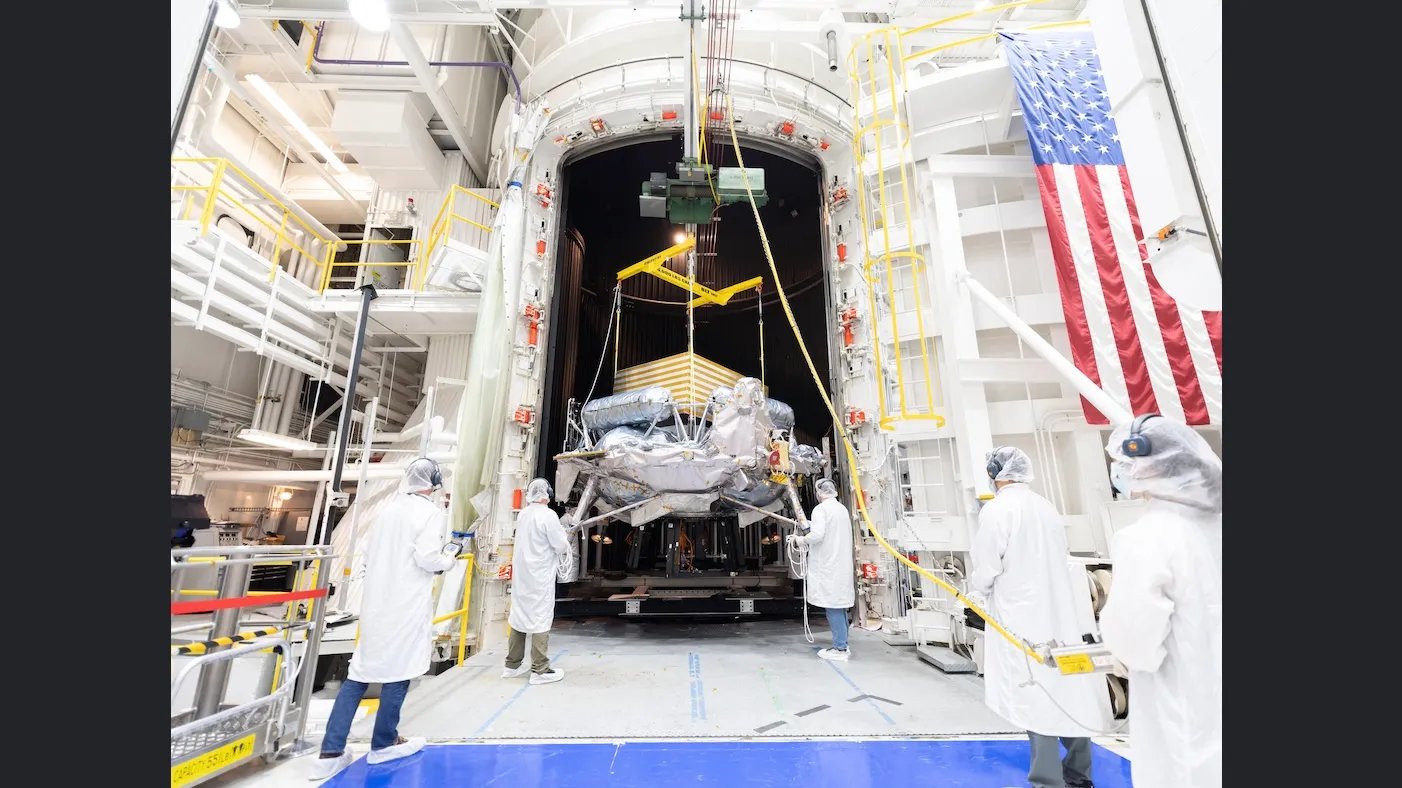
The most critical testing involved environmental stress. Griffin-1 was placed inside a thermal vacuum chamber that simulates space’s extreme temperatures. Over two weeks, it was heated to 167°F (75°C) and chilled to minus 148°F (minus 100°C). This tests its ability to survive the temperature swings during transit and on the lunar surface.
JPL’s 25-Foot Space Simulator, a historic chamber listed on the National Register of Historic Places, hosted these environmental tests. The chamber’s vast size and advanced capabilities support space missions from past to present, including the Perseverance Mars rover.
Preparing for the Lunar Journey
After completing testing, Griffin-1 returned to Voyager Lunar Systems’ facility for final assembly. The team will now focus on launch preparations before sending the lander to space. It is scheduled to launch later this year aboard a SpaceX Falcon Heavy rocket from Cape Canaveral.
The mission to the Moon’s south pole marks a significant milestone. Griffin-1 will deliver more than 1,100 pounds (455 kilograms) of cargo, which includes ten science and technology demonstrations from six countries. Among these is the FLIP (FLEX Lunar Innovation Platform) rover, the largest commercial payload ever sent to the Moon.
The tests at JPL Confirm the lander’s durability and readiness. As NASA’s Moon Base Program moves forward, Griffin-1 symbolizes a new era of commercial lunar exploration. Its success paves the way for future missions that aim to establish sustainable human settlement on the Moon.
To learn more about the Moon Base initiative, visit:
https://www.nasa.gov/moonbase
Media Contact:
Melissa Pamer
Jet Propulsion Laboratory, Pasadena, Calif.
626-314-4928
melissa.pamer@jpl.nasa.gov
Stay Ahead with the Latest Tech Trends
Dive deeper into the world of Cryptocurrency and its impact on global finance.
Discover archived knowledge and digital history on the Internet Archive.
Space
