

Fast Facts
-
NASA is funding 25 technologies for Mars exploration this year, including next-generation drone flight software to enhance navigation in challenging terrains.
-
Testing of the Extended Robust Aerial Autonomy software was conducted in Death Valley and the Mojave Desert, addressing issues faced by the Ingenuity Mars Helicopter, which struggled with featureless landscapes.
-
Field tests proved invaluable, revealing insights on camera filters and landing algorithms, with NASA’s ongoing research emphasizing the importance of realistic environments for technological advancements.
-
Future robotic explorers, like the Mars Electric Reusable Flyer, showcase innovations aimed at improving autonomous exploration capabilities, critical for navigating Mars’ complex landscapes.
NASA Tests Drones in Death Valley, Preps for Martian Sands and Skies
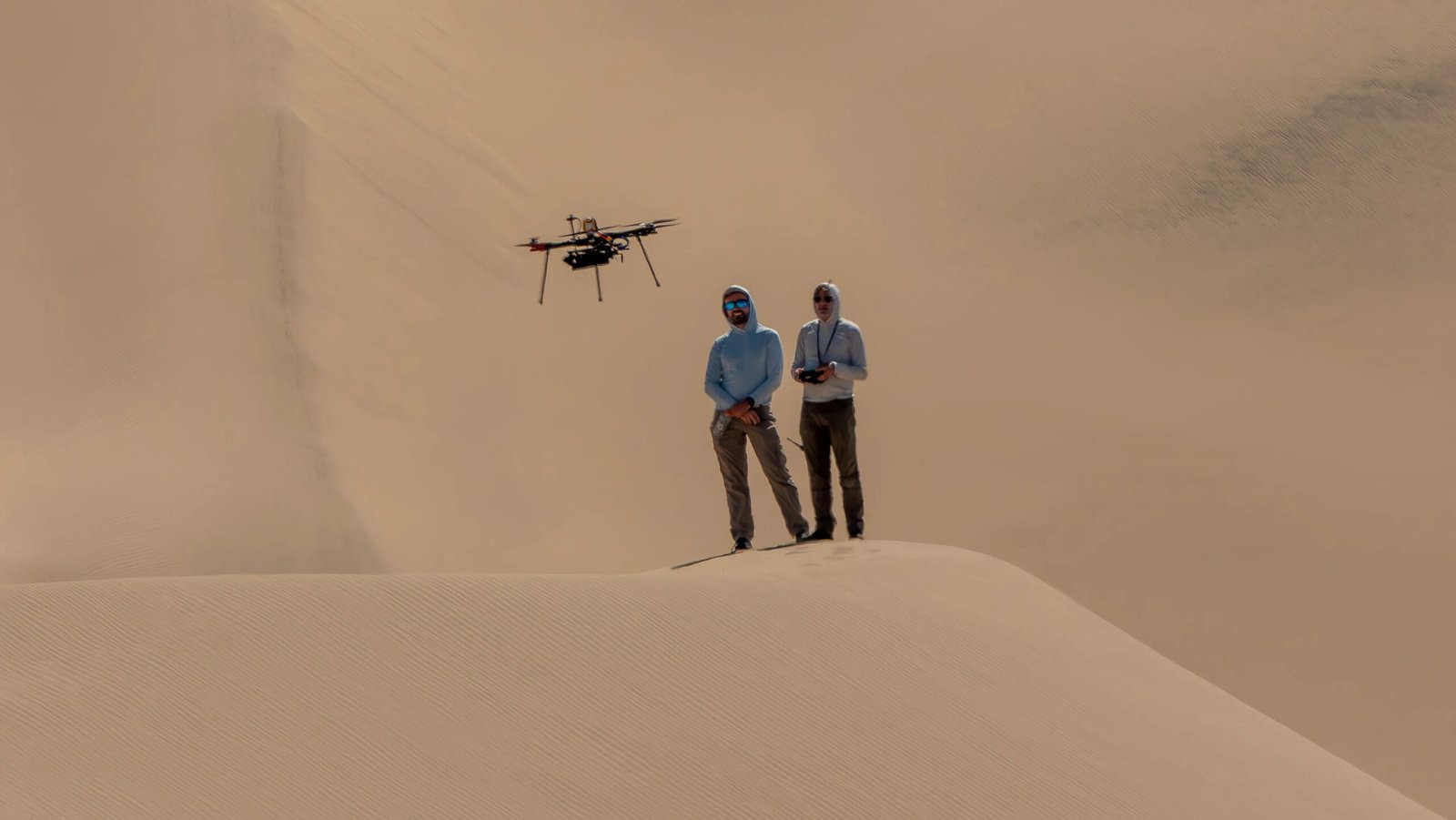
NASA engineers recently took to the California desert to refine their drone technology. Specifically, they tested navigation software intended for future missions to Mars. This testing took place in Death Valley National Park and the Mojave Desert.
To simulate Martian conditions, the team utilized terrain similar to that found on the Red Planet. They focused on the Extended Robust Aerial Autonomy program, aiming to improve how drones navigate across featureless surfaces. Notably, NASA’s Ingenuity Mars Helicopter experienced difficulties flying over similar sandy areas during its missions.
“Ingenuity struggled where the terrain lacked distinct features,” said a researcher involved in the project. “Our goal is for future drones to adapt more easily to various terrains.”
The Mars Exploration Program supports 25 innovative projects this year. Current developments include slope-scaling robotic scouts and autonomous drones capable of self-navigation. These advancements could enhance our understanding of Mars, allowing robots to explore autonomously or assist astronauts.
NASA has used Death Valley for testing since the 1970s, preparing for the first Mars landings. Recent tests included flying components of the Perseverance rover’s landing system in the park.
In April and September, engineers flew their drones in areas like Mesquite Flats Sand Dunes. Despite temperatures reaching 113 degrees Fahrenheit, the team gathered data on how various camera filters improved ground tracking.
“Death Valley serves not just as a stunning landscape, but as a vital research site for future space exploration,” noted the park’s superintendent.
Further expeditions took the team to the Dumont Dunes in the Mojave Desert, offering a different terrain for testing their software. A team member explained that field tests provide insights beyond what computer models can show. They want to prepare for even more challenging terrains than those faced by Ingenuity.
Meanwhile, researchers at NASA’s Johnson Space Center have also explored New Mexico’s White Sands National Park. There, they tested a robot called LASSIE-M. This robotic dog adapts its movements based on the surface’s physical characteristics, which could signal scientifically valuable areas.
The development of these drones and robots highlights NASA’s aim to create versatile machines. One key project, the Mars Electric Reusable Flyer, seeks to enhance range and capability. Engineers have tested a prototype that can fly at high speeds while mapping the Martian surface.
With continuous advancements in drone technology and robotics, NASA paves the way for future Mars exploration. Each innovation brings humanity closer to understanding the mysteries of the Red Planet and beyond.
Discover More Technology Insights
Learn how the Internet of Things (IoT) is transforming everyday life.
Explore past and present digital transformations on the Internet Archive.
SciV1
