

Fast Facts
- AI training capacity has exponentially increased by over a trillion times since 2010, far surpassing expectations based on traditional Moore’s Law.
- Breakthroughs in hardware, networking, and software advancements now enable continuous, massive-scale AI training, reducing training times drastically.
- Future projections suggest another 1,000x increase in compute capacity by 2028, enabling near-human-level AI agents capable of complex, autonomous tasks.
- Despite energy concerns, falling costs of solar and batteries provide a pathway for sustainable, large-scale AI development, promising unprecedented technological abundance.
The Growth of AI Power
Since 2010, the amount of data used for training advanced AI models has grown immensely. In fact, it has increased by an astonishing trillion times. Early AI systems used about 10^14 floating-point operations, but now, the largest models need over 10^26. This exponential growth is driving the AI revolution. Many skeptics believe progress will slow down. However, recent trends suggest otherwise.
Why Predictions of a Wall Are Wrong
Some argue that Moore’s Law, which predicts regular doubling of computer power, is slowing. Others say that data or energy limits will hold back AI. Still, the combined advances in technology tell a different story. The exponential trend in AI shows no clear sign of stopping anytime soon.
The New Era of Computing Power
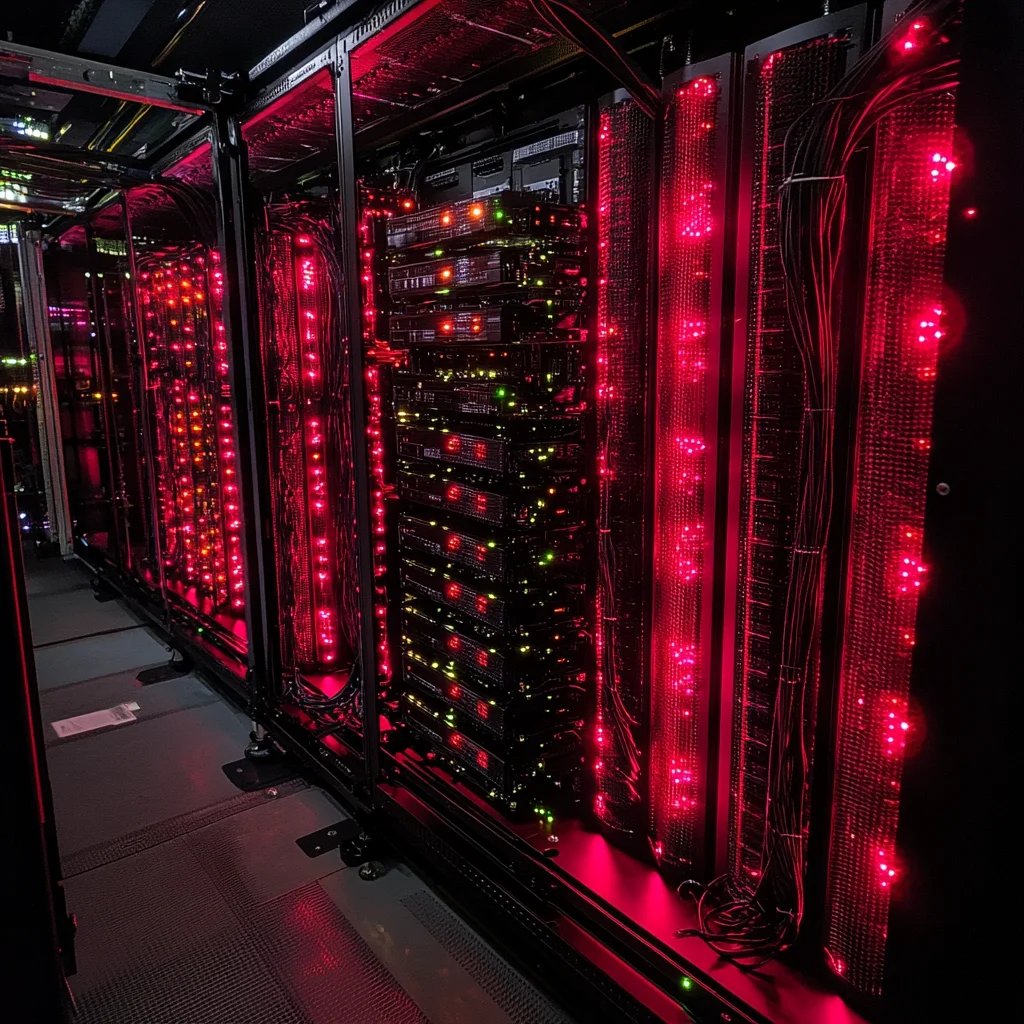
Imagine many people with calculators working together. In the past, more computers meant simply adding more calculators. But today, the goal is to keep all the calculators working constantly. Several key innovations make this possible. New chips are faster, and memory technology now feeds data to processors much quicker. Also, huge numbers of GPUs are linked into massive supercomputers that work as a single, powerful brain.
Faster, Cheaper, and More Efficient
Thanks to these improvements, AI training times have dropped dramatically. For example, a language model that once took over two hours to train now trains in just a few minutes. And the cost of running these models has also fallen by hundreds of times. Software improvements mean AI is becoming much cheaper and easier to use.
The Bright Future of AI
Looking ahead, the capacity to train AI models is set to grow even more. Experts estimate that AI computing power could increase tenfold by 2027 and another thousand times by 2028. By 2030, we could have enough AI processing power to match the energy use of entire countries.
Transforming Industries and Daily Life
This surge in power will lead to smarter, more capable AI systems. These will do more than chat or answer questions; they will write code, manage projects, make calls, and negotiate deals. Right now, we’re just at the beginning of this shift. Almost every industry will see significant changes as AI becomes more advanced.
Challenges and Opportunities in Energy
AI’s growth does come with energy challenges. Large AI systems can consume a lot of electricity—equivalent to hundreds of homes. However, falling solar and battery costs point to a way forward. Clean energy solutions are becoming more affordable, making sustainable AI development possible.
The Future Is Coming Into View
Investment and innovation are already underway. Big projects are breaking ground around the world, creating powerful supercomputers. These developments bring us closer to a world of cognitive abundance—where AI capabilities grow rapidly and sustainably. The explosion in AI power is the story of our time, and it is just beginning.
Discover More Technology Insights
Explore the future of technology with our detailed insights on Artificial Intelligence.
Access comprehensive resources on technology by visiting Wikipedia.
AITechV1
