

Top Highlights
-
Ice Age Legacy: The landscape around Hudson Bay shows evidence of its glacial past, with the Laurentide Ice Sheet shaping the region and ongoing land uplift due to glacial isostatic adjustment at a rate of 10 mm per year.
-
Land Features: Beach ridges formed by tidal actions are visible along James Bay, indicating the interaction of rising land and decreasing sea levels as the area continues to rebound from glacial retreat.
-
Peatland Carbon Storage: The Hudson Bay Lowlands, the world’s second-largest peatland complex, play a crucial role in carbon storage through the boreal peat bogs, significantly influencing global carbon cycles.
-
Seasonal Transformation: As spring transitions to summer, the landscape shifts from muted winter tones to vibrant greens, with significant changes in water color due to organic matter decay in the peatlands.
James Bay Lowlands: A Dynamic Landscape Evolving Through Time
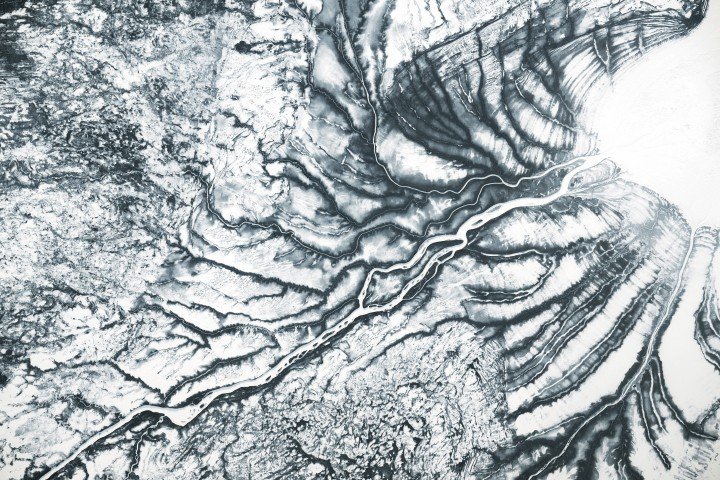
Early spring around Hudson Bay in northern Canada looks much like winter. Land remains frozen and sea ice clings to the shores. However, this harsh landscape is not without beauty. Snow highlights the region’s subtle topography, creating a unique view. In late March 2026, an astronaut aboard the International Space Station photographed frozen channels feeding Hannah Bay, showcasing the southern edge of James Bay.
The contours of the James Bay Lowlands reflect a significant geological history. During the Pleistocene Epoch, the Laurentide Ice Sheet dominated the area. Its immense weight depressed the land around Hudson Bay. As the ice retreated, the land began to rebound. This process, known as glacial isostatic adjustment, currently raises the surface at a rate of about 10 millimeters (0.4 inches) per year.
This rebound shapes the land’s features today. For instance, the astronaut’s photo reveals closely spaced ridges along the shore. These ridges formed from tidal action that reshaped sands and silts. As the land rises, new ridges develop, reflecting the dynamic nature of this ecosystem.
Waterways like the Harricana River meander through boreal peat bogs, or muskeg, on their journey to the sea. The Hudson Bay Lowlands, the world’s second-largest peatland complex, store vast amounts of soil carbon. This storage plays a crucial role in carbon cycling, benefiting climate regulation.
As summer approaches, the landscape transforms. Peatlands bloom into lush greens, while organic matter releases tannins, staining the water dark brown. Sea ice, which clung to the shoreline, typically starts breaking up by mid- to late-May, completing its transformation by the end of July.
With ongoing technological advancements, understanding these changes becomes easier. Satellites and aerial photography provide valuable data that scientists can use to monitor climate impacts. Maintaining a focus on these ecosystems fosters a connection between technology and nature, enhancing quality of life for local communities and beyond. As researchers study these dynamic landscapes, they emphasize the importance of conservation efforts to sustain this unique environment for future generations.
Continue Your Tech Journey
Stay informed on the revolutionary breakthroughs in Quantum Computing research.
Stay inspired by the vast knowledge available on Wikipedia.
SciV1
