

Fast Facts
- NASA’s LAVA tool predicts airflow for successful aerospace missions and designs.
- The software accelerates innovation, enabling complex simulations for researchers and companies.
- LAVA runs intricate simulations quickly, reducing computation time and resource needs.
- Its release democratizes access to advanced aerospace analysis for diverse applications.
Navigating the Future of Aerospace Innovation
For years, NASA engineers relied on the Launch, Ascent, and Vehicle Aerodynamics (LAVA) framework to tackle complex airflow challenges. These challenges can dictate the success or failure of missions. Whether determining how a spacecraft will re-enter the Earth’s atmosphere or testing new aircraft wing designs, LAVA has been an essential tool.
Recently, NASA released the LAVA software to the U.S. aerospace community. This powerful computational fluid dynamics tool predicts airflow with remarkable accuracy. It enables engineers to simulate conditions for rockets, aircraft, and spacecraft, harnessing NASA’s collective expertise. The software utilized for Mars landers and launch predictions is now accessible to researchers and companies across the nation.
“This isn’t only about releasing software; it’s about accelerating innovation,” said Jared Duensing, LAVA team lead at NASA’s Ames Research Center. With LAVA in their toolkit, university researchers and small companies can conduct more complex simulations. This freedom allows them to optimize designs with a new level of precision, effectively unleashing the potential of the aerospace sector.
Streamlining Simulations for Enhanced Outcomes
NASA’s use of computational tools has transformed how engineers understand air movement around new aircraft and rocket launches. Picture watching a movie on a slow flip-phone versus a crystal-clear 4K stream. This analogy captures the real change LAVA brings to aerospace simulations. Problems that once consumed days or weeks now yield answers in a matter of hours.
LAVA is compatible with specialized graphics processing units (GPUs), making simulations faster and more energy-efficient. These systems handle multiple tasks simultaneously, making expensive simulation methods less daunting. LAVA has proven particularly efficient on NASA’s flagship GPU supercomputer, Cabeus.
Much of LAVA’s impact lies in its ability to simplify complex simulations. Engineers often rely on “scale-resolving simulations” to capture critical phenomena such as pressure waves and turbulence. Previously resource-intensive, LAVA allows these simulations to be performed with modest computational resources, making them more accessible to even novice users.
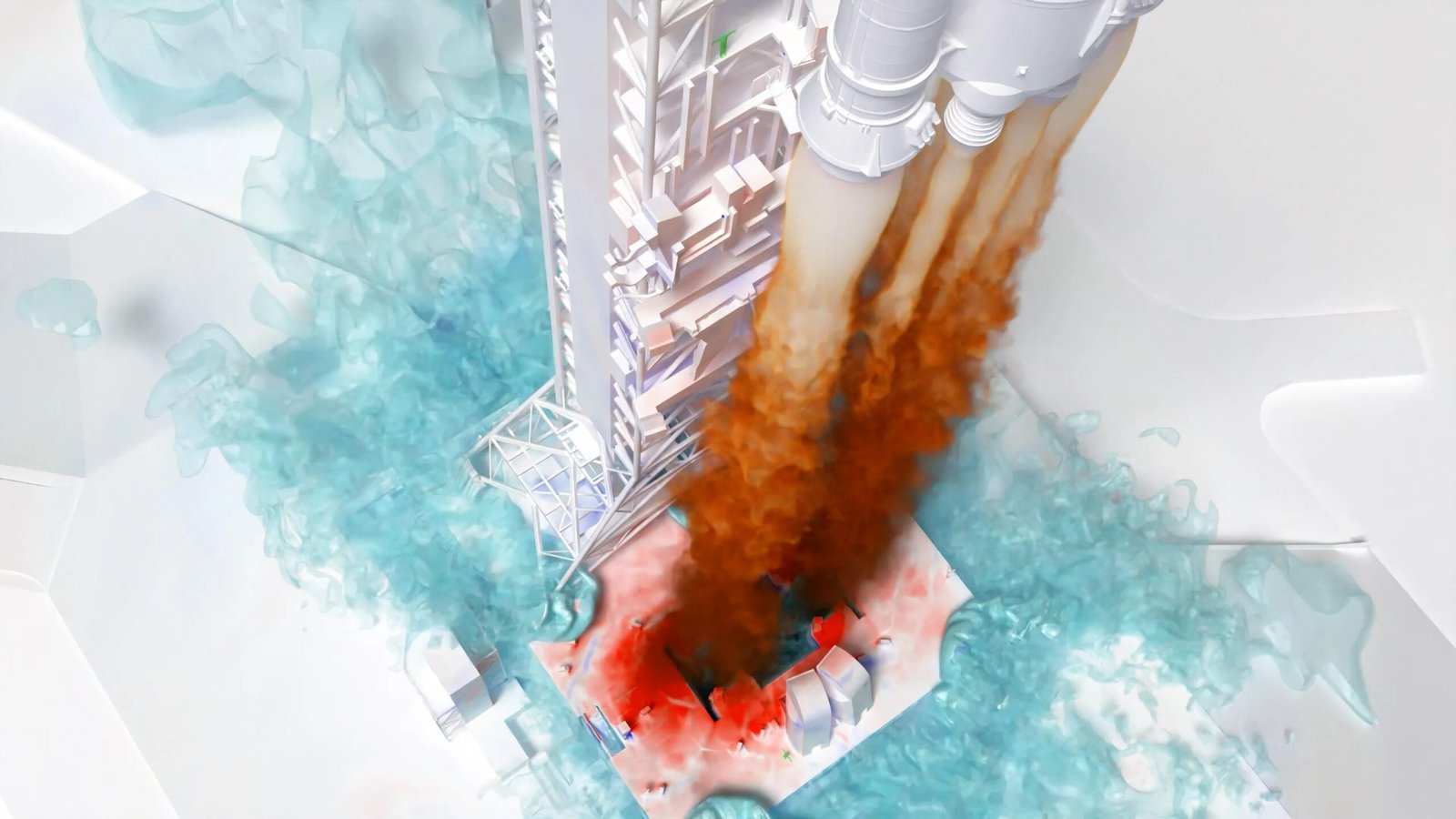
At NASA, LAVA has informed vital projects, including those involving lunar and Martian missions. For instance, when understanding supersonic parachute deployment for Mars missions, LAVA provided essential insights that aren’t easily obtainable in Earth’s atmosphere. It also played a crucial role in assessing how ice formations affect aircraft performance, which is critical for ensuring flight safety. Additionally, LAVA simulated the launch sequence for the Artemis I mission, helping teams analyze the Space Launch System’s flight environment in detail.
LAVA’s framework offers flexibility by incorporating three distinct approaches for generating meshes—connected grids that predict fluid behavior. This allows users to switch methods based on specific challenges or compare different predictions. The software can also complement other analysis and optimization tools, creating a comprehensive development environment.
Through NASA’s Transformational Tools and Technologies project, LAVA contributes significantly to predicting aircraft performance—a key component of modern aerospace research. The release of LAVA not only empowers the aerospace community but could lead to innovations in various fields, from large supersonic airliners to the emerging technology of delivery drones and air taxis.
To explore the possibilities offered by LAVA, visit the NASA software catalog for access information and consider attending an upcoming seminar to dive into its computational capabilities.
Expand Your Tech Knowledge
Explore the future of technology with our detailed insights on Artificial Intelligence.
Access comprehensive resources on technology by visiting Wikipedia.
Space
