

Fast Facts
- NASA will provide live coverage of a Roscosmos spacewalk on May 27.
- The spacewalk starts at 10:15 a.m. EDT and lasts about five hours.
- Cosmonauts will install experiments and photograph malfunctioning equipment during the walk.
- This will be Kud-Sverchkov’s second spacewalk and Mikaev’s first.
NASA’s Live Coverage of the Roscosmos Spacewalk
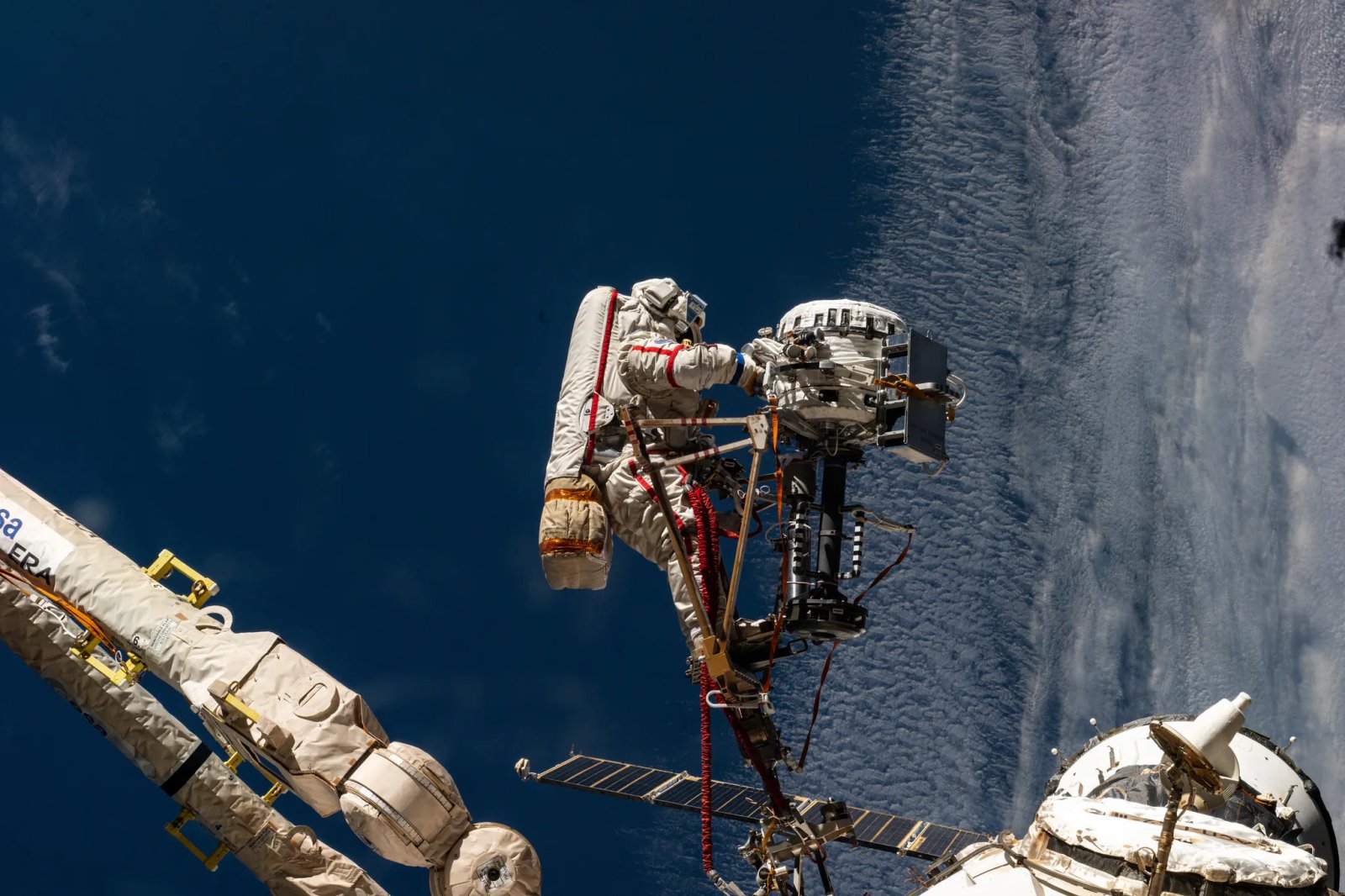
On May 27, NASA will broadcast live as two cosmonauts from Roscosmos perform a spacewalk outside the International Space Station (ISS). The event is set to kick off around 10:15 a.m. EDT and is expected to last about five hours. Viewers can tune in at 9:45 a.m. on multiple platforms, including NASA+, Amazon Prime, and the agency’s YouTube channel. This coverage emphasizes NASA’s commitment to making space exploration accessible to everyone through various online channels and social media.
The spacewalk features Expedition 74 commander Sergey Kud-Sverchkov and flight engineer Sergei Mikaev. The duo will install a solar radiation experiment on the Zvezda service module and remove scientific equipment from both the Poisk and Nauka modules of the Roscosmos segment. If time permits, they plan to photograph a malfunctioning Kurs rendezvous antenna on the Progress 94 cargo spacecraft, which failed to deploy back in March.
Significance of the Spacewalk
This mission marks the second spacewalk for Kud-Sverchkov and the debut for Mikaev. Their spacesuits will help distinguish their roles during the event: Kud-Sverchkov will wear a suit with red stripes, while Mikaev will wear blue. This spacewalk will be noteworthy as it is the 279th in support of space station assembly, maintenance, and upgrades.
The collaboration between NASA and Roscosmos illustrates the international effort in space exploration. Each spacewalk contributes vital data that assists in the understanding of long-term space habitation. As advancements continue, the insights gained from these missions can pave the way for future exploration missions to the Moon, Mars, and beyond.
To learn more about ongoing research and operations aboard the International Space Station, visit NASA’s ISS page.
Continue Your Tech Journey
Stay informed on the revolutionary breakthroughs in Quantum Computing research.
Stay inspired by the vast knowledge available on Wikipedia.
Space
