

Fast Facts
- Curiosity is exploring Mount Sharp through various rock textures and layers.
- Planned activities include APXS, MAHLI imaging, and ChemCam spectrometry.
- Communication delays impacted drive planning, but Mars exploration continues.
- Upcoming investigations will target smooth-textured, light-toned surface materials.
Curiosity Blog, Sols 4920-4926: Surveying the Bands
Rather than hopping from stage to stage at a music festival, Curiosity is navigating the rocky terrain of Mount Sharp. It climbs through bands of rocks that exhibit varying textures and tones. The rover’s work during these sols highlights the unique geologic features of Mars.
Exploring Rough Textures
During sols 4920 and 4921, Curiosity found itself on a rough-textured, dark-toned bedrock unit. In this environment, brushing the rocks was not feasible. Instead, scientists planned detailed examinations of two bedrock targets: “Salto La Cascada” and “Puerto de Rosas.” The Alpha Particle X-ray Spectrometer (APXS) was set to analyze the chemical composition of these rocks. The Mars Hand Lens Imager (MAHLI) was also deployed for close-up imaging.
ChemCam, the rover’s laser tool, targeted a bedrock sample called “Kishuara” and a small, layered float rock referred to as “La Rosita.” This tool performed laser-induced breakdown spectroscopy (LIBS) to determine the elemental makeup of the targets. Additionally, the Remote Micro-Imager (RMI) on ChemCam captured striking images of the “Mishe Mokwa” butte and nearby dunes displaying tonal differences.
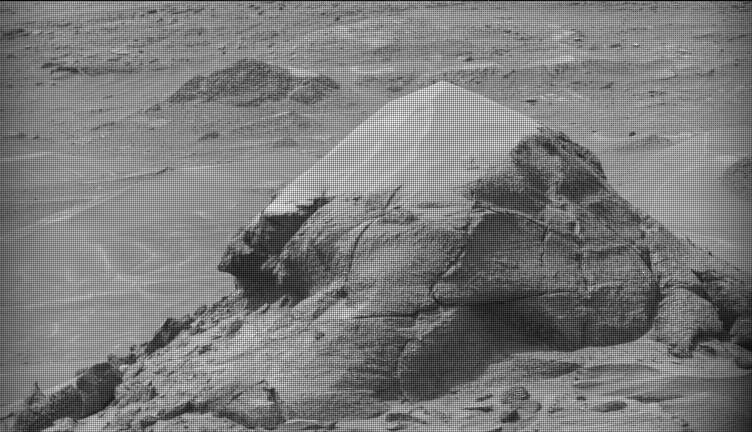
Mastcam mosaics were produced to provide a comprehensive view of various geological features, including the “Valle Grande” channel and the aircraft carrier-shaped rock “El Matir.”
Advancing the Survey
As Curiosity continued its ascent, it approached the upper boundary of the dark-toned band. Once again, brushing was not an option, but APXS and MAHLI studies were conducted on new targets: “Santa Gracia” and “Laguna San Rafael.” These observations aimed to gather crucial information about the region’s geology.
Mastcam continued its essential work by capturing mosaics of surrounding layered rocks and troughs, while also documenting the smaller butte “Miraflores.” This feature exhibited intriguing layers and ragged dark-toned rocks, significant for understanding the local geology.
Communication challenges arose when the team did not receive timely data downlinks for the planned Sol 4923 activities. This delay inhibited further planning for the rover’s movements and remote sensing. Nonetheless, the team made the most of the situation. The three-sol plan for sols 4924 to 4926 included a full 360-degree Mastcam mosaic andAegis, the automatic targeting tool for LIBS measurements.
The work on Mars continues to push boundaries, with plans to investigate a new surface band characterized by smooth textures and lighter tones. As Curiosity collects and analyzes data, it adds to the growing understanding of the planet’s geological history.
Discover More Technology Insights
Explore the future of technology with our detailed insights on Artificial Intelligence.
Stay inspired by the vast knowledge available on Wikipedia.
Space
