

Summary Points
- Quantum systems are fragile; information can be easily lost in noise.
- Gabbassov explores reversing quantum information loss inspired by diffusion models.
- Diffusion models turn images into noise and then reconstruct the original.
- He derived quantum stochastic Schrödinger equations for reversing quantum information loss.
Reversing Quantum Information Loss Through Machine Learning Inspiration
Quantum systems are delicate. When a qubit interacts with a noisy environment, its information can be lost or scrambled beyond easy recovery. This makes storing and processing quantum data challenging. However, recent research has uncovered new ways to reverse this damage.
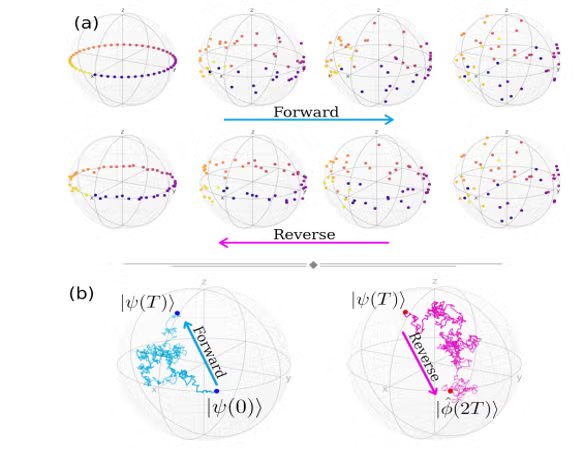
A researcher at the Institute for Quantum Computing explored how lessons from machine learning can help. Specifically, he looked at diffusion models used in image generation. These models, like DALL-E or SORA, gradually turn an image into noise and then reverse the process to recreate the picture. This process is guided by mathematical equations from the 1970s, adapted for modern machine learning.
The researcher asked if similar ideas could work with quantum information. In his study, he derived new equations called stochastic Schrödinger equations. These equations describe how a quantum system can be reversed back to its original state after losing information. The breakthrough is showing it is theoretically possible to undo some quantum information loss, inspired by techniques used in image generation. This work opens new possibilities for protecting and restoring quantum data in noisy environments.
Stay Ahead with the Latest Tech Trends
Learn how the Internet of Things (IoT) is transforming everyday life.
Discover archived knowledge and digital history on the Internet Archive.
QuantumV1
