
Close Menu
    Facebook X (Twitter) Instagram
    Friday, July 31
    Top Stories:
    • Bezel-Less Brilliance: Tecno’s Stunning Concept Phone Revealed!
    • Unlocking the Employee Benefits Paradox
    • Empowering Sustainability: The EU’s Right to Repair Directive Takes Effect!
    Facebook X (Twitter) Instagram Pinterest Vimeo
    IO Tribune
    • Home
    • AI
    • Tech
      • Gadgets
      • Fashion Tech
    • Crypto
    • Smart Cities
      • IOT
    • Science
      • Space
      • Quantum
    • OPED
    IO Tribune
    Home » Climbing New Heights: Safe Webbings for Oxygen-Rich Environments
    Space

    Climbing New Heights: Safe Webbings for Oxygen-Rich Environments

    Staff ReporterBy Staff ReporterJuly 31, 2026No Comments3 Mins Read
    Share Facebook Twitter Pinterest LinkedIn Tumblr Reddit Telegram Email
    Share
    Facebook Twitter LinkedIn Pinterest Email

    Summary Points

    1. NASA tested commercial webbings for flammability in elevated oxygen environments.
    2. Sturges’ 60% Kevlar®/40% polybenzimidazole passed flammability requirements at 37% oxygen.
    3. Results indicate potential for use in lunar and Martian missions’ softgoods.
    4. Final material performance must be confirmed in full product configurations.

    TB 26-04 Webbings for Use in Elevated Oxygen Environments

    Elevated Oxygen Environments and Flammability Risks

    Future crewed missions to the Moon and Mars plan to use elevated oxygen environments. This approach reduces the time required for astronauts to prebreathe before performing extravehicular activities. However, a higher concentration of oxygen—as much as 37%—increases the risk of flammability. As a result, there is a pressing demand for fire-resistant materials.

    The NASA Engineering and Safety Center (NESC) has developed a strategy to identify textiles that meet NASA’s stringent flammability requirements. This initiative aims to provide safe materials for the aerospace community, ensuring that they can be effectively used in softgoods applications, such as mobility aids and restraint nets. The first phase of this project involves testing commercial-off-the-shelf (COTS) textiles with promising potential.

    Testing and Results

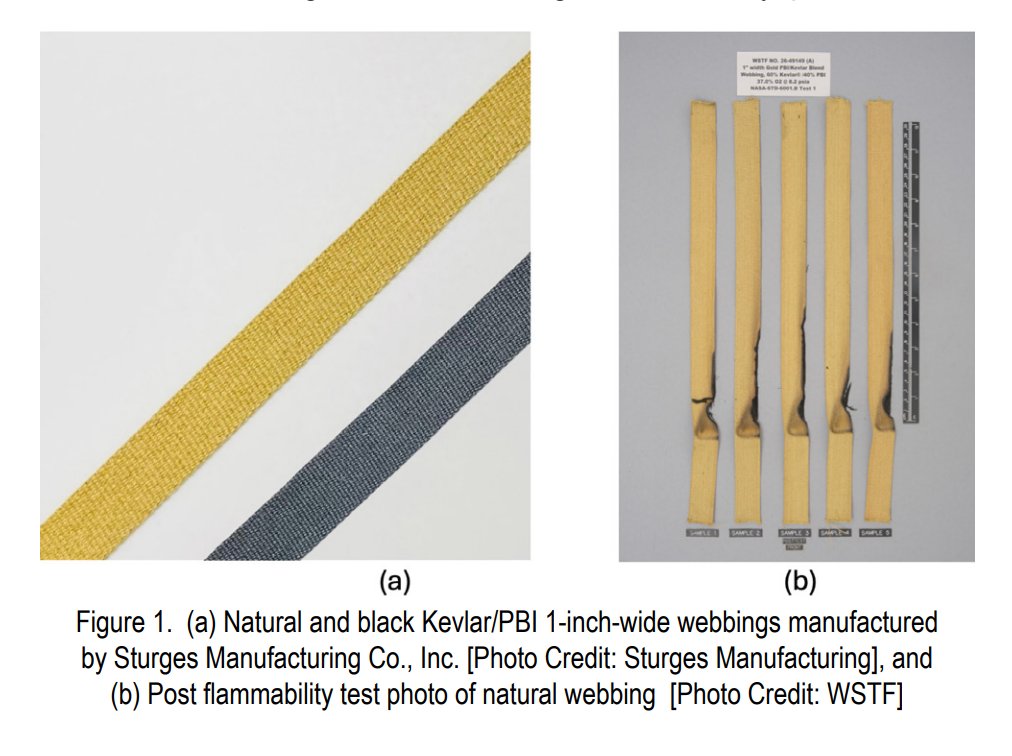
    Testing of potential webbings was conducted at the White Sands Test Facility (WSTF). The goal was to determine the maximum oxygen concentration (MOC) at a pressure of 8.2 psia. The selected webbings, composed of 60% Kevlar® and 40% polybenzimidazole (PBI) from Sturges Manufacturing Company, were examined under NASA-STD-6001B Test 1. Both natural and black versions of these webbings were tested in an unshielded J configuration.

    The results showed that the natural webbing achieved a MOC of 37% oxygen, while the black webbing achieved a MOC of 35% at the specified pressure. These findings indicate that the natural webbing passed the initial flammability tests, making it a potential candidate for future use in elevated oxygen environments. However, it’s crucial to note that the final performance will depend on the specific configuration. Various factors—including dimensions, yarn size, weave type, and additional features—could significantly impact flammability characteristics.

    Offgassing tests were also conducted on the natural webbing, further evaluating its safety in these elevated oxygen conditions. Data from these tests are critical when selecting materials for final softgoods development. The standards for approval require comprehensive testing in the configuration of the final product. Thus, while these individual results are promising, they do not guarantee that the final assembled item will meet required flammability standards.

    The need for materials that can withstand the unique challenges of lunar and Martian environments is more pressing than ever. Adopting advanced materials like the Kevlar/PBI webbings represents a significant step toward achieving safer and more effective space missions.

    Expand Your Tech Knowledge

    Explore the future of technology with our detailed insights on Artificial Intelligence.

    Access comprehensive resources on technology by visiting Wikipedia.

    Space

    Cosmos Mars NASA NASA Engineering and Safety Center Space VT1
    Share. Facebook Twitter Pinterest LinkedIn Tumblr Email
    Previous ArticleChinese AI Researchers Make Waves on X
    Next Article Bezel-Less Brilliance: Tecno’s Stunning Concept Phone Revealed!
    Avatar photo
    Staff Reporter
    • Website

    John Marcelli is a staff writer for IO Tribune, with a passion for exploring and writing about the ever-evolving world of technology. From emerging trends to in-depth reviews of the latest gadgets, John stays at the forefront of innovation, delivering engaging content that informs and inspires readers. When he's not writing, he enjoys experimenting with new tech tools and diving into the digital landscape.

    Related Posts

    Tech

    Bezel-Less Brilliance: Tecno’s Stunning Concept Phone Revealed!

    July 31, 2026
    AI

    Chinese AI Researchers Make Waves on X

    July 31, 2026
    Tech

    Unlocking the Employee Benefits Paradox

    July 31, 2026
    Add A Comment

    Comments are closed.

    Must Read

    Bezel-Less Brilliance: Tecno’s Stunning Concept Phone Revealed!

    July 31, 2026

    Climbing New Heights: Safe Webbings for Oxygen-Rich Environments

    July 31, 2026

    Chinese AI Researchers Make Waves on X

    July 31, 2026

    Unlocking the Employee Benefits Paradox

    July 31, 2026

    Sony Stands Firm on Ending PS5 Disc Production Despite Backlash

    July 31, 2026
    Categories
    • AI
    • Crypto
    • Fashion Tech
    • Gadgets
    • IOT
    • OPED
    • Quantum
    • Science
    • Smart Cities
    • Space
    • Tech
    Most Popular

    iPhone 18: The Game Changer for Android Releases

    November 17, 2025

    Netflix: The Blueprint for Startup Evolution

    December 13, 2025

    Samsung and SK Hynix set record supply squeeze amid soaring AI demand

    May 1, 2026
    Our Picks

    BioSentinel: Pioneering Space Biology

    November 22, 2025

    Copilot Mode Retired: Now Everything Has Copilot

    May 14, 2026

    Mira Murati: AI Must Keep Humans Involved

    May 15, 2026
    Categories
    • AI
    • Crypto
    • Fashion Tech
    • Gadgets
    • IOT
    • OPED
    • Quantum
    • Science
    • Smart Cities
    • Space
    • Tech
    • Privacy Policy
    • Disclaimer
    • Terms and Conditions
    • About Us
    • Contact us
    Copyright © 2025 Iotribune.comAll Rights Reserved.

    Type above and press Enter to search. Press Esc to cancel.