

Summary Points
NASA integrated Artemis III’s core stage with twin boosters at Kennedy Space Center.
Technicians used specialized lifting equipment to position the 212-foot rocket stage.
Teams will test fueling and countdown procedures at Launch Pad 39B.
Four astronauts will test Orion docking with Blue Origin and SpaceX vehicles.
Artemis III SLS Core Stage Joins Boosters at Kennedy
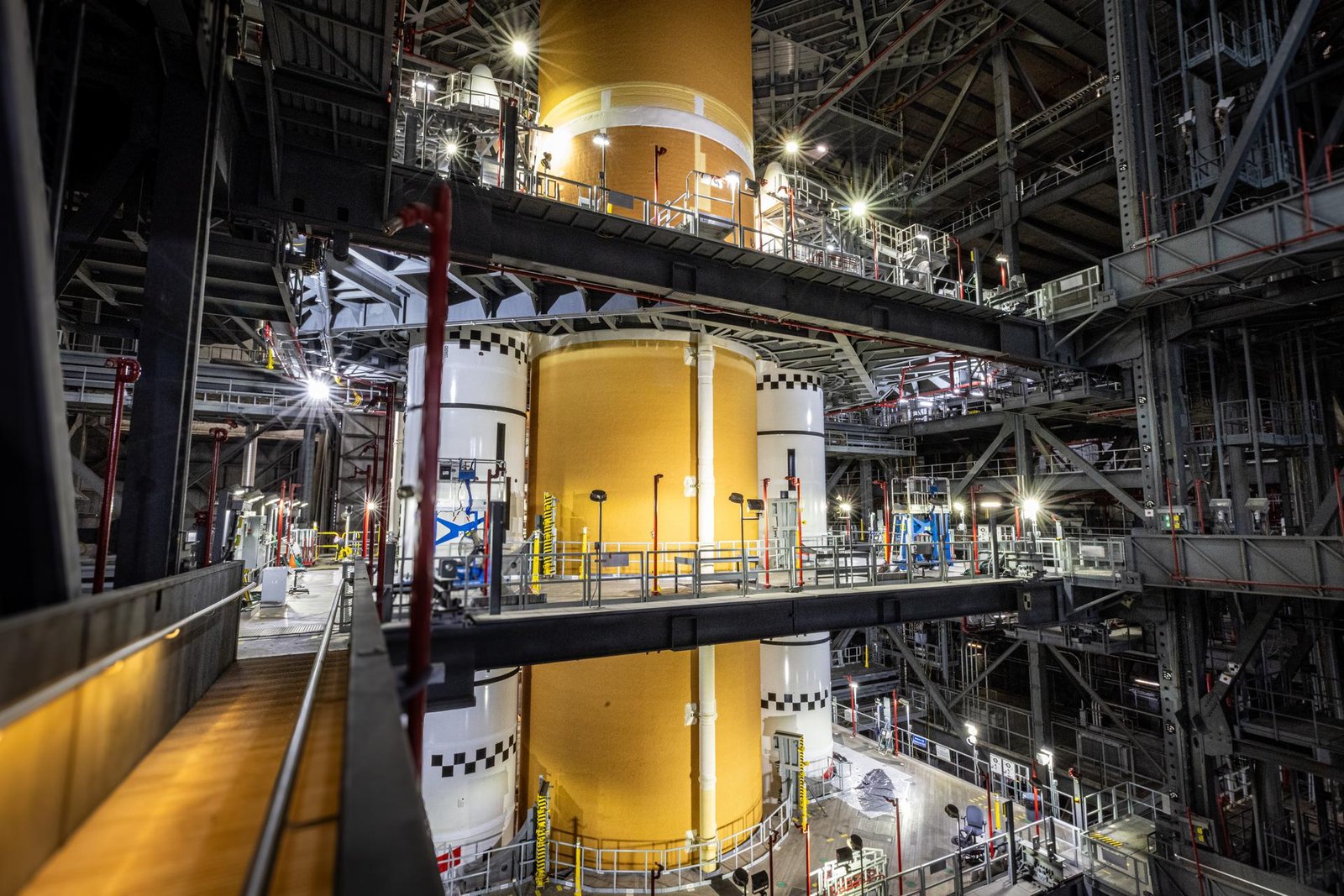
NASA has moved a major piece of the Artemis III rocket into place. On Oct. 28, technicians integrated the 212-foot Space Launch System (SLS) core stage alongside the rocket’s two solid rocket boosters inside High Bay 3 of the Vehicle Assembly Building at Kennedy Space Center in Florida.
The operation marks a visible step in assembling the launch vehicle. It also begins a demanding stretch of testing before the rocket can leave the assembly building for the launch pad.
A precision lift inside the Vehicle Assembly Building
Technicians raised the core stage from High Bay 2 and moved it into High Bay 3. They used a one-of-a-kind lifting beam designed to handle the stage and position it on the mobile launcher.
The lift required specialized equipment and careful coordination. The core stage is a central part of the SLS, and moving a structure of this size leaves little room for error. The custom beam gives teams a tool built for the task, while the scale of the operation underscores the complexity of assembling a large launch vehicle.
With the core stage now alongside the boosters, teams will conduct testing and checkouts. Those steps help verify the rocket’s systems and configuration before the stack moves outside. The work takes time, but it is essential: a successful lift is only one milestone, not a substitute for confirming that the hardware is ready for the next phase.
Next stop: Launch Pad 39B
After testing and checkouts are complete, teams plan to roll the core stage and booster stack to Launch Pad 39B. There, they will conduct a tanking test. Liquid hydrogen and liquid oxygen will be loaded into the core stage, and launch teams will rehearse countdown procedures and timelines.
The test will let teams practice operating the vehicle and ground systems together. It also provides an opportunity to identify issues before launch preparations reach their final stages. The rehearsal is a practical use of the assembled hardware, though it requires extensive coordination among launch teams and support systems.
Artemis III is planned to carry NASA astronauts Randy Bresnik, Frank Rubio and Andre Douglas, along with European Space Agency astronaut Luca Parmitano, aboard the Orion spacecraft. The mission is intended to test rendezvous and docking capabilities between Orion and commercial spacecraft from Blue Origin and SpaceX. Those demonstrations are intended to support future missions to land astronauts on the Moon.
The assembly milestone does not, by itself, determine when the mission will launch. Testing, vehicle readiness and launch operations remain important steps. But the core stage’s move into the booster stack brings the Artemis III rocket closer to the integrated configuration needed for those tests.
Photo credit: NASA/Sean Cannon, Cory S. Huston and Frank Michaux
Continue Your Tech Journey
Stay informed on the revolutionary breakthroughs in Quantum Computing research.
Discover archived knowledge and digital history on the Internet Archive.
Space
