
Close Menu
    Facebook X (Twitter) Instagram
    Saturday, September 19
    Top Stories:
    • Chip Foundries Survive Better in AI Slump Than Asia-Pacific Peers
    • Time-Restricted Eating Enhances Markers in Huntington’s Disease
    • Chinese Smartphone Makers Shift from Samsung and SK Hynix to CXMT
    Facebook X (Twitter) Instagram Pinterest Vimeo
    IO Tribune
    • Home
    • AI
    • Tech
      • Gadgets
      • Fashion Tech
    • Crypto
    • Smart Cities
      • IOT
    • Science
      • Space
      • Quantum
    • OPED
    IO Tribune
    Home » A Zodiacal Night: Illuminating the Cosmic Dust Corridor
    Space

    A Zodiacal Night: Illuminating the Cosmic Dust Corridor

    Staff ReporterBy Staff ReporterSeptember 19, 2026No Comments2 Mins Read
    Share Facebook Twitter Pinterest LinkedIn Tumblr Reddit Telegram Email
    Share
    Facebook Twitter LinkedIn Pinterest Email

    Essential Insights

    1. The zodiacal light appears as a glowing band in dark night skies.
    2. It was photographed over Hanle Dark Sky Reserve in Ladakh, India.
    3. Jupiter, Mars, and star cluster M44 are visible near the zodiacal glow.
    4. NASA’s Juno spacecraft suggests Mars may be the source of interplanetary dust.

    APOD: 2026 September 19 – A Zodiacal Night

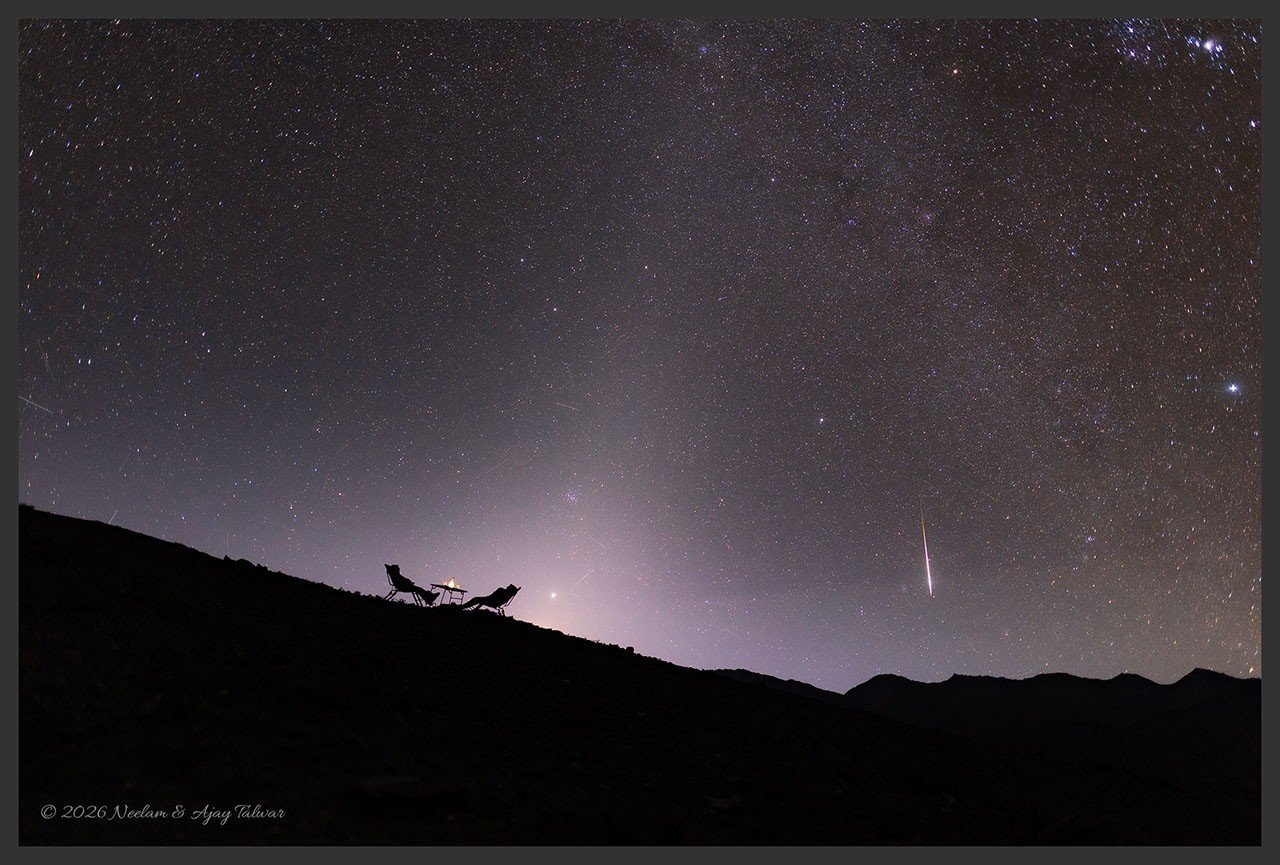
    On a clear night in September, a stunning light display adorns the dark sky over Ladakh, India. This image captures a rare and beautiful phenomenon known as zodiacal light. Also called the false dawn, zodiacal light appears as a faint, luminous band stretching across the night sky. It occurs when sunlight scatters off tiny dust particles orbiting between the planets in our solar system.

    This particular sky was observed just before the start of astronomical twilight—when the Sun is below the horizon, but its light still faintly illuminates the sky. The setting was during a star party at the Hanle Dark Sky Reserve, a remote area known for its extraordinarily dark skies and high altitude of about 4,500 meters (14,800 feet). Such conditions make this spot a favorite among stargazing and astrophotography enthusiasts.

    While the night was filled with celestial sights, meteors streaked through the sky and the bright planet Jupiter was visible near the eastern horizon. If you trace the faint zodiacal band upward toward the zenith (the point overhead), you can spot the open star cluster M44, also called the Beehive Cluster, and the yellowish planet Mars close to the center of the frame. The glow of zodiacal light is caused by tiny dust particles orbiting the Sun—some of which NASA’s Juno spacecraft has detected coming from Mars itself. These dust particles reflect sunlight, creating the faint, glowing band we see from Earth.

    This image reminds us of the interconnectedness of our solar system. Dust from planets like Mars can travel vast distances, scattering sunlight and revealing the dynamic interactions within space. Ladakh’s clear, high-altitude skies and the presence of interplanetary dust make it an ideal place to observe such phenomena.

    Note: The main NASA Astronomy Picture of the Day (APOD) site is moving. Starting soon, you can find their daily images at science.nasa.gov/apod instead of apod.nasa.gov.
    Tomorrow’s forecast? Expect only sunny days.

    Expand Your Tech Knowledge

    Dive deeper into the world of Cryptocurrency and its impact on global finance.

    Discover archived knowledge and digital history on the Internet Archive.

    Space

    APOD Cosmos Mars NASA Space VT1
    Share. Facebook Twitter Pinterest LinkedIn Tumblr Email
    Previous ArticlePinned Model to Stay Safe, Provider Ignored Devotion
    Avatar photo
    Staff Reporter
    • Website

    John Marcelli is a staff writer for IO Tribune, with a passion for exploring and writing about the ever-evolving world of technology. From emerging trends to in-depth reviews of the latest gadgets, John stays at the forefront of innovation, delivering engaging content that informs and inspires readers. When he's not writing, he enjoys experimenting with new tech tools and diving into the digital landscape.

    Related Posts

    AI

    Pinned Model to Stay Safe, Provider Ignored Devotion

    September 19, 2026
    IOT

    SES and Elveo Expand D2D Services in Europe

    September 19, 2026
    Gadgets

    Ultimate AirPods 5 Review: Elevate Your Listening Experience

    September 19, 2026
    Add A Comment

    Comments are closed.

    Must Read

    A Zodiacal Night: Illuminating the Cosmic Dust Corridor

    September 19, 2026

    Pinned Model to Stay Safe, Provider Ignored Devotion

    September 19, 2026

    SES and Elveo Expand D2D Services in Europe

    September 19, 2026

    Ultimate AirPods 5 Review: Elevate Your Listening Experience

    September 19, 2026

    Uncover Silent Coding Failures Before They Strike

    September 19, 2026
    Categories
    • AI
    • Crypto
    • Fashion Tech
    • Gadgets
    • IOT
    • OPED
    • Quantum
    • Science
    • Smart Cities
    • Space
    • Tech
    Most Popular

    China’s Robot Boom: Hype or Reality in Cash Flow?

    May 10, 2026

    Disable Pixel Ads: Easy Steps to Stop Unwanted Promotions

    August 22, 2026

    Build the World’s Smallest E-Reader Yourself!

    April 15, 2026
    Our Picks

    Exploring the Future: NASA’s Orion Mission Control

    August 27, 2025

    Unleashing Unicorns: Lessons from Sweden’s Startup Success

    April 28, 2026

    Unbeatable Fall Prime Day Deals: 4K TVs, Streaming & Audio Tech!

    October 7, 2025
    Categories
    • AI
    • Crypto
    • Fashion Tech
    • Gadgets
    • IOT
    • OPED
    • Quantum
    • Science
    • Smart Cities
    • Space
    • Tech
    • Privacy Policy
    • Disclaimer
    • Terms and Conditions
    • About Us
    • Contact us
    Copyright © 2025 Iotribune.comAll Rights Reserved.

    Type above and press Enter to search. Press Esc to cancel.