

Essential Insights
- The zodiacal light appears as a glowing band in dark night skies.
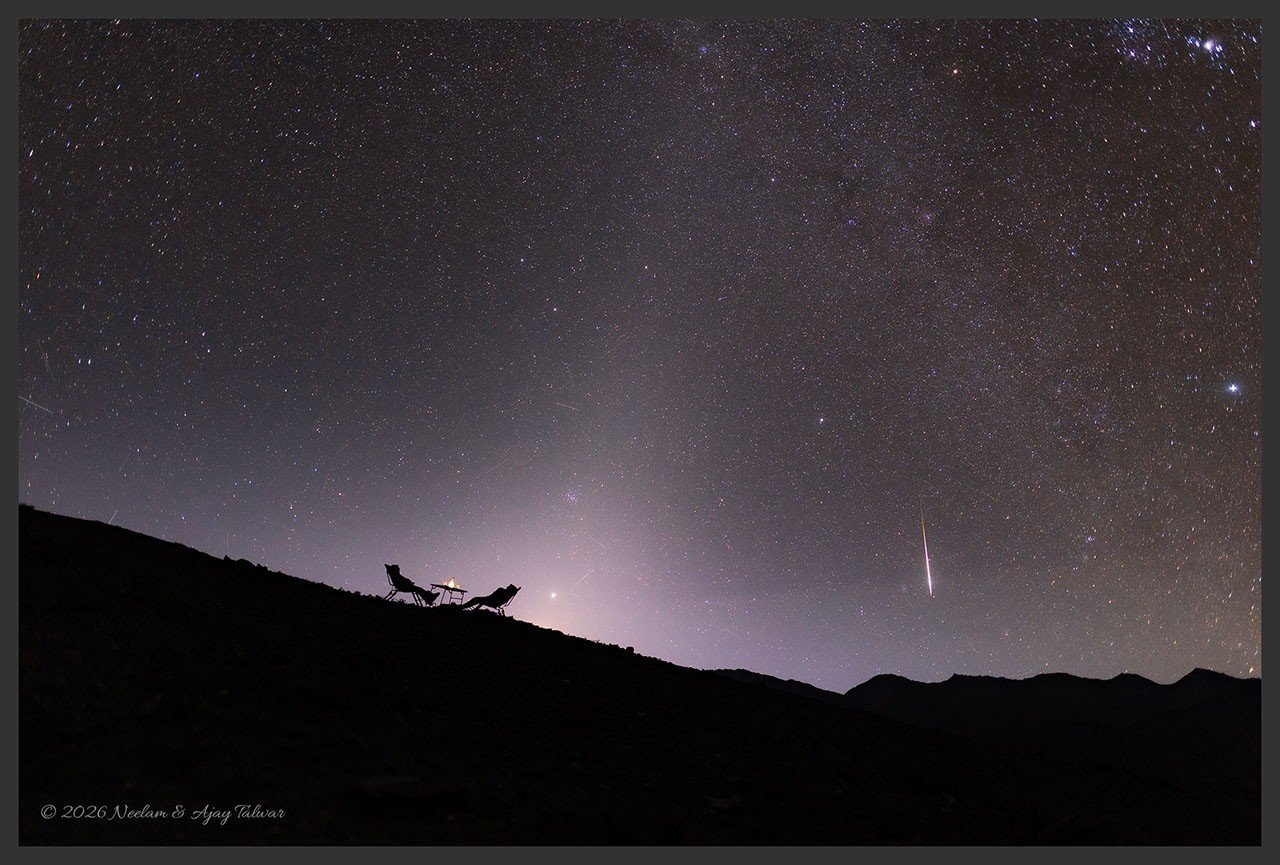
- It was photographed over Hanle Dark Sky Reserve in Ladakh, India.
- Jupiter, Mars, and star cluster M44 are visible near the zodiacal glow.
- NASA’s Juno spacecraft suggests Mars may be the source of interplanetary dust.
APOD: 2026 September 19 – A Zodiacal Night
On a clear night in September, a stunning light display adorns the dark sky over Ladakh, India. This image captures a rare and beautiful phenomenon known as zodiacal light. Also called the false dawn, zodiacal light appears as a faint, luminous band stretching across the night sky. It occurs when sunlight scatters off tiny dust particles orbiting between the planets in our solar system.
This particular sky was observed just before the start of astronomical twilight—when the Sun is below the horizon, but its light still faintly illuminates the sky. The setting was during a star party at the Hanle Dark Sky Reserve, a remote area known for its extraordinarily dark skies and high altitude of about 4,500 meters (14,800 feet). Such conditions make this spot a favorite among stargazing and astrophotography enthusiasts.
While the night was filled with celestial sights, meteors streaked through the sky and the bright planet Jupiter was visible near the eastern horizon. If you trace the faint zodiacal band upward toward the zenith (the point overhead), you can spot the open star cluster M44, also called the Beehive Cluster, and the yellowish planet Mars close to the center of the frame. The glow of zodiacal light is caused by tiny dust particles orbiting the Sun—some of which NASA’s Juno spacecraft has detected coming from Mars itself. These dust particles reflect sunlight, creating the faint, glowing band we see from Earth.
This image reminds us of the interconnectedness of our solar system. Dust from planets like Mars can travel vast distances, scattering sunlight and revealing the dynamic interactions within space. Ladakh’s clear, high-altitude skies and the presence of interplanetary dust make it an ideal place to observe such phenomena.
Note: The main NASA Astronomy Picture of the Day (APOD) site is moving. Starting soon, you can find their daily images at science.nasa.gov/apod instead of apod.nasa.gov.
Tomorrow’s forecast? Expect only sunny days.
Expand Your Tech Knowledge
Dive deeper into the world of Cryptocurrency and its impact on global finance.
Discover archived knowledge and digital history on the Internet Archive.
Space
